

An Aloalo figure from Mahafaly,
Toliara Provence, Madagascar
Jerome Feldman
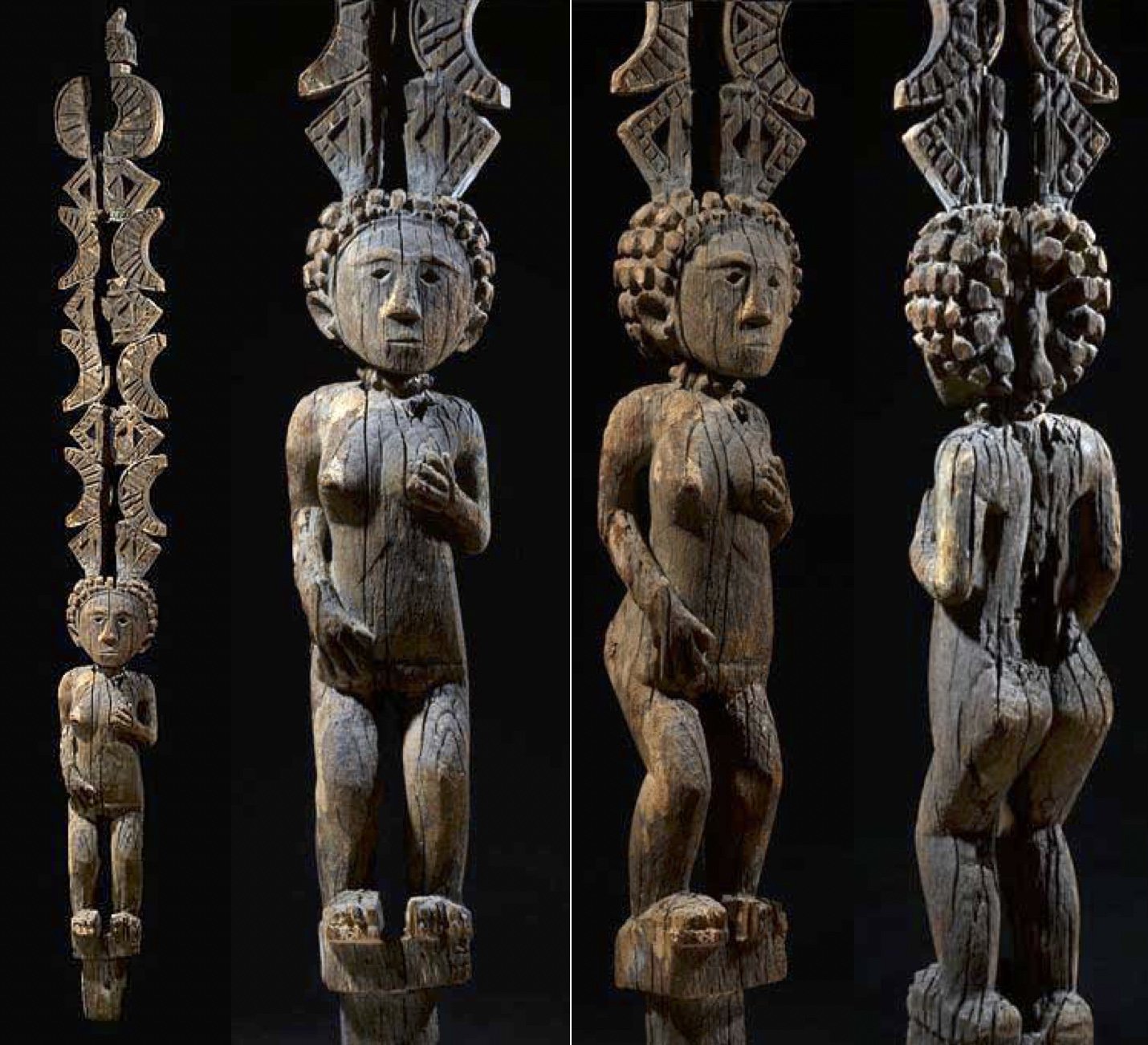
Madagascar is a large, and in many ways, unique island off the east coast of Africa in the Indian Ocean. Although there has been some cultural blending from Africa, many of its cultural aspects show strong Southeast Asian roots. The dialects spoken on the island are distinctly Austronesian and derive from Indonesia. Many linguists link these dialects as closest to Borneo. Other distinctly Southeast Asian traits include rectangular houses, outrigger canoes and aspects of their cosmology and sculptural styles.
Funerary posts such as this are commonly called aloalo- a term that translates best a ‘messenger’. This indicates its role as both commemorating the dead and connecting with the departed. Aloalo are arranged in rectangular cenotaphs outside the village, usually near, or over, the burial plot. The site is oriented in cardinal directions that reify the cosmic order and establish sets of oppositions that are also found in house layouts. This is also an organizational pattern in in many parts of tribal Indonesia.
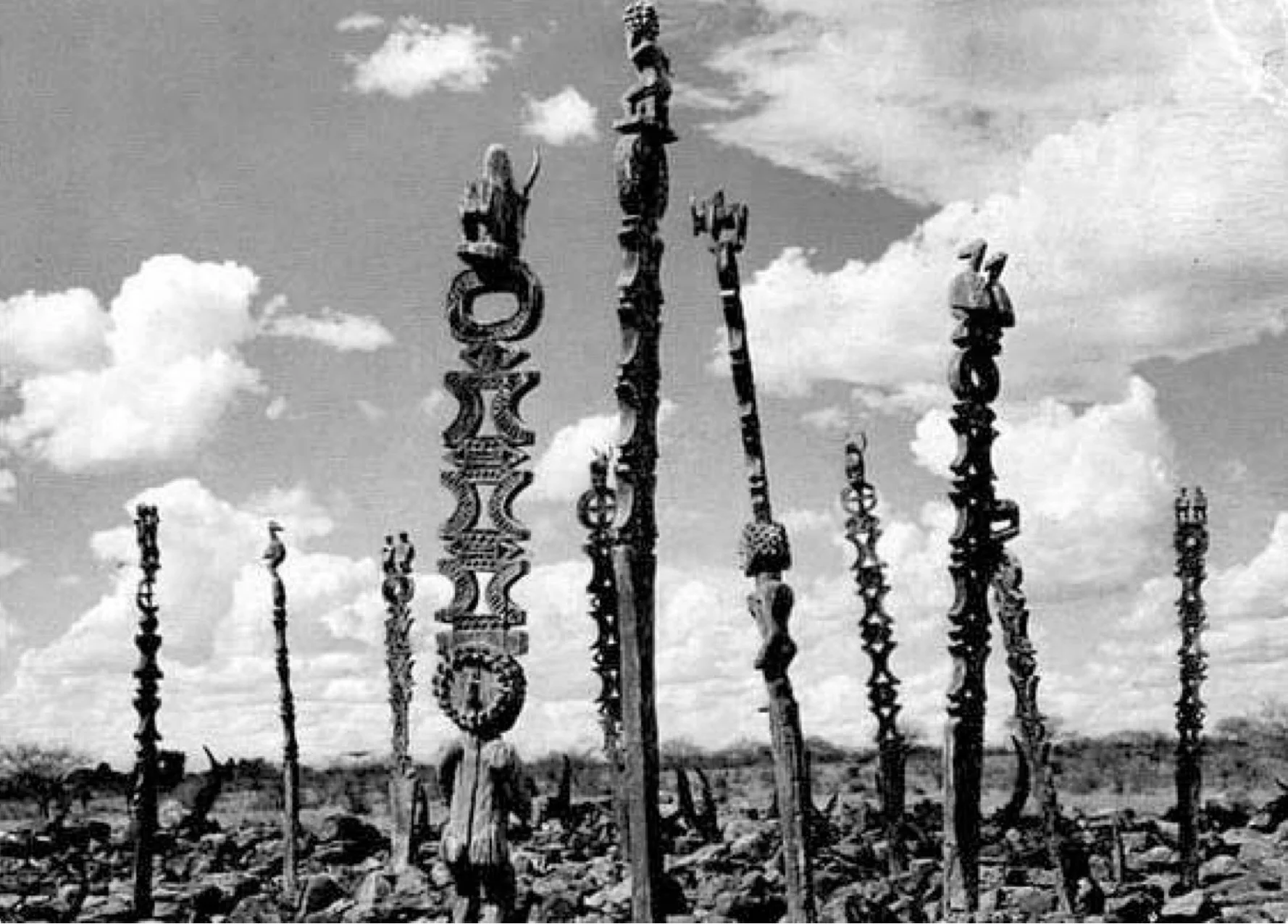
This photo shows the funerary layout from the same region as our example. A post similar to this, seen from the rear, is closest to the camera. The human figures are typically female and when male figures are shown, they are distinctly smaller than the females. The post above the female figure has curved designs called lalantioky, a term that literally means the path of the wind- perhaps a reference to the sculpture’s role as a ‘messenger’. Above that is a disk, volala, that represents the full moon. At the top there would have been a sculpture of some aspect of wealth. This is most often a zebu (cattle). In our instance the top is obliterated. The spiritual leader of a clan or dynasty with other village men choose the wood and arranges the transaction between the carver and the person commissioning the art work.
Our figure is a truly beautiful example of the Mahafaly style. A similar figure was displayed in a group at the Musèe Quay Branly in Paris. A somewhat eroded version is in the foreground of the display. Another example at the same museum is in storage and shown here. The great condition and outstanding sculptural technique of the Blackburn piece is evident even in comparison to examples in major museums.
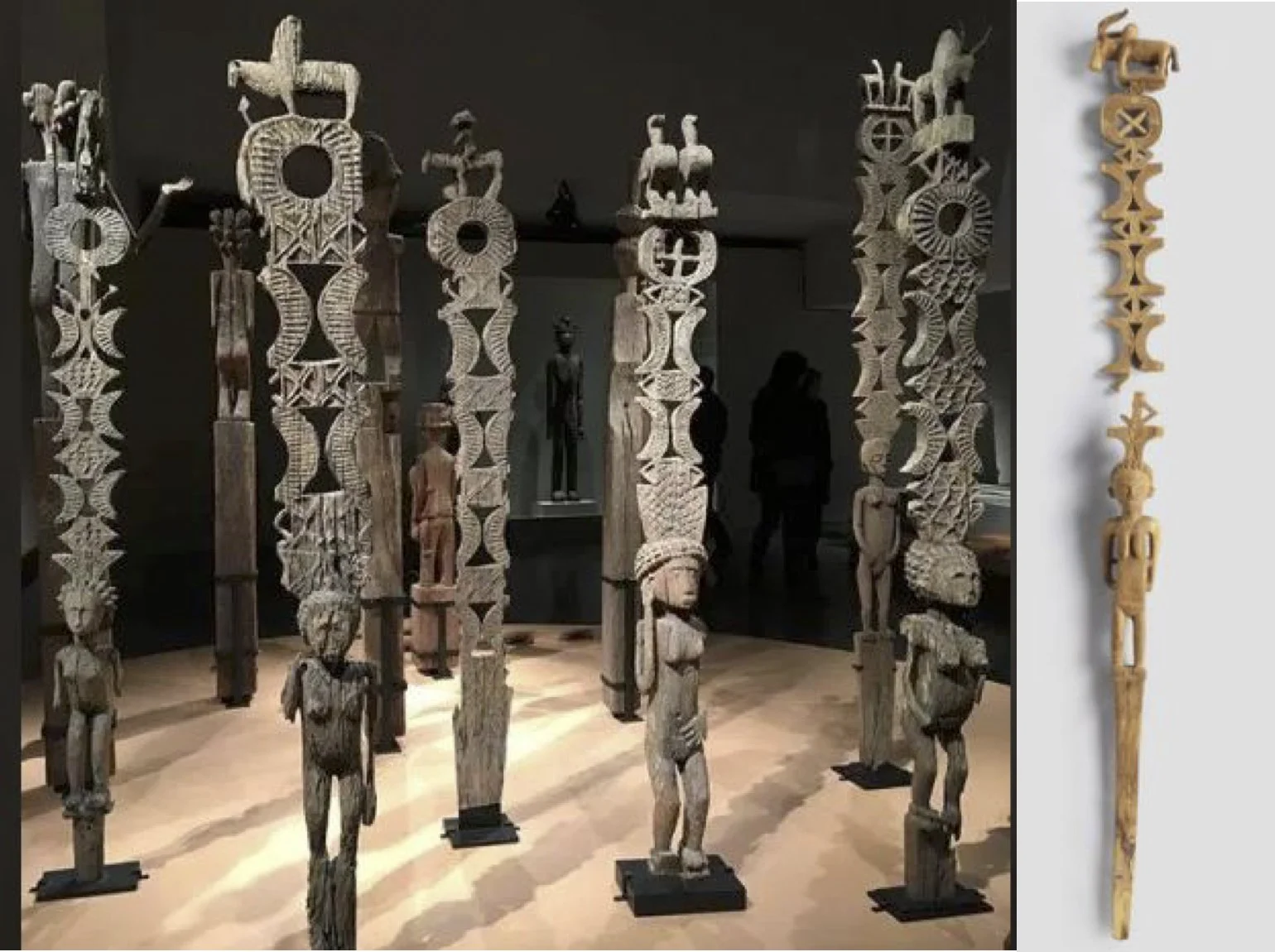
Examples in the Musèe Quay Branly
Provenance:
Martin and Faith-Dorian Collection, N.Y.
J.J Klejman Gallery, N.Y.
M. Blackburn, Honolulu
Bibliography:
Bloch, M.
1971 Placing the Dead: Tombs, Ancestral Villages and Kinship Organization in Madagascar, London: Seminar Press.
Boulfroy, N.
1976 “Vers l’art funeraire mahafaly”, Ojbets et Mondes 16: 95-116.
Goedefroit, S., J. Lombard
2001 “Sakalava Sculpture” in J. Kerchache, Sculpture, Africa, Asia, Oceania, Americas, Paris; Musèe Quay Branley.
2007 Andolo L’art funèraire Sakalava a Madagascar, Singapore.
2008 “To the Glory of the Ancestors” Arts and Cultures 137-153.
Mack, J.
1986 Madagascar Island of the Ancestors, London: The British Museum.
Marcinkowska, K.
2011 “A Mahafaly aloalo Funerary Post from the Barbier-Mueller Museum”, Arts and Cultures, 131-139.