Australia, Kimberley, Western Australia
1930s
Pearl shell, blue pigment
Height: 7 inches (17.8 cm); Width: 5 inches (12.7 cm)
Provenance: Jonathan Saussehrd, Australia
This longka longka departs from convention in two notable respects: the pigment filling the incised lines is blue rather than the ochre or black seen on the great majority of Kimberley shells, and the design itself is organized around a central oval reserve left unworked, with the engraved elements — geometric bar forms, T-shapes, and dotted fields — radiating outward from that open center in a structured, symmetrical arrangement. The combination produces a composition that reads differently from the dense maze patterns typical of the tradition, with negative space used as a deliberate design element. The shell's nacre surface remains largely intact, its iridescence visible in the unworked central field.
The use of blue pigment on longka longka is documented but uncommon, and its presence here alongside an atypical compositional structure places this shell among the more distinctive examples in the Saussehrd collection. The engraving is precise and confident, the bar and T-form elements evenly weighted and cleanly separated, suggesting a maker working within a specific regional or individual design vocabulary that diverged from the dominant Kimberley maze tradition.
We ship free anywhere in the world, fully insured, packed by hand.
Australia, Kimberley, Western Australia
1930s
Pearl shell, blue pigment
Height: 7 inches (17.8 cm); Width: 5 inches (12.7 cm)
Provenance: Jonathan Saussehrd, Australia
This longka longka departs from convention in two notable respects: the pigment filling the incised lines is blue rather than the ochre or black seen on the great majority of Kimberley shells, and the design itself is organized around a central oval reserve left unworked, with the engraved elements — geometric bar forms, T-shapes, and dotted fields — radiating outward from that open center in a structured, symmetrical arrangement. The combination produces a composition that reads differently from the dense maze patterns typical of the tradition, with negative space used as a deliberate design element. The shell's nacre surface remains largely intact, its iridescence visible in the unworked central field.
The use of blue pigment on longka longka is documented but uncommon, and its presence here alongside an atypical compositional structure places this shell among the more distinctive examples in the Saussehrd collection. The engraving is precise and confident, the bar and T-form elements evenly weighted and cleanly separated, suggesting a maker working within a specific regional or individual design vocabulary that diverged from the dominant Kimberley maze tradition.
We ship free anywhere in the world, fully insured, packed by hand.


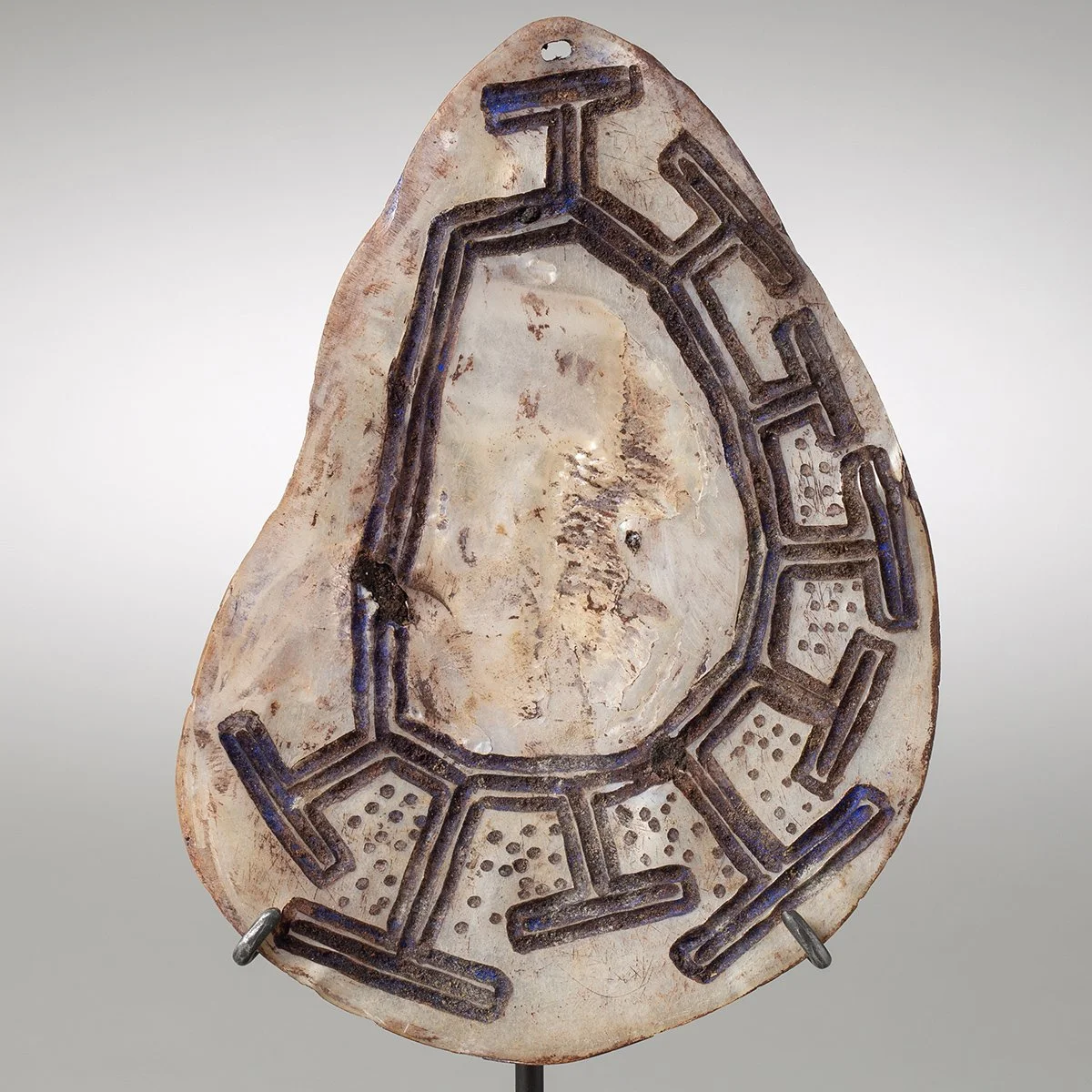 Image 1 of 6
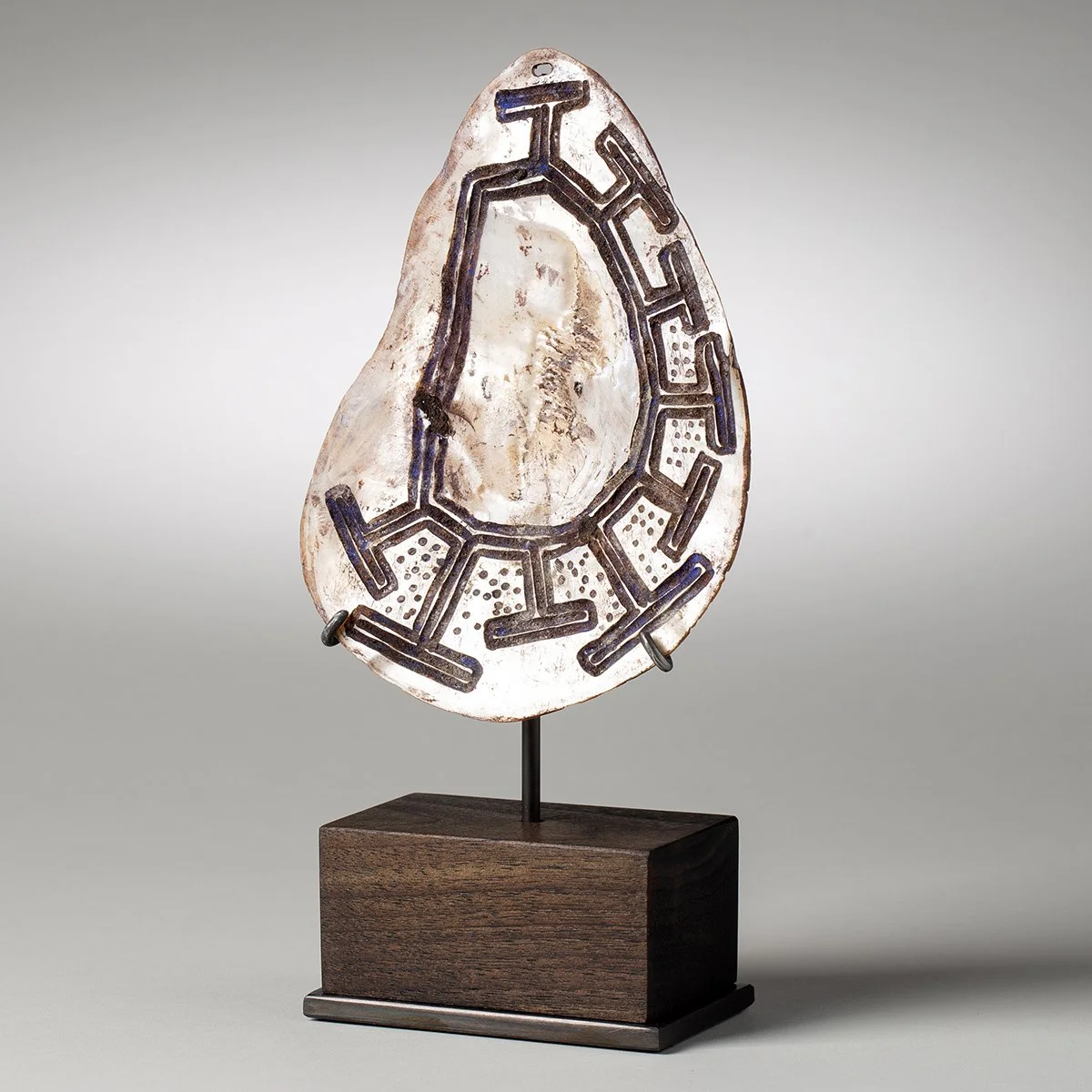 Image 2 of 6
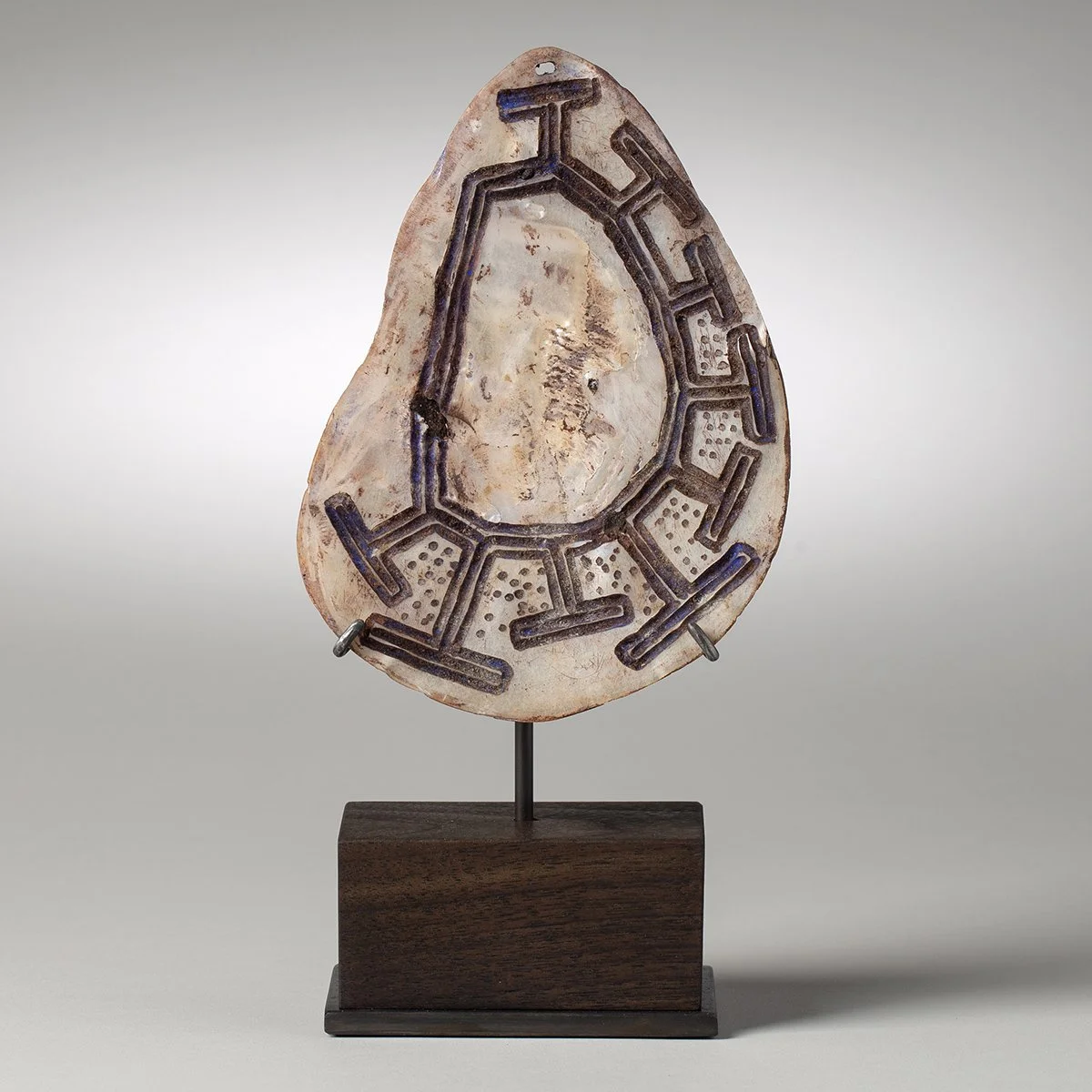 Image 3 of 6
 Image 4 of 6
 Image 5 of 6
 Image 6 of 6