

 Image 1 of 3
 Image 2 of 3
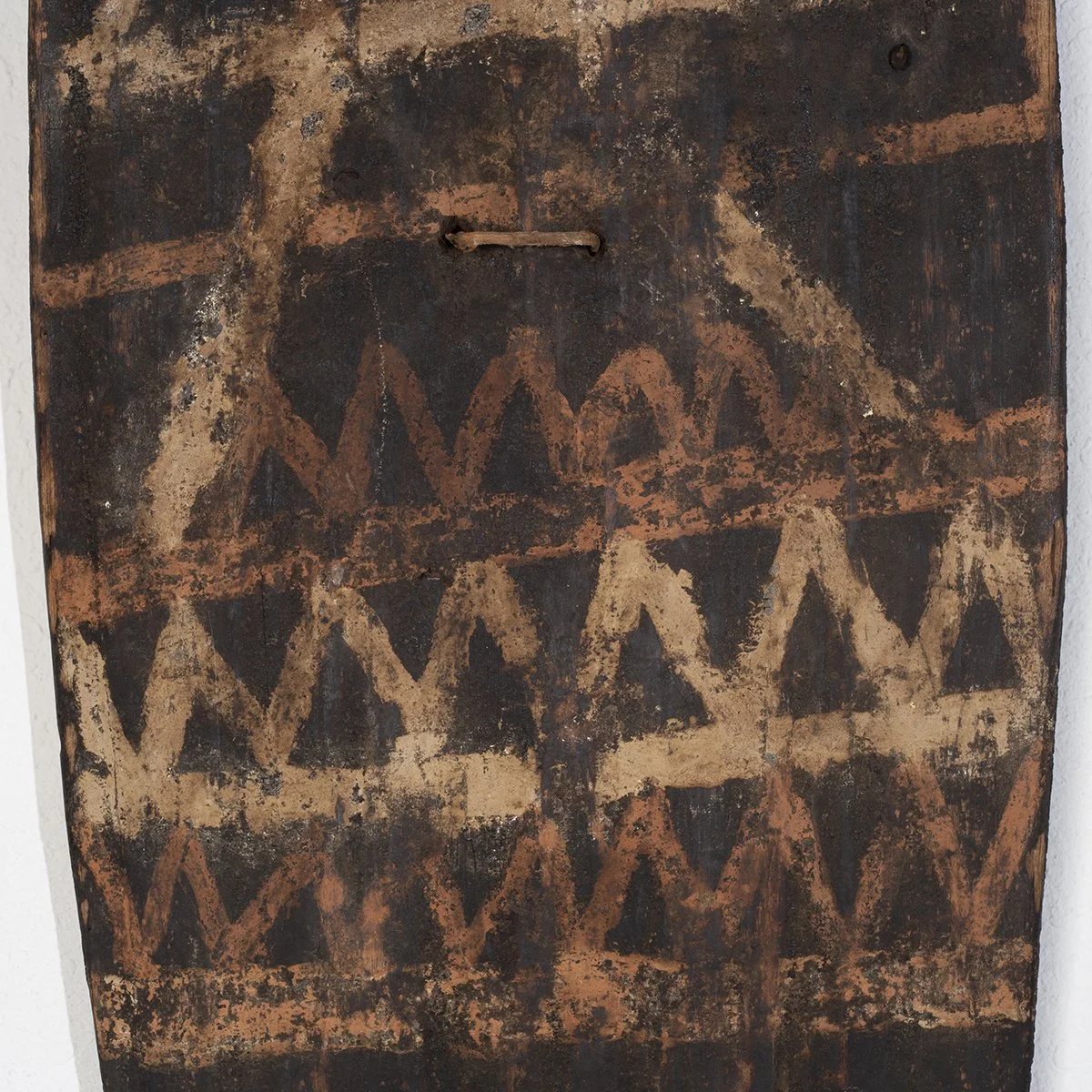 Image 3 of 3
Anga culture, Eastern Highlands, Papua New Guinea
Late 19th century
Wood, natural pigments
Height: 38 in (96.5 cm)
Provenance: Marcia and John Friede, Rye, New York
Publication: New Guinea Highlands: Art from the Jolika Collection, p. 226
The saabya is the war shield form associated with the Anga people of the Eastern Highlands, carved and decorated to communicate the warrior's power and standing within a society where individual prestige was publicly displayed through objects carried into conflict. Shields of this type were carved from wood and decorated with geometric pigment designs, the surface treatment as significant as the form itself in encoding the identity and affiliation of the bearer. The Marcia and John Friede Collection was one of the most significant private assemblages of Papua New Guinea art formed in the twentieth century, and its publication in the Jolika Collection catalogue establishes this shield within a documented scholarly context.
Two arrow tips remain embedded in the front face of the shield, direct physical evidence of its use in battle and one of the more compelling proofs of active deployment that a shield of this type can carry. The pigment surface is remarkably well-preserved across large areas of the face, the geometric patterning in red-brown and white retaining strong contrast against the darkened ground. The overall patina is consistent with age and sustained use, the surface carrying the depth of a piece that has been handled and exposed over a long period.
We ship free anywhere in the world, fully insured, packed by hand.
Anga culture, Eastern Highlands, Papua New Guinea
Late 19th century
Wood, natural pigments
Height: 38 in (96.5 cm)
Provenance: Marcia and John Friede, Rye, New York
Publication: New Guinea Highlands: Art from the Jolika Collection, p. 226
The saabya is the war shield form associated with the Anga people of the Eastern Highlands, carved and decorated to communicate the warrior's power and standing within a society where individual prestige was publicly displayed through objects carried into conflict. Shields of this type were carved from wood and decorated with geometric pigment designs, the surface treatment as significant as the form itself in encoding the identity and affiliation of the bearer. The Marcia and John Friede Collection was one of the most significant private assemblages of Papua New Guinea art formed in the twentieth century, and its publication in the Jolika Collection catalogue establishes this shield within a documented scholarly context.
Two arrow tips remain embedded in the front face of the shield, direct physical evidence of its use in battle and one of the more compelling proofs of active deployment that a shield of this type can carry. The pigment surface is remarkably well-preserved across large areas of the face, the geometric patterning in red-brown and white retaining strong contrast against the darkened ground. The overall patina is consistent with age and sustained use, the surface carrying the depth of a piece that has been handled and exposed over a long period.
We ship free anywhere in the world, fully insured, packed by hand.