Colima (Comala style)
Mexico
100 BC–250 AD
Ceramic, shell
Height 11.8"
Provenance: Earl Stendahl, Los Angeles, 1960s
This Colima Comala-style burden carrier depicts a standing male figure with a large jar carried on his back, one arm raised and reaching behind the head to support the vessel, the body treated in broad curving planes with a deep brown to black burnished slip and red-brown tones at the arms, legs, and face. A single white shell is applied at the groin, providing a strong contrast against the dark body, and the figure wears a crescent-shaped necklace with the face rendered in the restrained closed-eye manner characteristic of the Comala type. The burden carrier is a recurring subject type in Colima ceramic production, representing figures engaged in the transport of goods that played a central role in ancient West Mexican exchange networks.
The Comala style is distinguished within the broader Colima tradition by its abstract reduction of the human form and its burnished surfaces. Earl Stendahl of Los Angeles dealt in pre-Columbian art from the 1930s onward, and his inventory is the source of pieces now held in major American museum collections. A comparable example of the type is in the collection of the Art Institute of Chicago.
We ship free anywhere in the world, fully insured, packed by hand.
Colima (Comala style)
Mexico
100 BC–250 AD
Ceramic, shell
Height 11.8"
Provenance: Earl Stendahl, Los Angeles, 1960s
This Colima Comala-style burden carrier depicts a standing male figure with a large jar carried on his back, one arm raised and reaching behind the head to support the vessel, the body treated in broad curving planes with a deep brown to black burnished slip and red-brown tones at the arms, legs, and face. A single white shell is applied at the groin, providing a strong contrast against the dark body, and the figure wears a crescent-shaped necklace with the face rendered in the restrained closed-eye manner characteristic of the Comala type. The burden carrier is a recurring subject type in Colima ceramic production, representing figures engaged in the transport of goods that played a central role in ancient West Mexican exchange networks.
The Comala style is distinguished within the broader Colima tradition by its abstract reduction of the human form and its burnished surfaces. Earl Stendahl of Los Angeles dealt in pre-Columbian art from the 1930s onward, and his inventory is the source of pieces now held in major American museum collections. A comparable example of the type is in the collection of the Art Institute of Chicago.
We ship free anywhere in the world, fully insured, packed by hand.


 Image 1 of 7
 Image 2 of 7
 Image 3 of 7
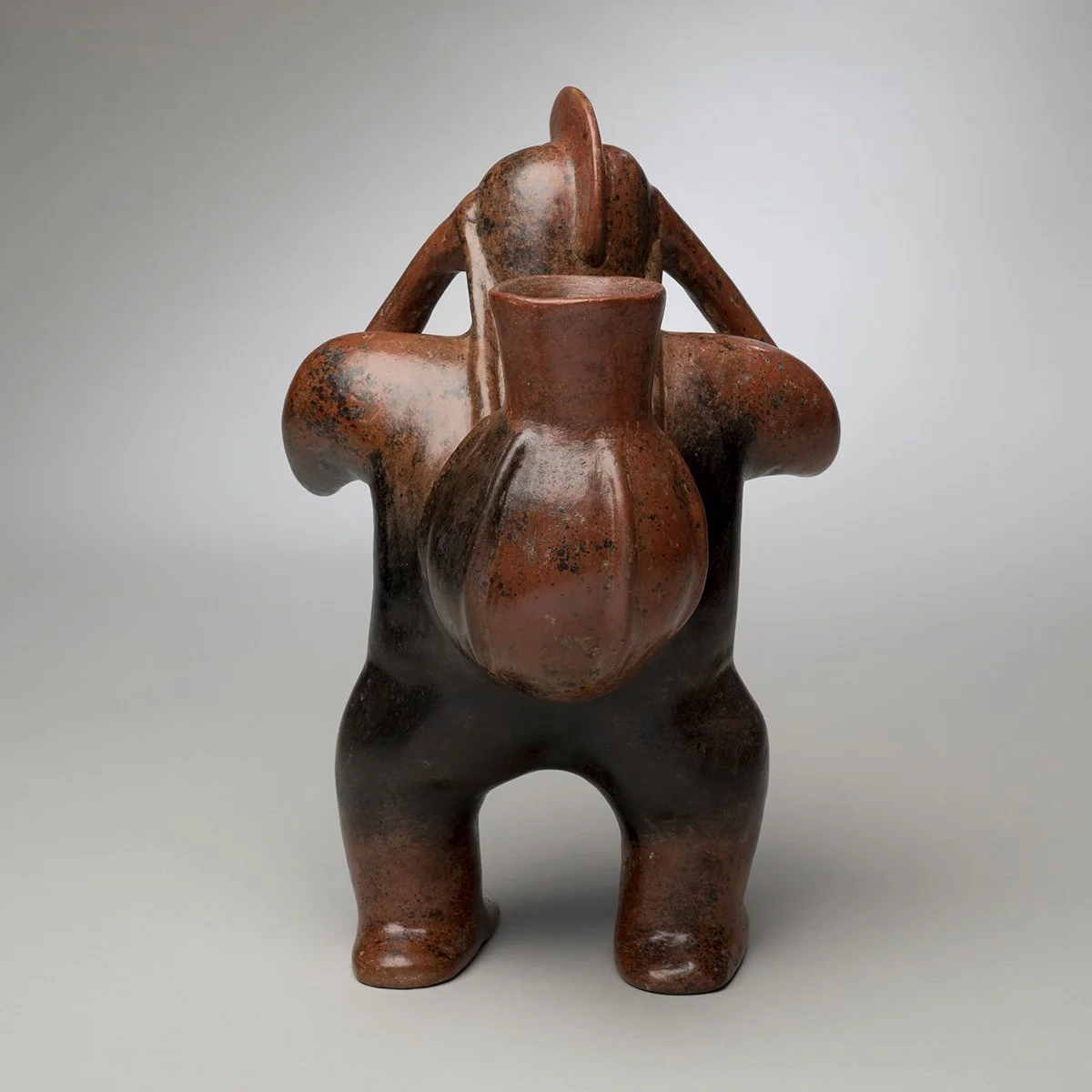 Image 4 of 7
 Image 5 of 7
 Image 6 of 7
 Image 7 of 7