

 Image 1 of 4
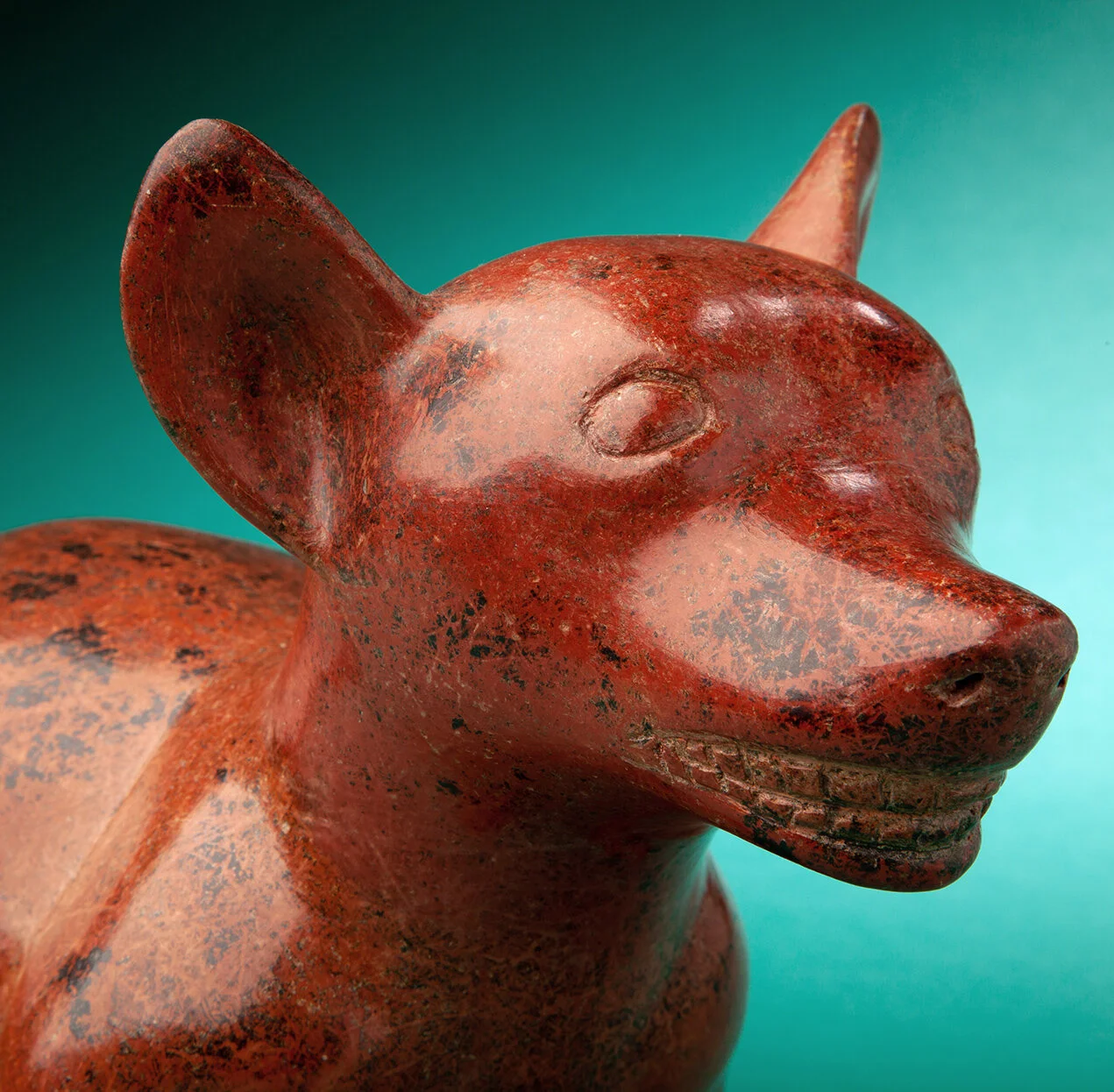 Image 2 of 4
 Image 3 of 4
 Image 4 of 4
Colima, West Mexico
100 BC to 250 AD
Ceramic
Height 8 1/2 inches (21.6 cm), Length 16 inches (40.6 cm)
Provenance: Private Southern California collection
This Colima redware dog stands on four legs with the head raised and the mouth open to show incised teeth, a single horn rising from between the ears, and a lateral spout projecting from the back at an angle. The large upright ears, elongated body, and short sturdy legs give the figure a horizontal emphasis, and the red brown burnished surface carries dark manganese deposits scattered across the flanks and back. Deposits of this kind form on the ceramic surface over long burial and are recognized as evidence of age and authenticity, and the incised teeth and horn further distinguish this example from more common Colima dog representations.
Colima dogs are among the most widely recognized subjects in West Mexican ceramic production, associated with the hairless Xoloitzcuintli breed and with the belief that the dog served as a guide for the dead. Vessels of this kind were placed in shaft tombs and functioned as containers as well as effigies, and the spout confirms its use as a vessel rather than a solid sculpture. The burnished surface was achieved by polishing the clay with a smooth stone before firing, and it remains intact beneath the mineral deposits.
We ship free anywhere in the world, fully insured, packed by hand.
Colima, West Mexico
100 BC to 250 AD
Ceramic
Height 8 1/2 inches (21.6 cm), Length 16 inches (40.6 cm)
Provenance: Private Southern California collection
This Colima redware dog stands on four legs with the head raised and the mouth open to show incised teeth, a single horn rising from between the ears, and a lateral spout projecting from the back at an angle. The large upright ears, elongated body, and short sturdy legs give the figure a horizontal emphasis, and the red brown burnished surface carries dark manganese deposits scattered across the flanks and back. Deposits of this kind form on the ceramic surface over long burial and are recognized as evidence of age and authenticity, and the incised teeth and horn further distinguish this example from more common Colima dog representations.
Colima dogs are among the most widely recognized subjects in West Mexican ceramic production, associated with the hairless Xoloitzcuintli breed and with the belief that the dog served as a guide for the dead. Vessels of this kind were placed in shaft tombs and functioned as containers as well as effigies, and the spout confirms its use as a vessel rather than a solid sculpture. The burnished surface was achieved by polishing the clay with a smooth stone before firing, and it remains intact beneath the mineral deposits.
We ship free anywhere in the world, fully insured, packed by hand.