

 Image 1 of 2
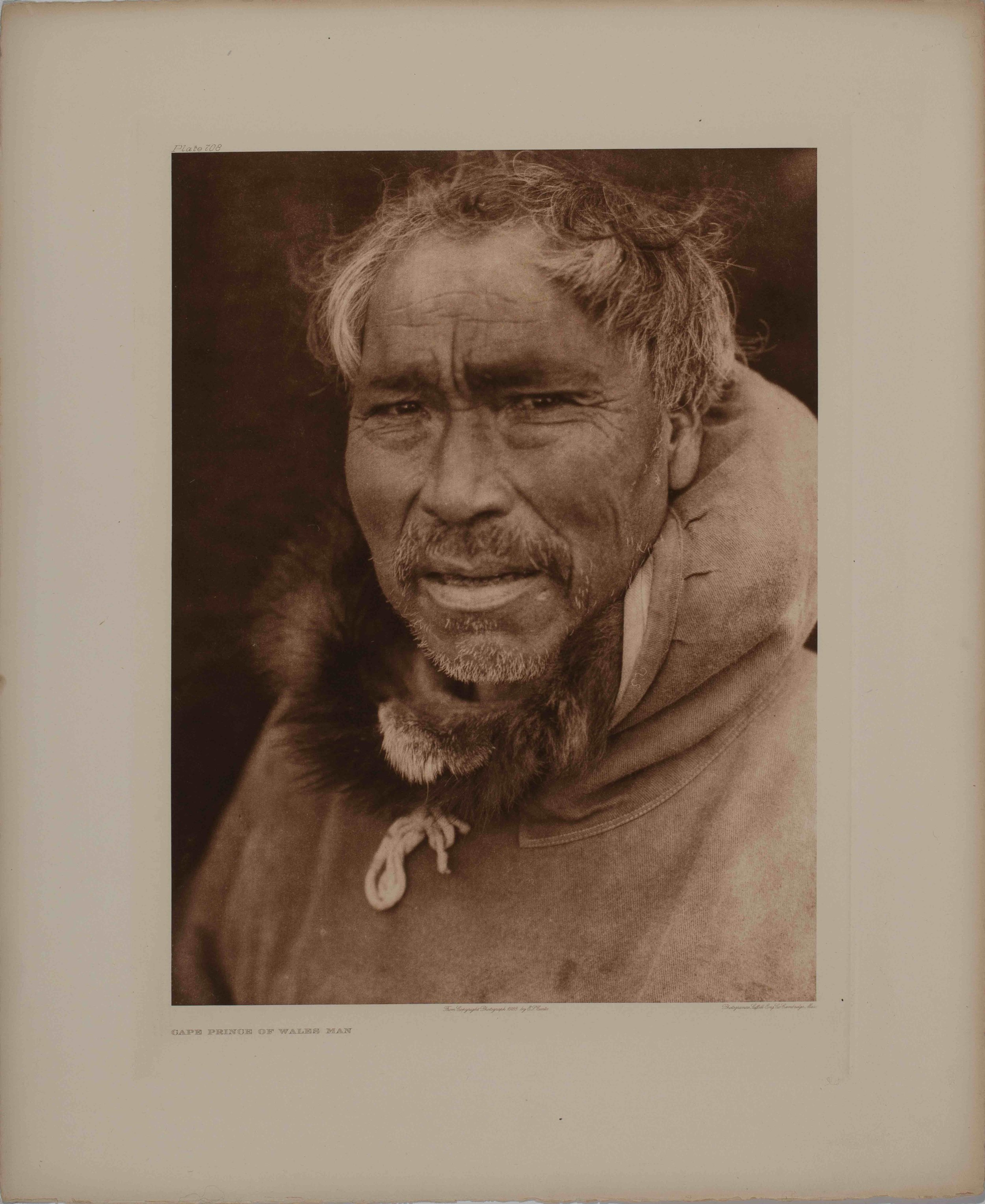 Image 2 of 2
Edward S. Curtis (1868–1952)
1928
Photogravure on Dutch Van Gelder paper
Image 11¹⁄₁₆ x 15⁵⁄₁₆ in.; sheet 17¹⁵⁄₁₆ x 21⁷⁄₈ in.
Provenance: Private collection, Tucson, AZ
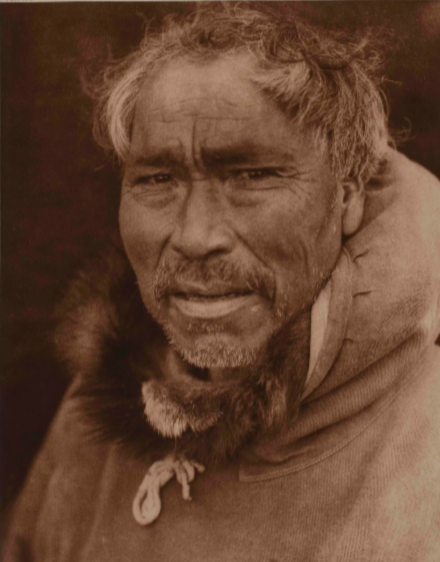
This photogravure depicts a man from Cape Prince of Wales, the westernmost point of the North American continent, where the Bering Strait separates Alaska from Siberia by just 55 miles. The indigenous people of Cape Prince of Wales, known as the Kiŋikmiut, are an Inupiaq people whose community at Wales represents one of the oldest continuously inhabited settlements in Alaska, sustained for centuries by the rich marine resources of the Bering Strait. Curtis made this image during his 1927 and 1928 expeditions to Arctic Alaska, which produced some of the most geographically remote photographs of his entire career.
The portrait is printed on Dutch Van Gelder paper, the standard edition paper for the text volume photogravures, with wide margins intact and the image displaying the tonal richness characteristic of well preserved Curtis plates. Late period Alaskan subjects on Van Gelder paper appear less frequently on the market than the earlier Plains and Southwest plates that draw the broadest collector attention. From a private collection in Tucson, Arizona.
We ship free anywhere in the world, fully insured, packed by hand.
Edward S. Curtis (1868–1952)
1928
Photogravure on Dutch Van Gelder paper
Image 11¹⁄₁₆ x 15⁵⁄₁₆ in.; sheet 17¹⁵⁄₁₆ x 21⁷⁄₈ in.
Provenance: Private collection, Tucson, AZ
This photogravure depicts a man from Cape Prince of Wales, the westernmost point of the North American continent, where the Bering Strait separates Alaska from Siberia by just 55 miles. The indigenous people of Cape Prince of Wales, known as the Kiŋikmiut, are an Inupiaq people whose community at Wales represents one of the oldest continuously inhabited settlements in Alaska, sustained for centuries by the rich marine resources of the Bering Strait. Curtis made this image during his 1927 and 1928 expeditions to Arctic Alaska, which produced some of the most geographically remote photographs of his entire career.
The portrait is printed on Dutch Van Gelder paper, the standard edition paper for the text volume photogravures, with wide margins intact and the image displaying the tonal richness characteristic of well preserved Curtis plates. Late period Alaskan subjects on Van Gelder paper appear less frequently on the market than the earlier Plains and Southwest plates that draw the broadest collector attention. From a private collection in Tucson, Arizona.
We ship free anywhere in the world, fully insured, packed by hand.