

 Image 1 of 5
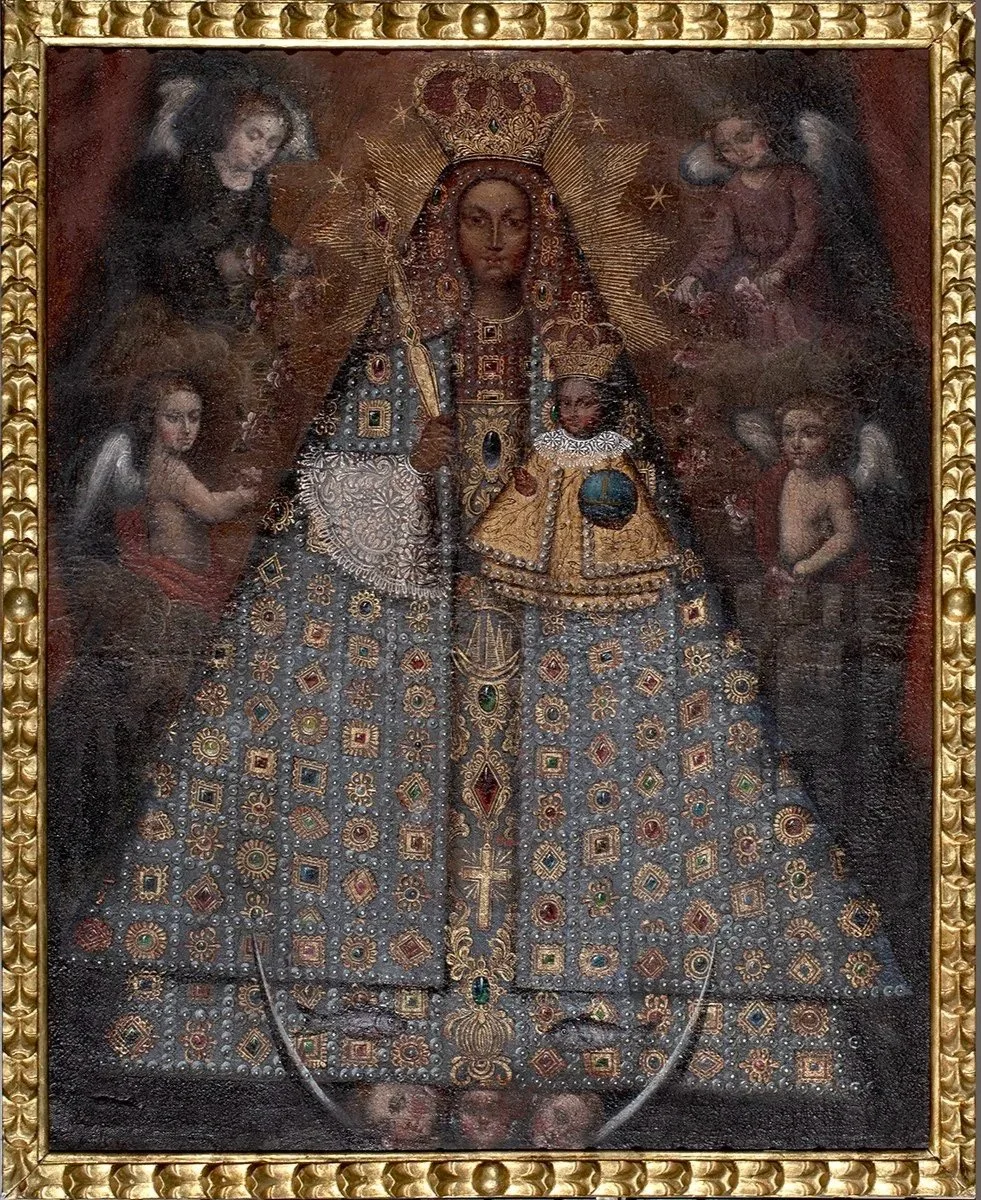 Image 2 of 5
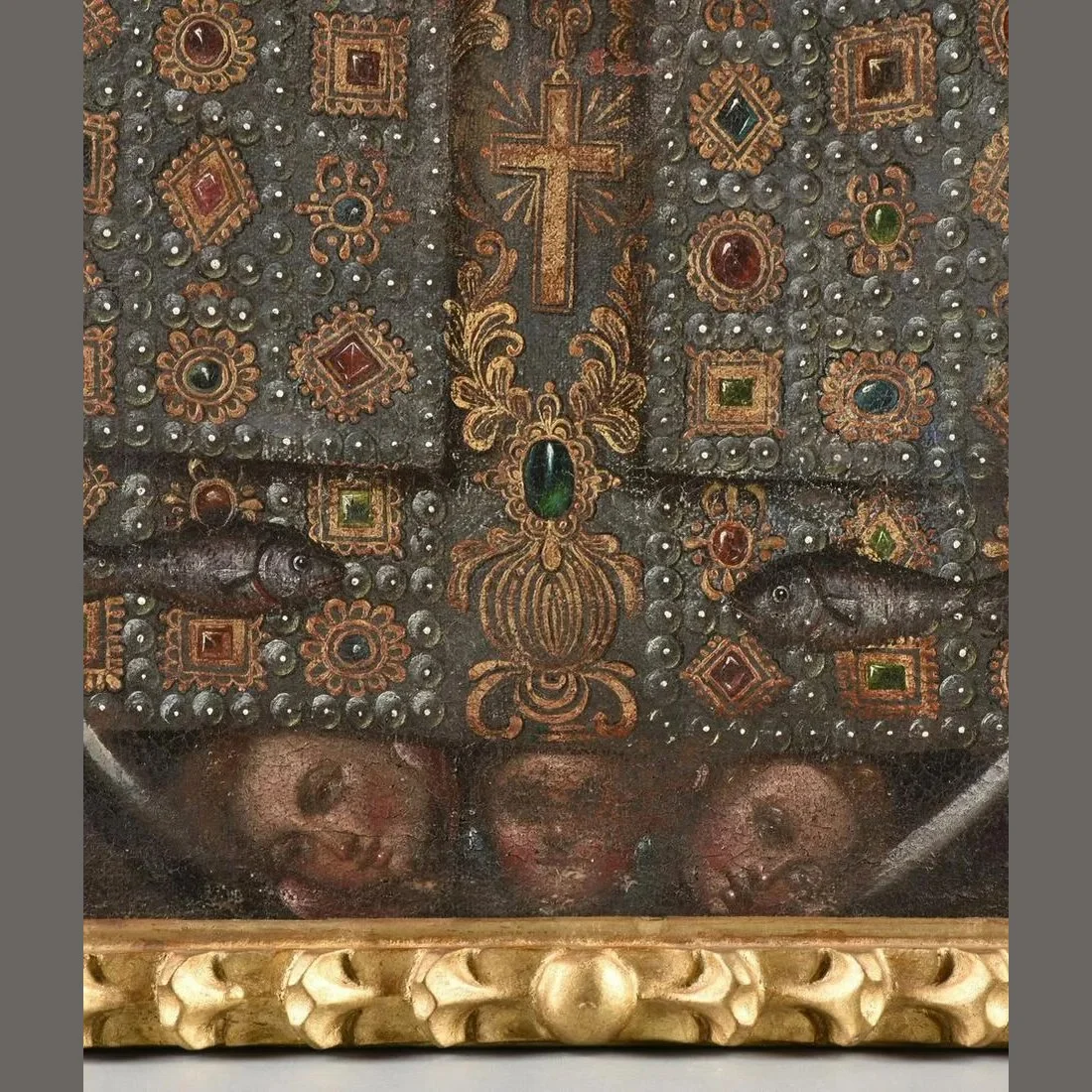 Image 3 of 5
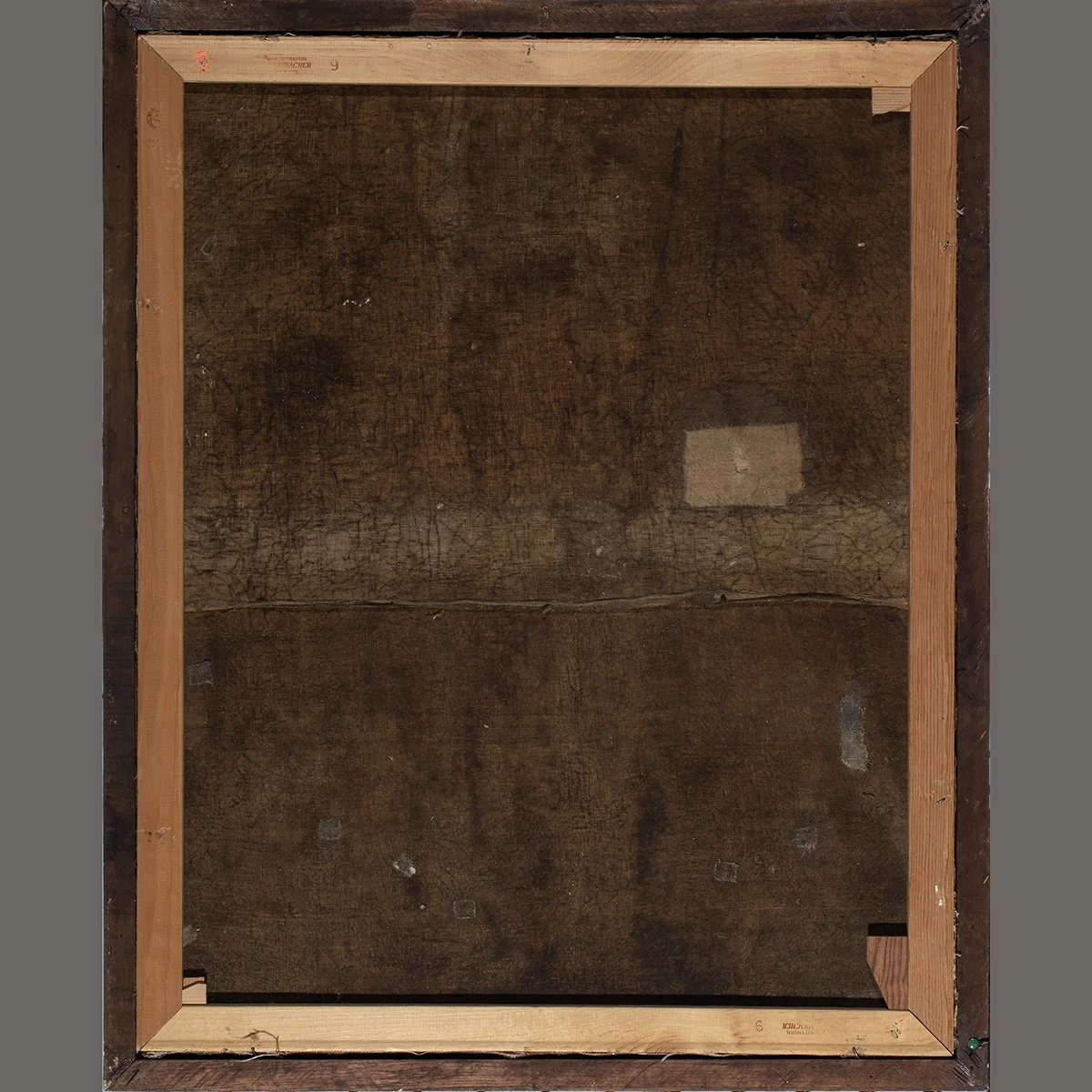 Image 4 of 5
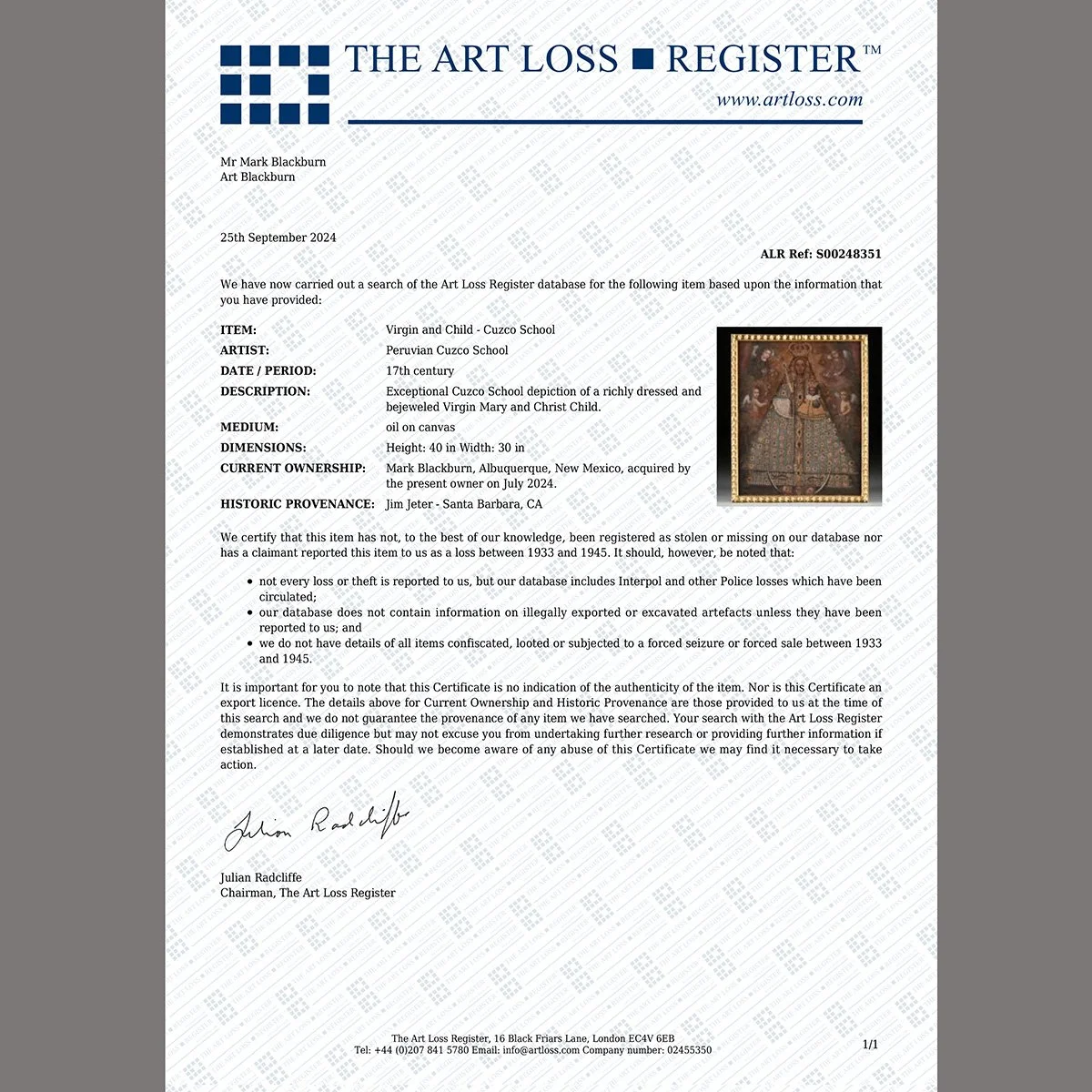 Image 5 of 5
Cuzco School, Peru / Bolivia border
17th century
Oil and gilt on canvas
Width 31 1/2" (80 cm); height 39" (99 cm) including period frame
Provenance: Jim Jeter, Santa Barbara, California; Simpson Galleries, Houston, Texas; Art Loss Register certificate #S00248351
This painting belongs to the genre of statue paintings that developed within the Cuzco School, a tradition founded by indigenous artists who withdrew from the Spanish painters guild in 1688 and developed a distinct pictorial style characterized by a colorful palette, flattened forms, indigenous symbolism, and brocateado, a technique of applying gold leaf ornamentation directly to the canvas surface. These paintings were created to replicate the three-dimensional devotional sculptures of the Virgin Mary displayed on altars within chapels and shrines, so that worshippers could pray to the statue from a distance. They were regarded as sacred objects in their own right and were believed to possess the power to produce miracles.
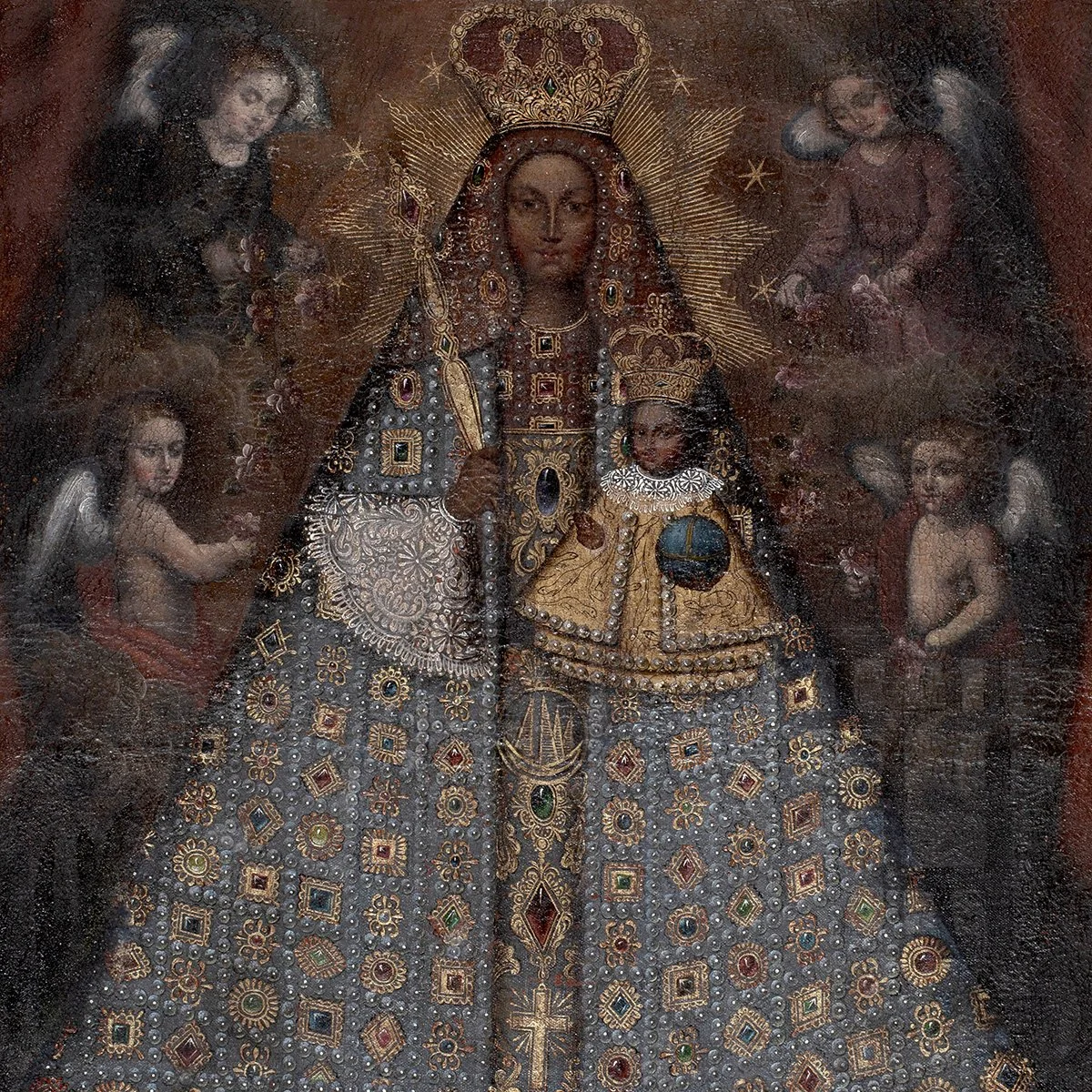
The original statue of the Virgin depicted here was carved by the indigenous sculptor Francisco Tito Yupanqui in 1576 and placed in a small shrine in Copacabana on the southeastern shore of Lake Titicaca; the Augustinians later built a permanent chapel to house it in 1614. The Virgin of Copacabana was among the most venerated images of the Cuzco School, strongly associated with the Inca earth goddess Pachamama, and the triangular form of the Virgin's dress is rendered as a stylized mountain peak in reference to that connection. Wealthy patrons commissioned paintings of this Virgin for display in private chapels, a history consistent with the present work.
The richly dressed Virgin stands atop her altar in the rigid frontal pose characteristic of Cuzco School statue paintings, her gown adorned with emeralds, rubies, pearls, and gold leaf, and the crowned Christ child at her side equally elaborately rendered. Four angelic figures spread a flower garland before the parted curtains of a baldachin canopy, while three angels and a crescent moon at her feet symbolize the immaculate conception. The painting is laid to old canvas with its period gilded frame intact, the surface unrestored and retaining its original aged patina and craquelure throughout.
We ship free anywhere in the world, fully insured, packed by hand.
Cuzco School, Peru / Bolivia border
17th century
Oil and gilt on canvas
Width 31 1/2" (80 cm); height 39" (99 cm) including period frame
Provenance: Jim Jeter, Santa Barbara, California; Simpson Galleries, Houston, Texas; Art Loss Register certificate #S00248351
This painting belongs to the genre of statue paintings that developed within the Cuzco School, a tradition founded by indigenous artists who withdrew from the Spanish painters guild in 1688 and developed a distinct pictorial style characterized by a colorful palette, flattened forms, indigenous symbolism, and brocateado, a technique of applying gold leaf ornamentation directly to the canvas surface. These paintings were created to replicate the three-dimensional devotional sculptures of the Virgin Mary displayed on altars within chapels and shrines, so that worshippers could pray to the statue from a distance. They were regarded as sacred objects in their own right and were believed to possess the power to produce miracles.
The original statue of the Virgin depicted here was carved by the indigenous sculptor Francisco Tito Yupanqui in 1576 and placed in a small shrine in Copacabana on the southeastern shore of Lake Titicaca; the Augustinians later built a permanent chapel to house it in 1614. The Virgin of Copacabana was among the most venerated images of the Cuzco School, strongly associated with the Inca earth goddess Pachamama, and the triangular form of the Virgin's dress is rendered as a stylized mountain peak in reference to that connection. Wealthy patrons commissioned paintings of this Virgin for display in private chapels, a history consistent with the present work.
The richly dressed Virgin stands atop her altar in the rigid frontal pose characteristic of Cuzco School statue paintings, her gown adorned with emeralds, rubies, pearls, and gold leaf, and the crowned Christ child at her side equally elaborately rendered. Four angelic figures spread a flower garland before the parted curtains of a baldachin canopy, while three angels and a crescent moon at her feet symbolize the immaculate conception. The painting is laid to old canvas with its period gilded frame intact, the surface unrestored and retaining its original aged patina and craquelure throughout.
We ship free anywhere in the world, fully insured, packed by hand.