

 Image 1 of 4
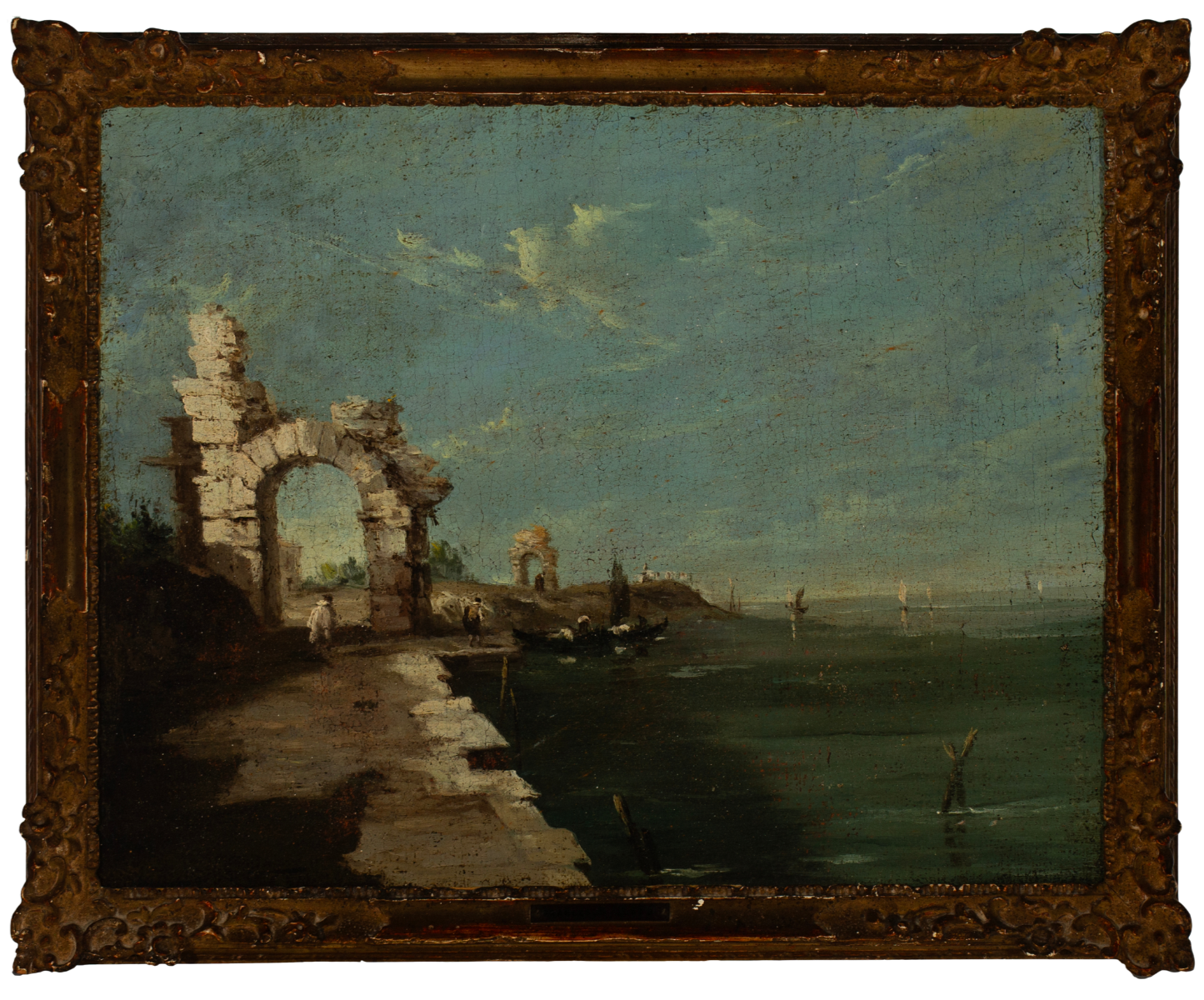 Image 2 of 4
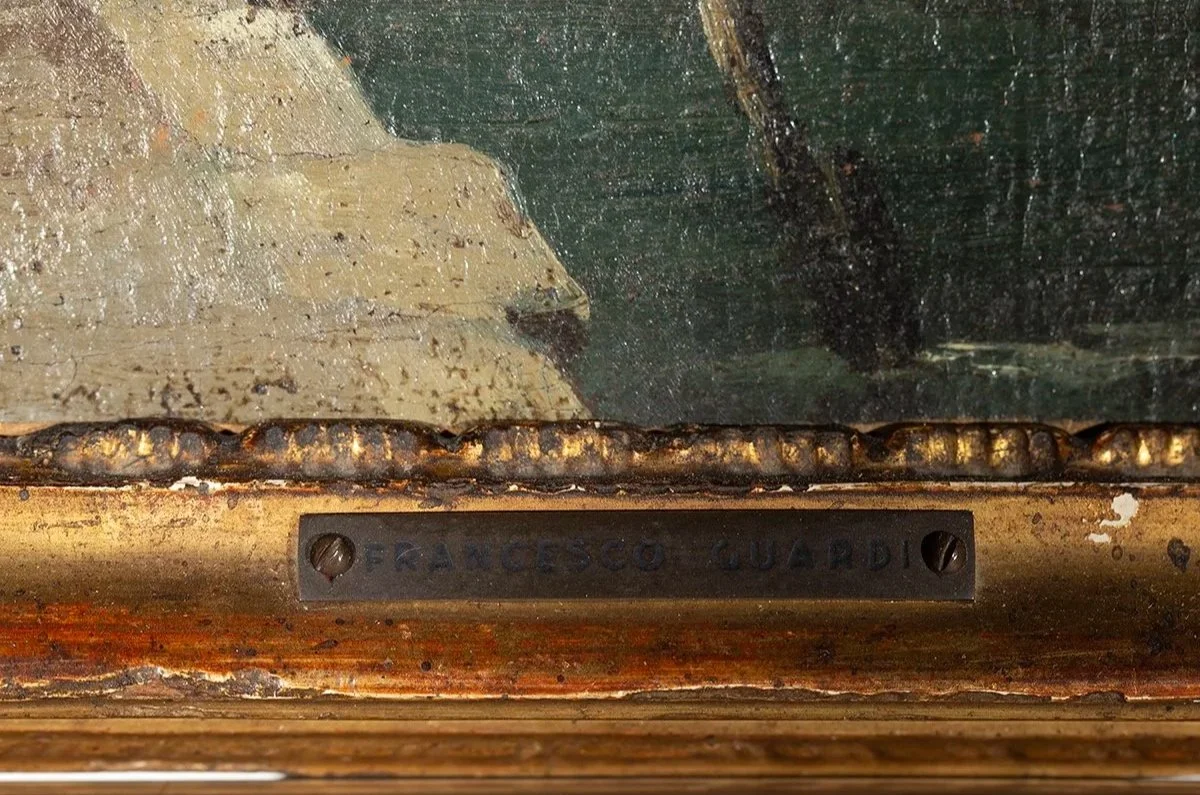 Image 3 of 4
 Image 4 of 4
Venice, Italy
18th century, silver period
Oil on canvas
Height 12 1/4" (31.1 cm); width 15 7/8" (40.3 cm); 18th century frame
Provenance: Diederick Poncelin de Raucourt, Paris, France; private collection; private collection, Massachusetts; with letter dated 1932 by Giuseppe Fiocco attributing the work to Francesco Guardi's silver period
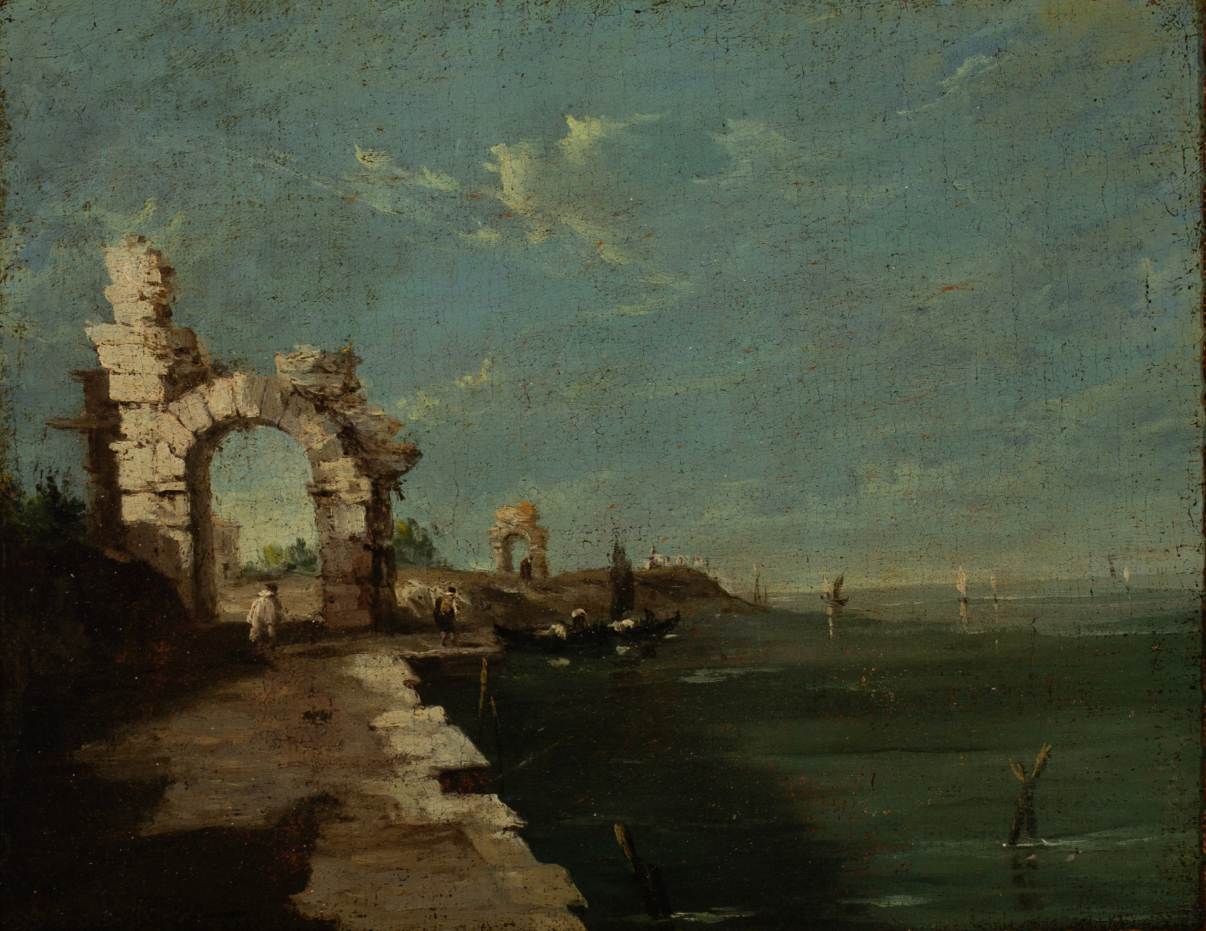
Francesco Lazzaro Guardi (1712 to 1793) was among the last major practitioners of the classic Venetian school of painting, initially collaborating with his brother Gian Antonio on religious works before concentrating after 1760 on vedute and capricci, imaginary architectural compositions combining ruins, figures, and freely invented landscape. His mature style, known as pittura di tocco, is characterized by spirited dotting brushwork and loosely rendered architecture that distinguishes his work from the more precise topographical painting of Canaletto. This looser handling, a century later, made Guardi's work highly prized by the French Impressionists.
This capriccio with ruins belongs to Guardi's silver period, a stylistic designation applied to works from his later career characterized by a cooler, more silvery palette and atmospheric handling of light. The attribution is supported by a 1932 letter from Giuseppe Fiocco, a leading 20th century Italian art historian and the first Chair of Art History at the University of Padua, who was a principal authority on Venetian painting of this period. The work is unsigned, consistent with Guardi's practice on smaller cabinet paintings produced for private collectors.
The capriccio as a genre allowed Venetian painters to combine observed architectural fragments with invented ruins and staffage figures in compositions that evoked the passage of time and the melancholy of decay. Guardi's buildings characteristically appear to dissolve into their atmospheric surroundings, the figures reduced to animated marks within a broader tonal composition. The 18th century frame is period to the work and integral to its presentation.
We ship free anywhere in the world, fully insured, packed by hand.
Venice, Italy
18th century, silver period
Oil on canvas
Height 12 1/4" (31.1 cm); width 15 7/8" (40.3 cm); 18th century frame
Provenance: Diederick Poncelin de Raucourt, Paris, France; private collection; private collection, Massachusetts; with letter dated 1932 by Giuseppe Fiocco attributing the work to Francesco Guardi's silver period
Francesco Lazzaro Guardi (1712 to 1793) was among the last major practitioners of the classic Venetian school of painting, initially collaborating with his brother Gian Antonio on religious works before concentrating after 1760 on vedute and capricci, imaginary architectural compositions combining ruins, figures, and freely invented landscape. His mature style, known as pittura di tocco, is characterized by spirited dotting brushwork and loosely rendered architecture that distinguishes his work from the more precise topographical painting of Canaletto. This looser handling, a century later, made Guardi's work highly prized by the French Impressionists.
This capriccio with ruins belongs to Guardi's silver period, a stylistic designation applied to works from his later career characterized by a cooler, more silvery palette and atmospheric handling of light. The attribution is supported by a 1932 letter from Giuseppe Fiocco, a leading 20th century Italian art historian and the first Chair of Art History at the University of Padua, who was a principal authority on Venetian painting of this period. The work is unsigned, consistent with Guardi's practice on smaller cabinet paintings produced for private collectors.
The capriccio as a genre allowed Venetian painters to combine observed architectural fragments with invented ruins and staffage figures in compositions that evoked the passage of time and the melancholy of decay. Guardi's buildings characteristically appear to dissolve into their atmospheric surroundings, the figures reduced to animated marks within a broader tonal composition. The 18th century frame is period to the work and integral to its presentation.
We ship free anywhere in the world, fully insured, packed by hand.