Hopi, Arizona
Circa 1890
Cottonwood root, natural mineral pigments
Height 11⅜ in (28.9 cm)
Provenance: John Kastner, Denver, CO; private collection, Boston, MA
This figure belongs to the earliest documented tradition of Hopi katsina carving, known as the old style or tihu, in which the body is rendered as a unified cylindrical form with legs defined but not separated and arms indicated rather than fully carved. The surface is painted in orange and white mineral pigments with black linear detail marking the kilt and facial features, all consistent with the natural iron and mineral-based paints used by Hopi carvers before synthetic materials became available. At eleven and three-eighths inches, the figure is larger than most surviving examples of this period and carries the quiet authority of an object made for ceremonial use rather than outside sale.
By the 1890s the old style was already giving way to more elaborated forms as outside collector interest grew, making figures that retain this restraint and integrity of surface increasingly uncommon. The matte finish, tonal variation, and undisturbed painted surface visible here are consistent with the mineral pigment application characteristic of late nineteenth century Hopi work. Provenance traces from John Kastner in Denver, an early dealer in Southwestern material, to a private Boston collection.
We ship free anywhere in the world, fully insured, packed by hand.
Hopi, Arizona
Circa 1890
Cottonwood root, natural mineral pigments
Height 11⅜ in (28.9 cm)
Provenance: John Kastner, Denver, CO; private collection, Boston, MA
This figure belongs to the earliest documented tradition of Hopi katsina carving, known as the old style or tihu, in which the body is rendered as a unified cylindrical form with legs defined but not separated and arms indicated rather than fully carved. The surface is painted in orange and white mineral pigments with black linear detail marking the kilt and facial features, all consistent with the natural iron and mineral-based paints used by Hopi carvers before synthetic materials became available. At eleven and three-eighths inches, the figure is larger than most surviving examples of this period and carries the quiet authority of an object made for ceremonial use rather than outside sale.
By the 1890s the old style was already giving way to more elaborated forms as outside collector interest grew, making figures that retain this restraint and integrity of surface increasingly uncommon. The matte finish, tonal variation, and undisturbed painted surface visible here are consistent with the mineral pigment application characteristic of late nineteenth century Hopi work. Provenance traces from John Kastner in Denver, an early dealer in Southwestern material, to a private Boston collection.
We ship free anywhere in the world, fully insured, packed by hand.


 Image 1 of 6
 Image 2 of 6
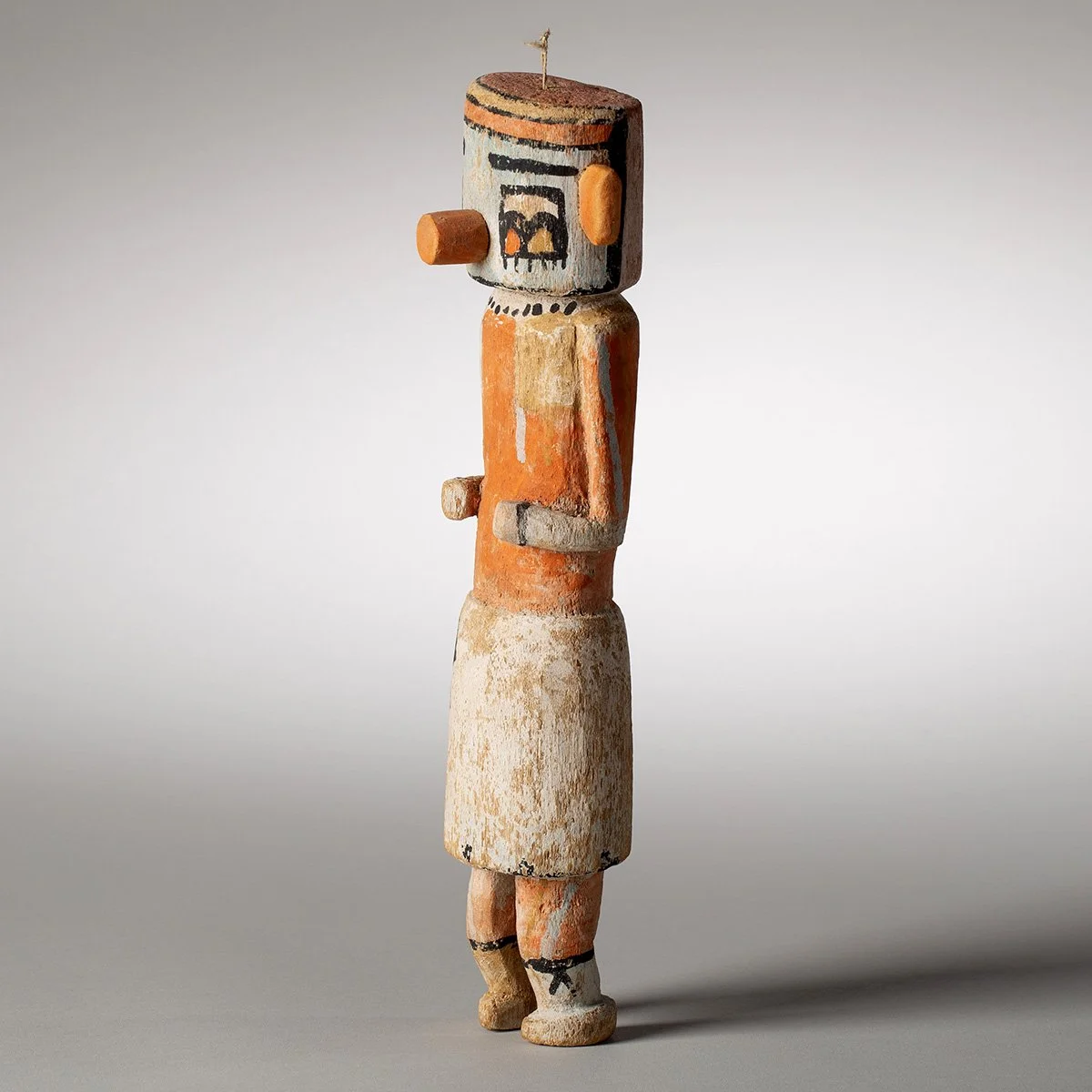 Image 3 of 6
 Image 4 of 6
 Image 5 of 6
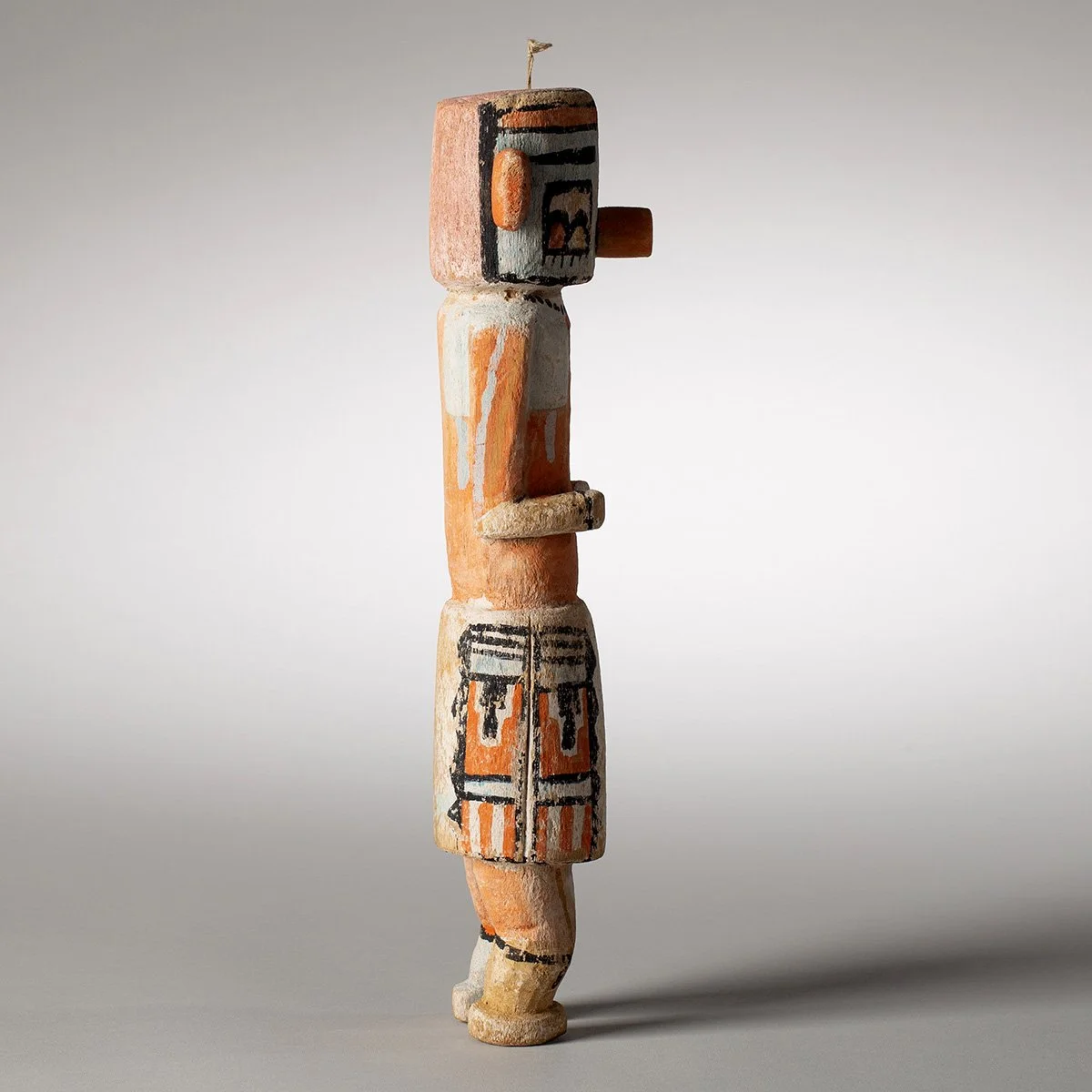 Image 6 of 6