Mexico, Huastec culture, Gulf Coast
250–600 AD
Sandstone
Height: 11 in (27.9 cm)
Provenance: Constance McCormick Fearing, Santa Barbara, California, acquired 1950s
The Huastec tradition of the northern Gulf Coast of Mexico concentrated its large-scale sculptural efforts on the human figure and head, working in the rich sandstone deposits along the Gulf shores in colors ranging from ruddy brown to yellow-orange and grey. Huastec standing figures are among the most formally complete expressions of this tradition, depicting the body with a frontality and compactness that reflects both the constraints of the stone and a consistent aesthetic preference for simplified, volumetric form. These works were produced from the Early Classic period onward and continued through the Spanish Conquest of the early sixteenth century.
This standing figure displays a broad face with defined features, a headdress or cap, and a compact body with arms indicated against the torso, rendered in the warm sandstone characteristic of Huastec production. The figure stands on a slightly tapering base consistent with Huastec architectural or freestanding sculptural context. It was acquired in the 1950s by Constance McCormick Fearing, whose Pre-Columbian collection was exhibited at LACMA in the 1960s with an accompanying catalog and remains one of the most significant named American collections of Gulf Coast material.
We ship free anywhere in the world, fully insured, packed by hand.
Mexico, Huastec culture, Gulf Coast
250–600 AD
Sandstone
Height: 11 in (27.9 cm)
Provenance: Constance McCormick Fearing, Santa Barbara, California, acquired 1950s
The Huastec tradition of the northern Gulf Coast of Mexico concentrated its large-scale sculptural efforts on the human figure and head, working in the rich sandstone deposits along the Gulf shores in colors ranging from ruddy brown to yellow-orange and grey. Huastec standing figures are among the most formally complete expressions of this tradition, depicting the body with a frontality and compactness that reflects both the constraints of the stone and a consistent aesthetic preference for simplified, volumetric form. These works were produced from the Early Classic period onward and continued through the Spanish Conquest of the early sixteenth century.
This standing figure displays a broad face with defined features, a headdress or cap, and a compact body with arms indicated against the torso, rendered in the warm sandstone characteristic of Huastec production. The figure stands on a slightly tapering base consistent with Huastec architectural or freestanding sculptural context. It was acquired in the 1950s by Constance McCormick Fearing, whose Pre-Columbian collection was exhibited at LACMA in the 1960s with an accompanying catalog and remains one of the most significant named American collections of Gulf Coast material.
We ship free anywhere in the world, fully insured, packed by hand.


 Image 1 of 6
 Image 2 of 6
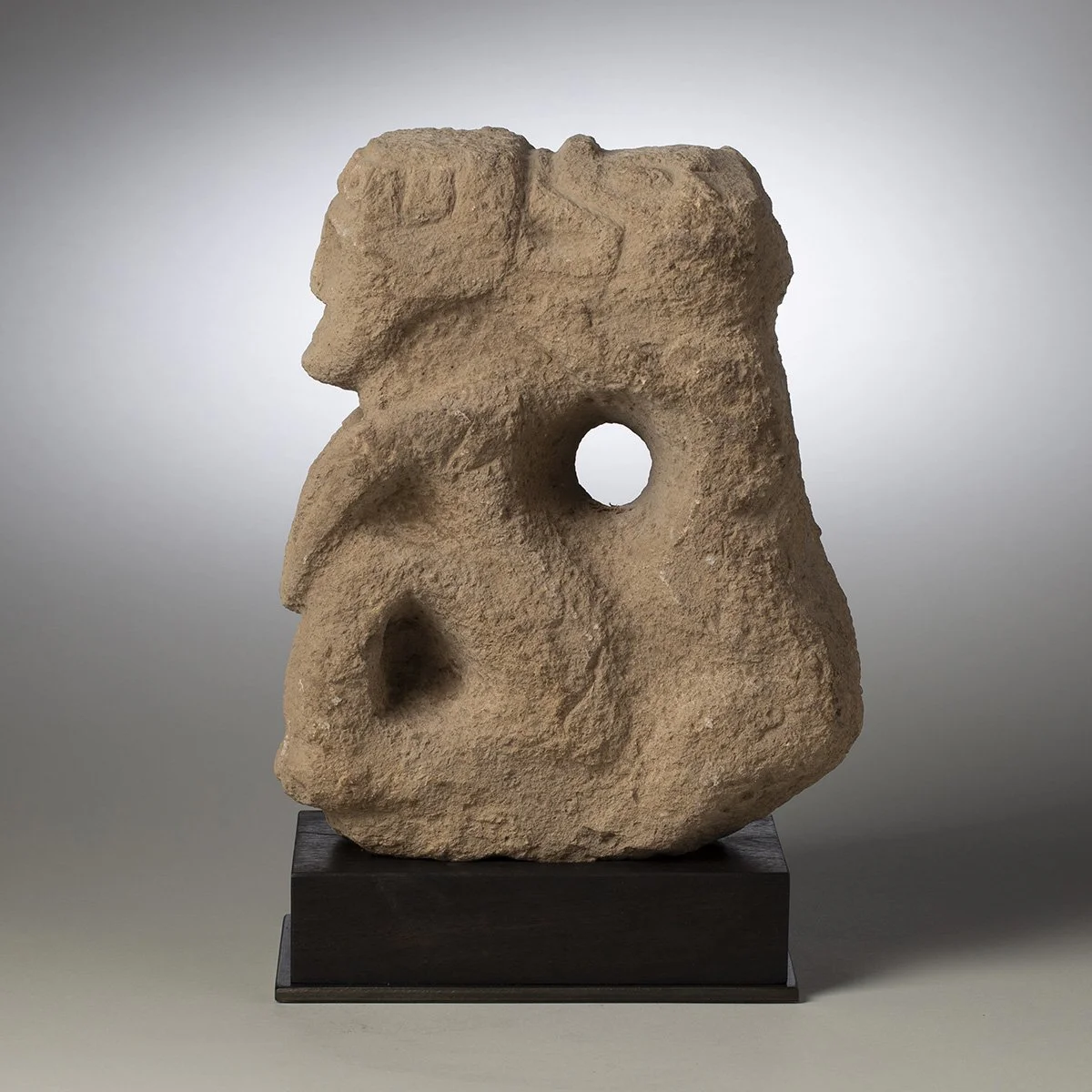 Image 3 of 6
 Image 4 of 6
 Image 5 of 6
 Image 6 of 6