

 Image 1 of 4
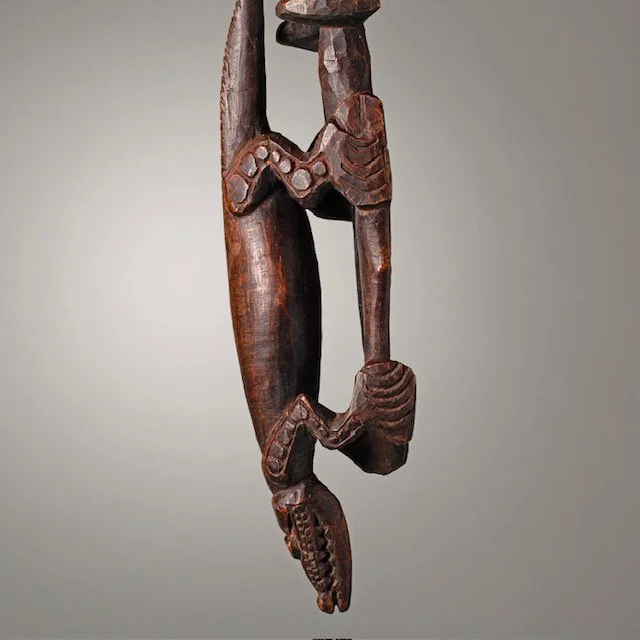 Image 2 of 4
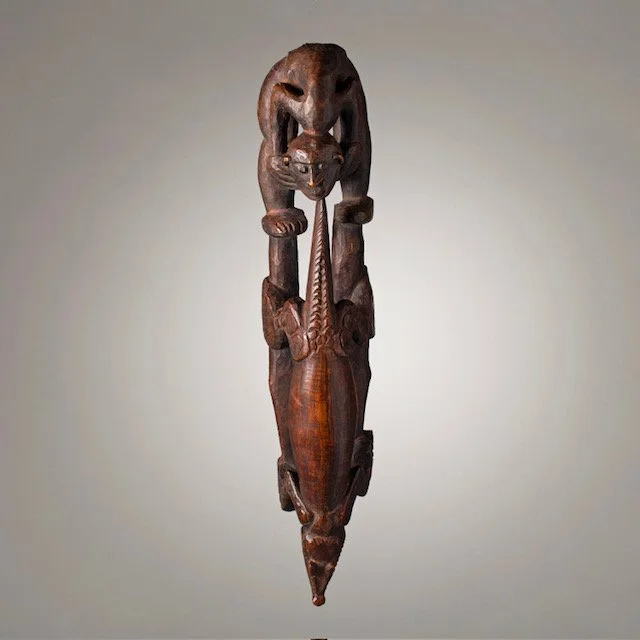 Image 3 of 4
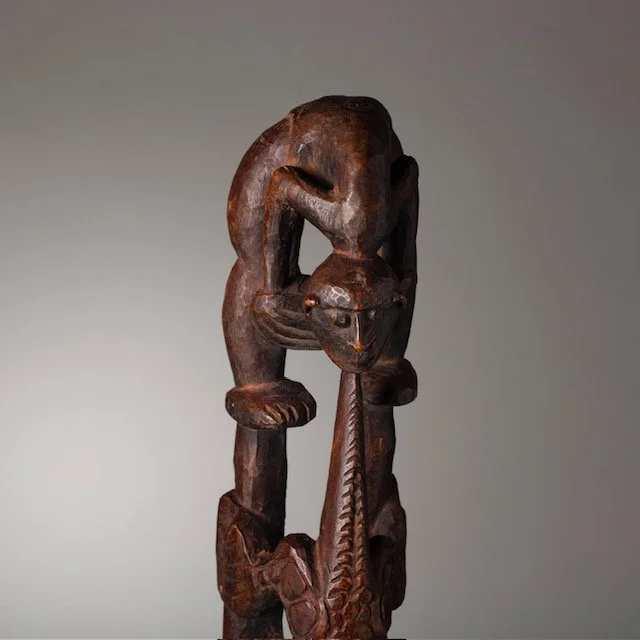 Image 4 of 4
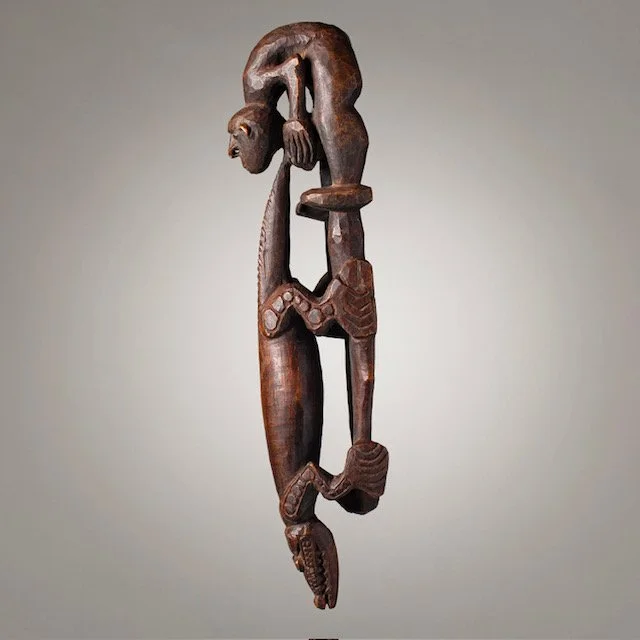
Iatmul People, Middle Sepik Region, Papua New Guinea
Early 20th century
Length: 19.25 inches (49 cm)
Provenance: Field collected in 1930 by a crew member of Burns Philp Steamship Line / Chris and Anna Thorpe personal collection – Sydney, Australia.
Among the Iatmul people of the middle Sepik River, crocodiles were foundational to cosmology, origin myth, male initiation, and clan identity. According to Iatmul tradition, an ancestral crocodile surfaced from a primordial ocean carrying mud on its back, which became the first island and the foundation of all dry land, whose movements still cause earthquakes. A second creation myth centers on the ancestral woman Kwalanambu, who gave birth to twin hero sons after pursuing the crocodile, and who is also credited with carving the course of the Sepik River from a vast mythical lake called Mebenbit.
Carved from dense vitex cofassus wood, this ritual implement gives form to that mythological world, its surface developing a dark, warm, glossy patina through long exposure to the smoke filled interior of a community men's house and repeated ritual handling. Closely related ceremonial implements from the neighboring Biwat people were reportedly clutched between men's thighs during initiation ceremonies, suggesting a similar function here. The carving is worked with sustained sculptural control, the crocodile form rendered with both formal precision and expressive force.
The 1930 field collection by a crew member of the Burns Philp Steamship Line places the object's removal from Papua New Guinea at a documented early date, within the era of active collecting along the Sepik River by traders, missionaries, and expedition members. The subsequent holding in the Chris and Anna Thorpe collection in Sydney provides a clear second point of documented ownership. Together the provenance establishes a collection history that spans nearly a century from first contact to the present.
To read more from Mark about this extraordinary item, please click here.
We ship free anywhere in the world, fully insured, packed by hand
Iatmul People, Middle Sepik Region, Papua New Guinea
Early 20th century
Length: 19.25 inches (49 cm)
Provenance: Field collected in 1930 by a crew member of Burns Philp Steamship Line / Chris and Anna Thorpe personal collection – Sydney, Australia.
Among the Iatmul people of the middle Sepik River, crocodiles were foundational to cosmology, origin myth, male initiation, and clan identity. According to Iatmul tradition, an ancestral crocodile surfaced from a primordial ocean carrying mud on its back, which became the first island and the foundation of all dry land, whose movements still cause earthquakes. A second creation myth centers on the ancestral woman Kwalanambu, who gave birth to twin hero sons after pursuing the crocodile, and who is also credited with carving the course of the Sepik River from a vast mythical lake called Mebenbit.
Carved from dense vitex cofassus wood, this ritual implement gives form to that mythological world, its surface developing a dark, warm, glossy patina through long exposure to the smoke filled interior of a community men's house and repeated ritual handling. Closely related ceremonial implements from the neighboring Biwat people were reportedly clutched between men's thighs during initiation ceremonies, suggesting a similar function here. The carving is worked with sustained sculptural control, the crocodile form rendered with both formal precision and expressive force.
The 1930 field collection by a crew member of the Burns Philp Steamship Line places the object's removal from Papua New Guinea at a documented early date, within the era of active collecting along the Sepik River by traders, missionaries, and expedition members. The subsequent holding in the Chris and Anna Thorpe collection in Sydney provides a clear second point of documented ownership. Together the provenance establishes a collection history that spans nearly a century from first contact to the present.
To read more from Mark about this extraordinary item, please click here.
We ship free anywhere in the world, fully insured, packed by hand