Middle Sepik River, Papua New Guinea
Early 20th century
Wood, cowrie shell inlay, red ocher, charcoal, white lime
Height: 29½ in (75 cm)
Provenance: Field collected 1982, Kambian village, Sawos region; private collection, Sydney, Australia
The mei masks of the Iatmul people of the Middle Sepik are among the most ceremonially significant objects produced in the region, representing the founding ancestral brothers and sisters of village clans and appearing in pairs — a longer, thinner male mask and a shorter, broader female — during performances connected to headhunting, warfare, and the ritual life of the men's house. Each clan owns a pair, kept suspended in the clan elder's house when not in use, and the masks are danced attached to conical basketry costumes that cover the dancer's head and upper body. The supernatural couple they embody symbolizes duality, a structuring principle that organizes social and cosmological life across the Iatmul and neighboring Sawos language groups of the Middle Sepik.
This mask represents the male of the pair. The long aquiline nose merges into a curved molot element that continues downward to join the chin, terminating in a carved ancestral bird head — a detail that marks this example as fully resolved within the Iatmul formal tradition. The eyes are deeply arched and inset with cowrie shells, the chin pierced with attachment holes for securing the mask to its basketry framework, and traces of red ocher, black charcoal, and white lime remain visible beneath the dark patina accumulated through decades of storage in the men's house. The mask was brought to Kambian village in the 1920s by the great-grandfather of the 1982 owner, a man named Flau, and carries the personal name Ombaligaui.
We ship free anywhere in the world, fully insured, packed by hand.
Middle Sepik River, Papua New Guinea
Early 20th century
Wood, cowrie shell inlay, red ocher, charcoal, white lime
Height: 29½ in (75 cm)
Provenance: Field collected 1982, Kambian village, Sawos region; private collection, Sydney, Australia
The mei masks of the Iatmul people of the Middle Sepik are among the most ceremonially significant objects produced in the region, representing the founding ancestral brothers and sisters of village clans and appearing in pairs — a longer, thinner male mask and a shorter, broader female — during performances connected to headhunting, warfare, and the ritual life of the men's house. Each clan owns a pair, kept suspended in the clan elder's house when not in use, and the masks are danced attached to conical basketry costumes that cover the dancer's head and upper body. The supernatural couple they embody symbolizes duality, a structuring principle that organizes social and cosmological life across the Iatmul and neighboring Sawos language groups of the Middle Sepik.
This mask represents the male of the pair. The long aquiline nose merges into a curved molot element that continues downward to join the chin, terminating in a carved ancestral bird head — a detail that marks this example as fully resolved within the Iatmul formal tradition. The eyes are deeply arched and inset with cowrie shells, the chin pierced with attachment holes for securing the mask to its basketry framework, and traces of red ocher, black charcoal, and white lime remain visible beneath the dark patina accumulated through decades of storage in the men's house. The mask was brought to Kambian village in the 1920s by the great-grandfather of the 1982 owner, a man named Flau, and carries the personal name Ombaligaui.
We ship free anywhere in the world, fully insured, packed by hand.


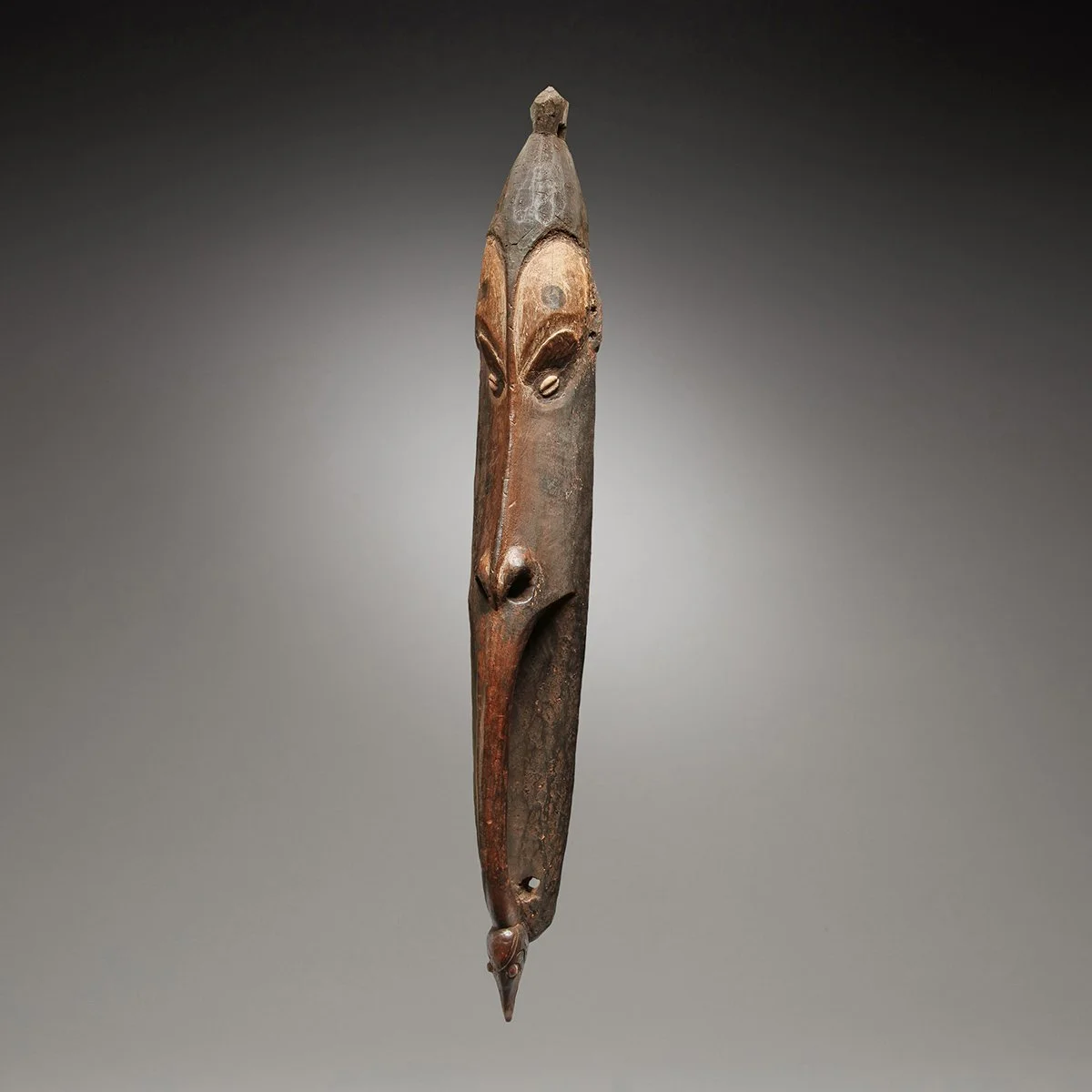 Image 1 of 6
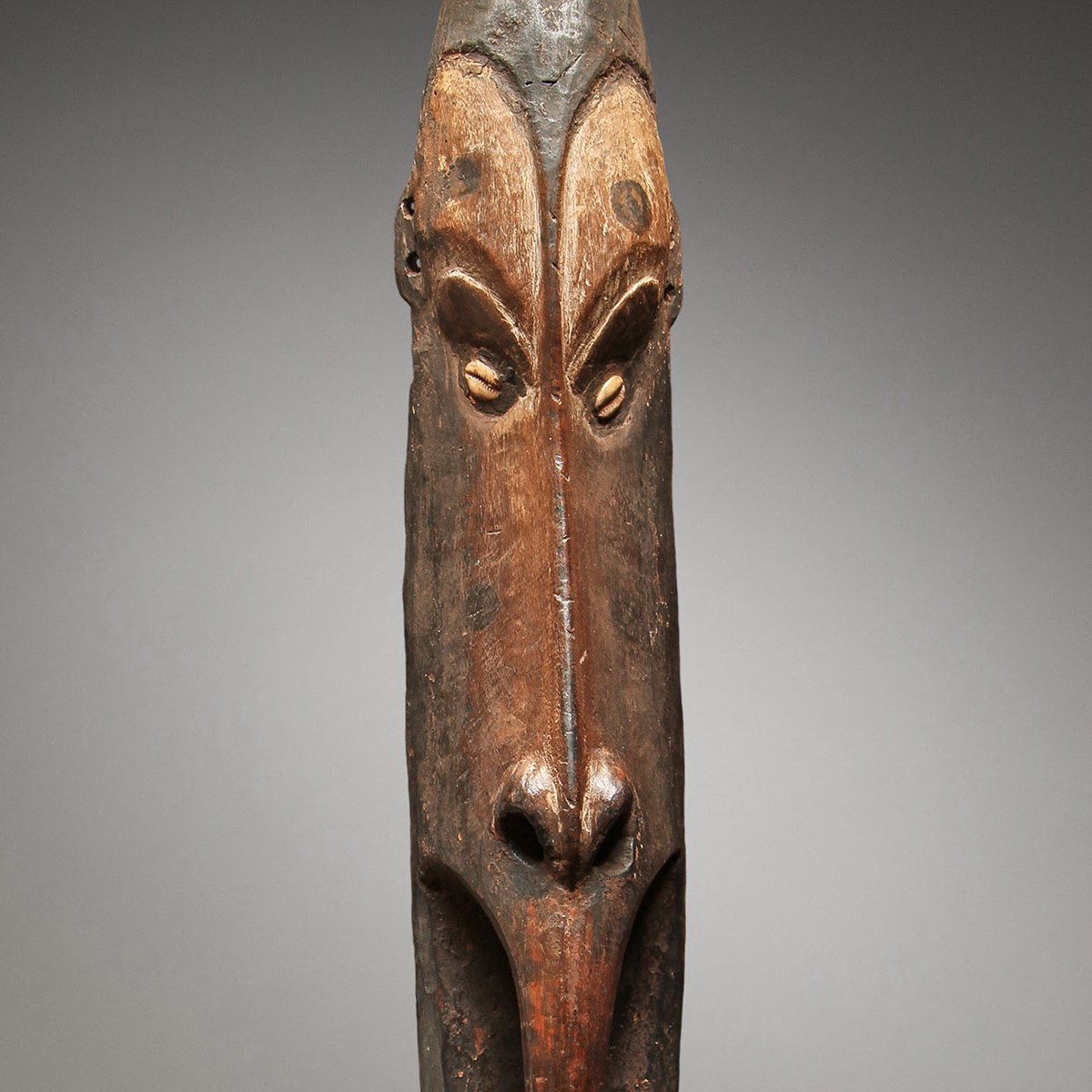 Image 2 of 6
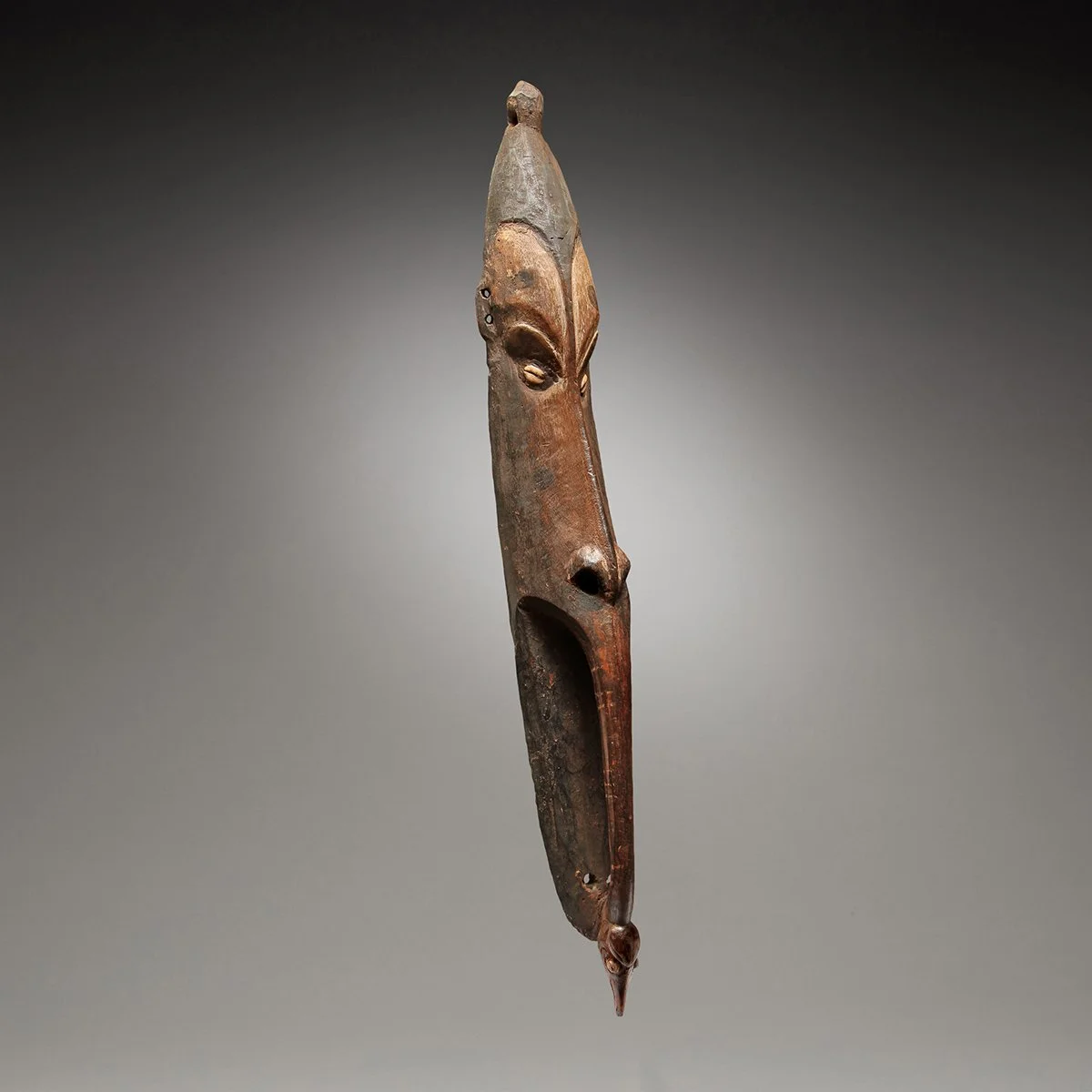 Image 3 of 6
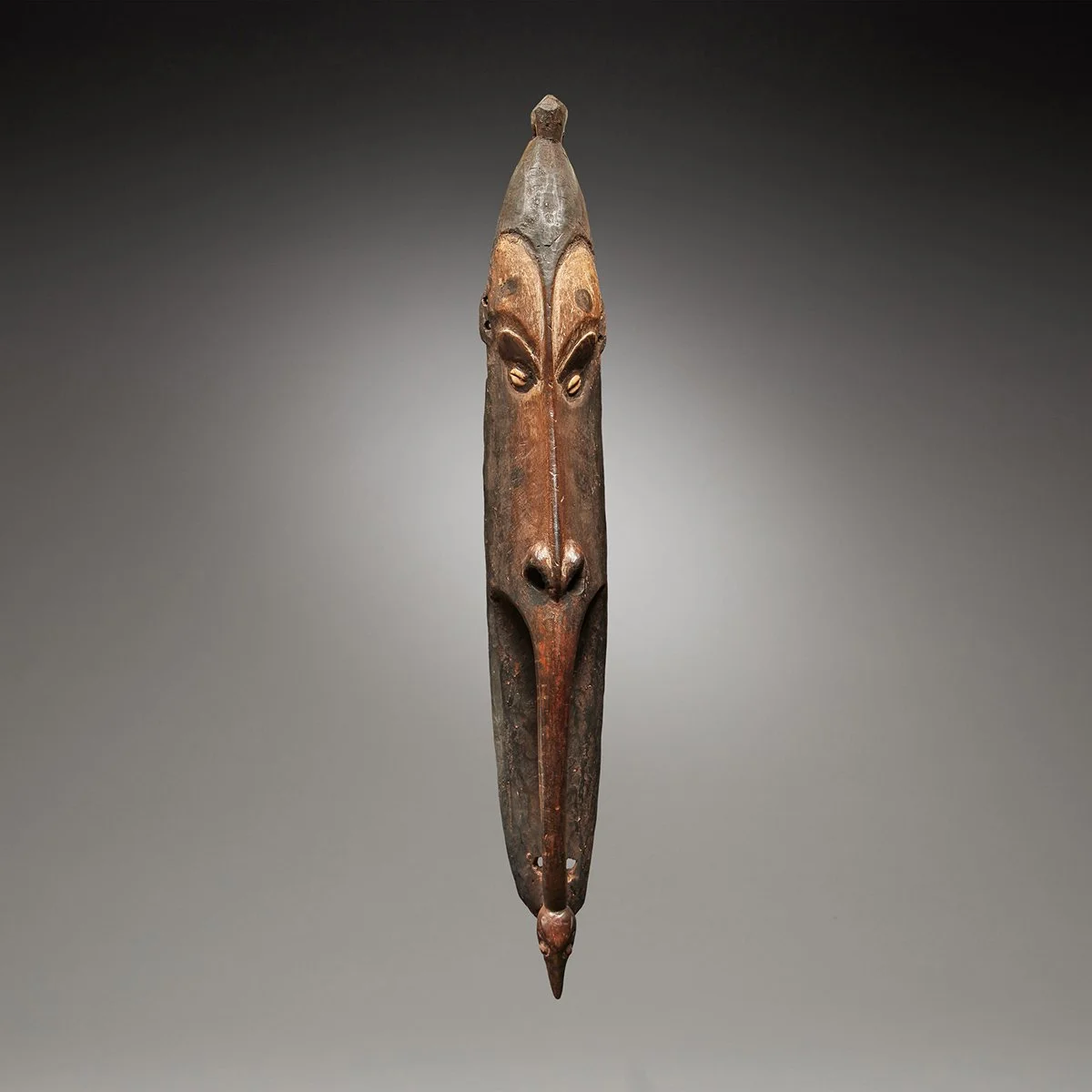 Image 4 of 6
 Image 5 of 6
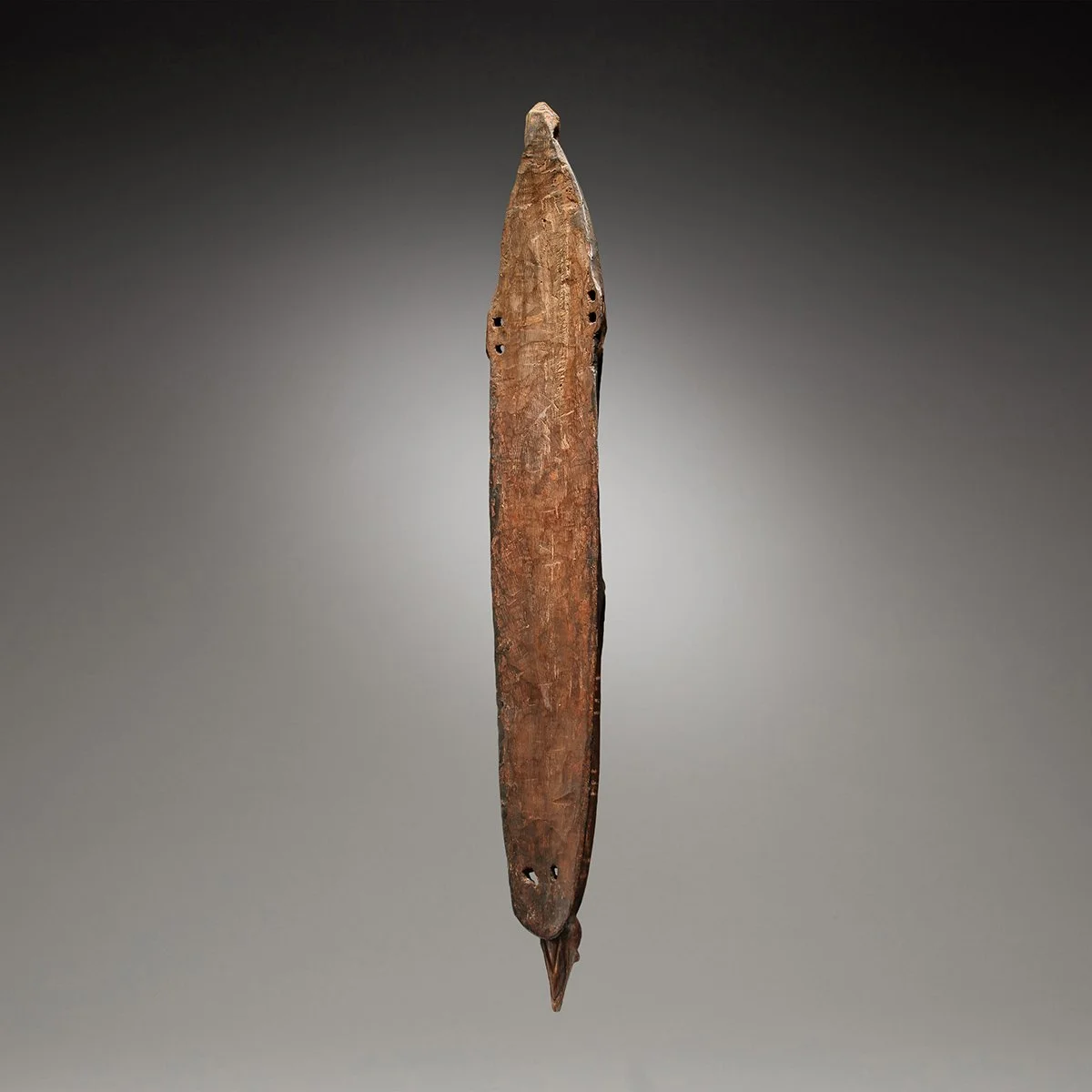 Image 6 of 6