Middle Sepik River, Papua New Guinea
Circa 1900
Wood, natural pigment residue, fiber
Length: 9½ in (24.1 cm)
Provenance: Private collection, Germany; remnants of old collection label present on underside
Pigment dishes from the Middle Sepik River were used to hold body paints applied during ceremonies, the interior surfaces of surviving examples often retaining traces of the pigments they once held. Objects of this type were handheld during use, their scale and weight suited to a single hand, and their carved surfaces reflect the same visual language found across Iatmul ceremonial objects. The German provenance, combined with the remnants of an old collection label on the underside, suggests early entry into a European collection consistent with the period of missionary and colonial contact in the Sepik region.
The exterior is carved with curvilinear Iatmul designs across the body and handle, the handle terminal rendered as a stylized ancestral or animal head with fiber binding at the neck. Pigment residue remains visible on the interior of the bowl, direct physical evidence of the object's use. The wood has darkened throughout to a deep tone, the carving crisp and the overall form compact and well-resolved.
We ship free anywhere in the world, fully insured, packed by hand.
Middle Sepik River, Papua New Guinea
Circa 1900
Wood, natural pigment residue, fiber
Length: 9½ in (24.1 cm)
Provenance: Private collection, Germany; remnants of old collection label present on underside
Pigment dishes from the Middle Sepik River were used to hold body paints applied during ceremonies, the interior surfaces of surviving examples often retaining traces of the pigments they once held. Objects of this type were handheld during use, their scale and weight suited to a single hand, and their carved surfaces reflect the same visual language found across Iatmul ceremonial objects. The German provenance, combined with the remnants of an old collection label on the underside, suggests early entry into a European collection consistent with the period of missionary and colonial contact in the Sepik region.
The exterior is carved with curvilinear Iatmul designs across the body and handle, the handle terminal rendered as a stylized ancestral or animal head with fiber binding at the neck. Pigment residue remains visible on the interior of the bowl, direct physical evidence of the object's use. The wood has darkened throughout to a deep tone, the carving crisp and the overall form compact and well-resolved.
We ship free anywhere in the world, fully insured, packed by hand.


 Image 1 of 9
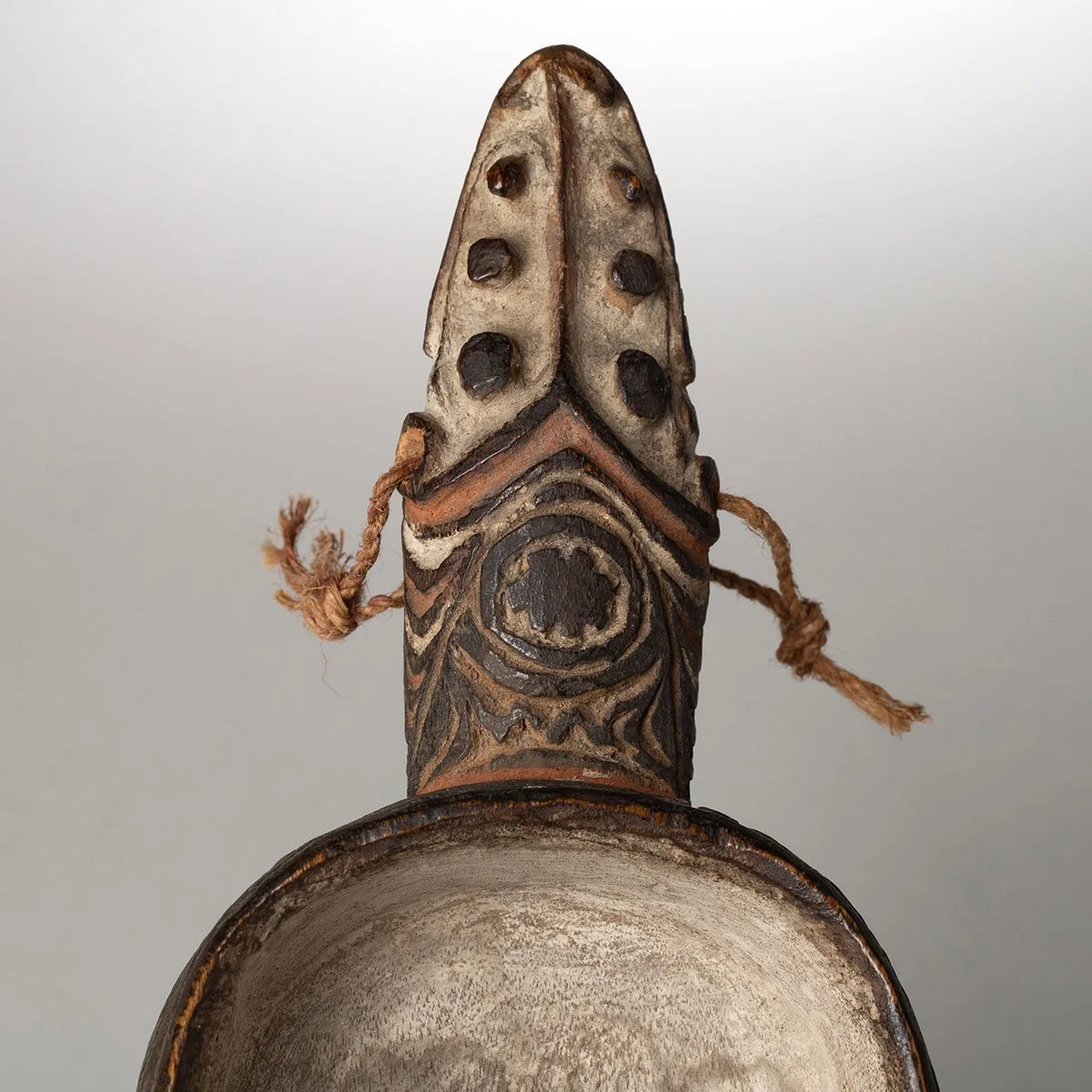 Image 2 of 9
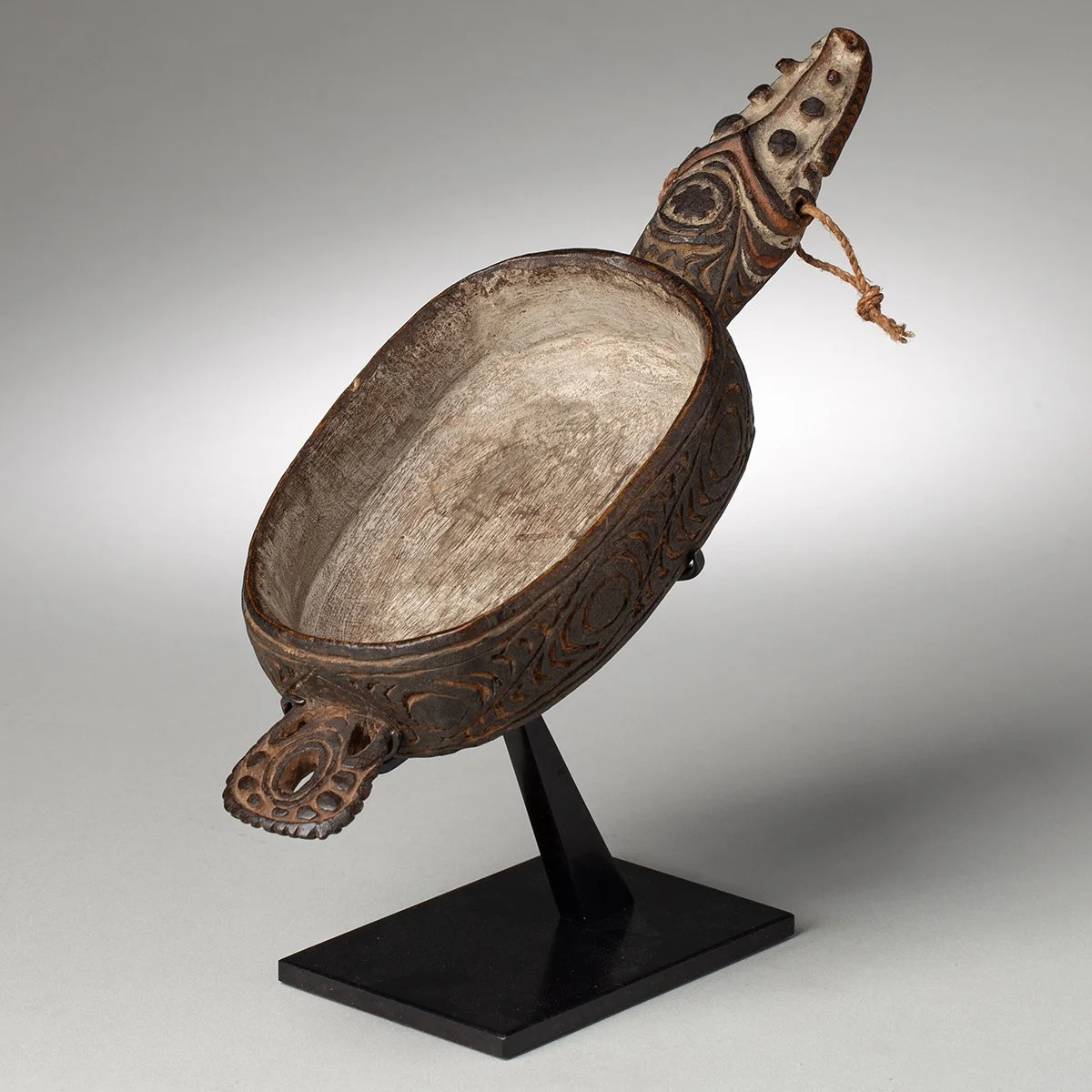 Image 3 of 9
 Image 4 of 9
 Image 5 of 9
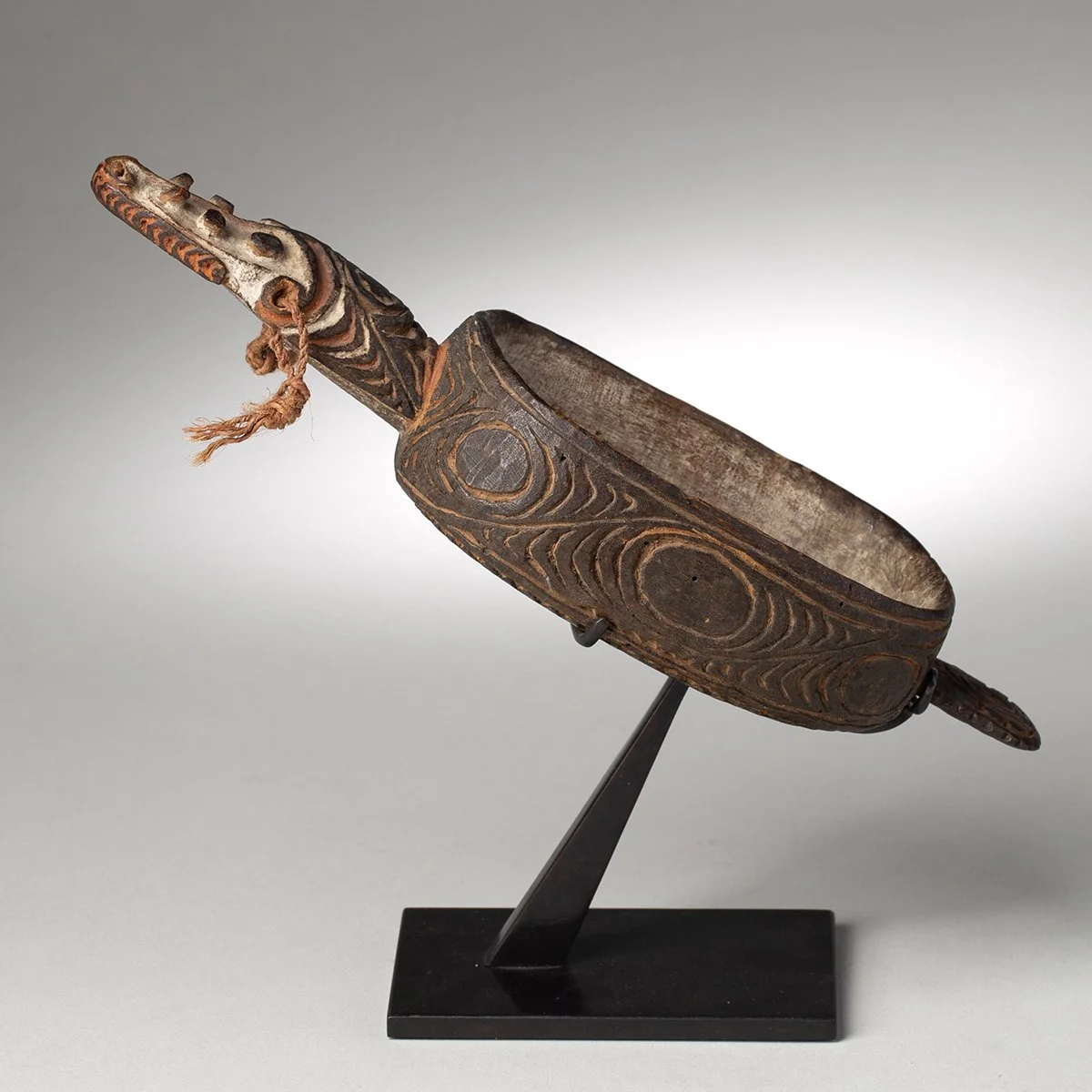 Image 6 of 9
 Image 7 of 9
 Image 8 of 9
 Image 9 of 9