

 Image 1 of 4
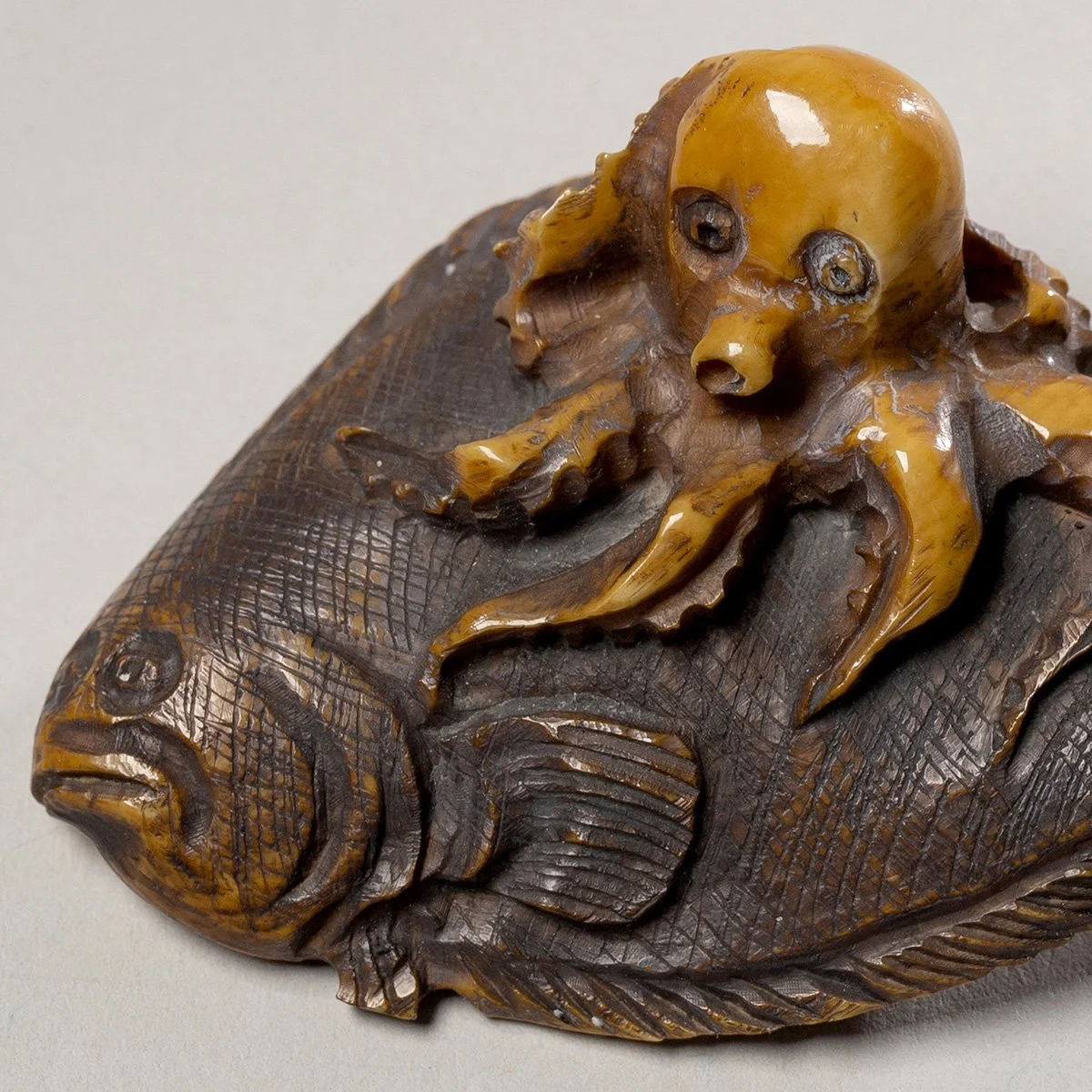 Image 2 of 4
 Image 3 of 4
 Image 4 of 4
Japan
19th century
Marine ivory
Signed
Height 1 1/2 in (3.8 cm), Width 2 1/2 in (6.4 cm)
Provenance: Private collection, Arizona
Marine subjects were among the most inventive in the netsuke carver's repertoire, drawing on the deep familiarity with ocean life that characterized coastal Japanese culture. This signed netsuke depicts an octopus grappling with a flounder, the two creatures rendered with naturalistic attention to surface texture and the dynamic tension of the encounter. The warm honey tone of the marine ivory and the fine carving of the octopus tentacles and fish scales demonstrate the technical command expected of accomplished Edo and Meiji period carvers.
The choice of marine ivory, derived from walrus tusk or whale tooth traded into Japan through northern networks, gives the piece a distinctive material character distinct from the more common boxwood or stag antler netsuke. Signed netsuke of this quality and subject were collected seriously in Japan and in the West from the Meiji period onward. The composition, in which predator and prey are locked together in a single compact form, is a classic demonstration of the netsuke carver's ability to resolve complex subject matter within the strict functional constraints of the form.
We ship free within the United States, fully insured, packed by hand.
Japan
19th century
Marine ivory
Signed
Height 1 1/2 in (3.8 cm), Width 2 1/2 in (6.4 cm)
Provenance: Private collection, Arizona
Marine subjects were among the most inventive in the netsuke carver's repertoire, drawing on the deep familiarity with ocean life that characterized coastal Japanese culture. This signed netsuke depicts an octopus grappling with a flounder, the two creatures rendered with naturalistic attention to surface texture and the dynamic tension of the encounter. The warm honey tone of the marine ivory and the fine carving of the octopus tentacles and fish scales demonstrate the technical command expected of accomplished Edo and Meiji period carvers.
The choice of marine ivory, derived from walrus tusk or whale tooth traded into Japan through northern networks, gives the piece a distinctive material character distinct from the more common boxwood or stag antler netsuke. Signed netsuke of this quality and subject were collected seriously in Japan and in the West from the Meiji period onward. The composition, in which predator and prey are locked together in a single compact form, is a classic demonstration of the netsuke carver's ability to resolve complex subject matter within the strict functional constraints of the form.
We ship free within the United States, fully insured, packed by hand.