

 Image 1 of 3
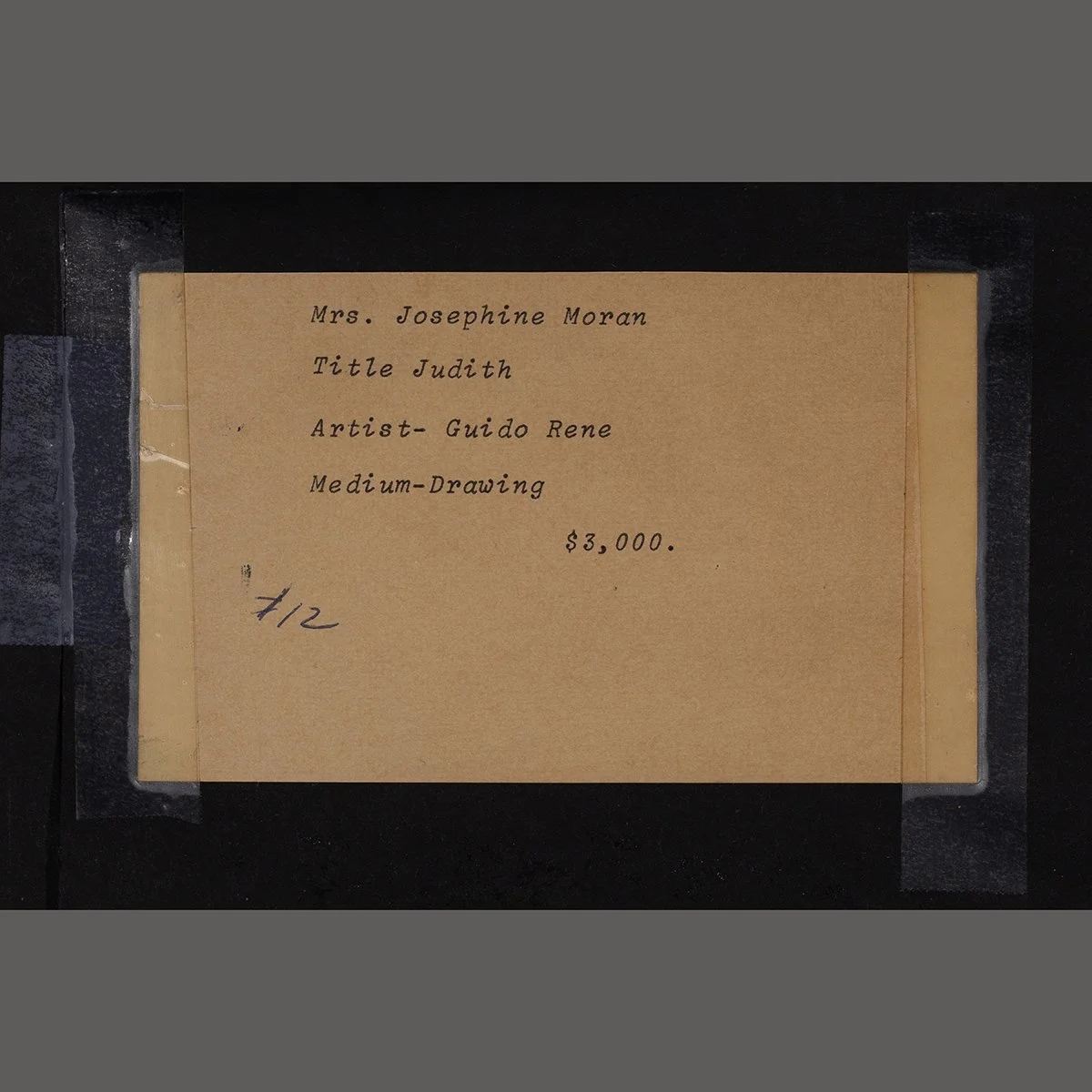 Image 2 of 3
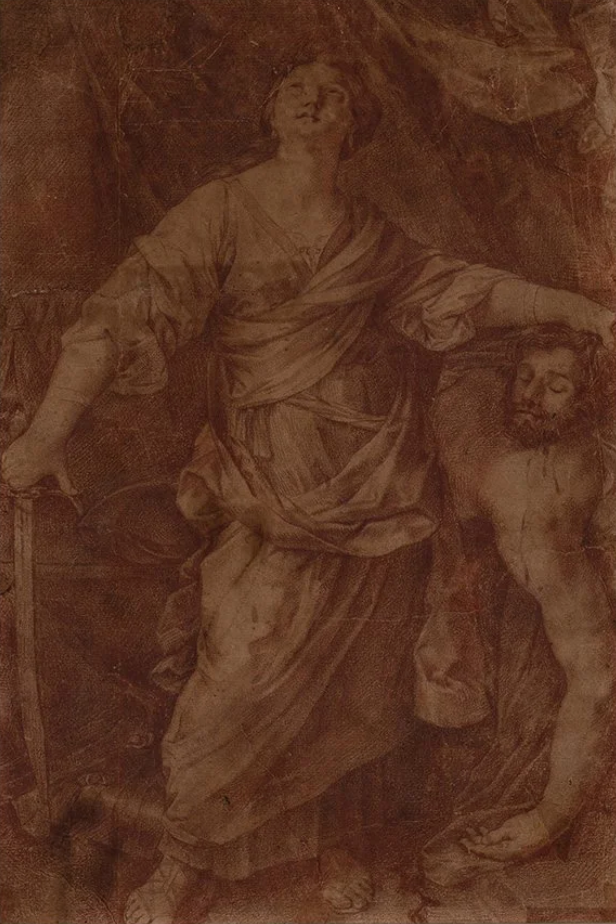 Image 3 of 3
Guido Reni, 1575 - 1642
Italy, Bologna and Rome
Drawing
16 1/2 x 21 1/2 inches (41.9 x 54.6 cm) including frame
Provenance: Josephine Moran, New York
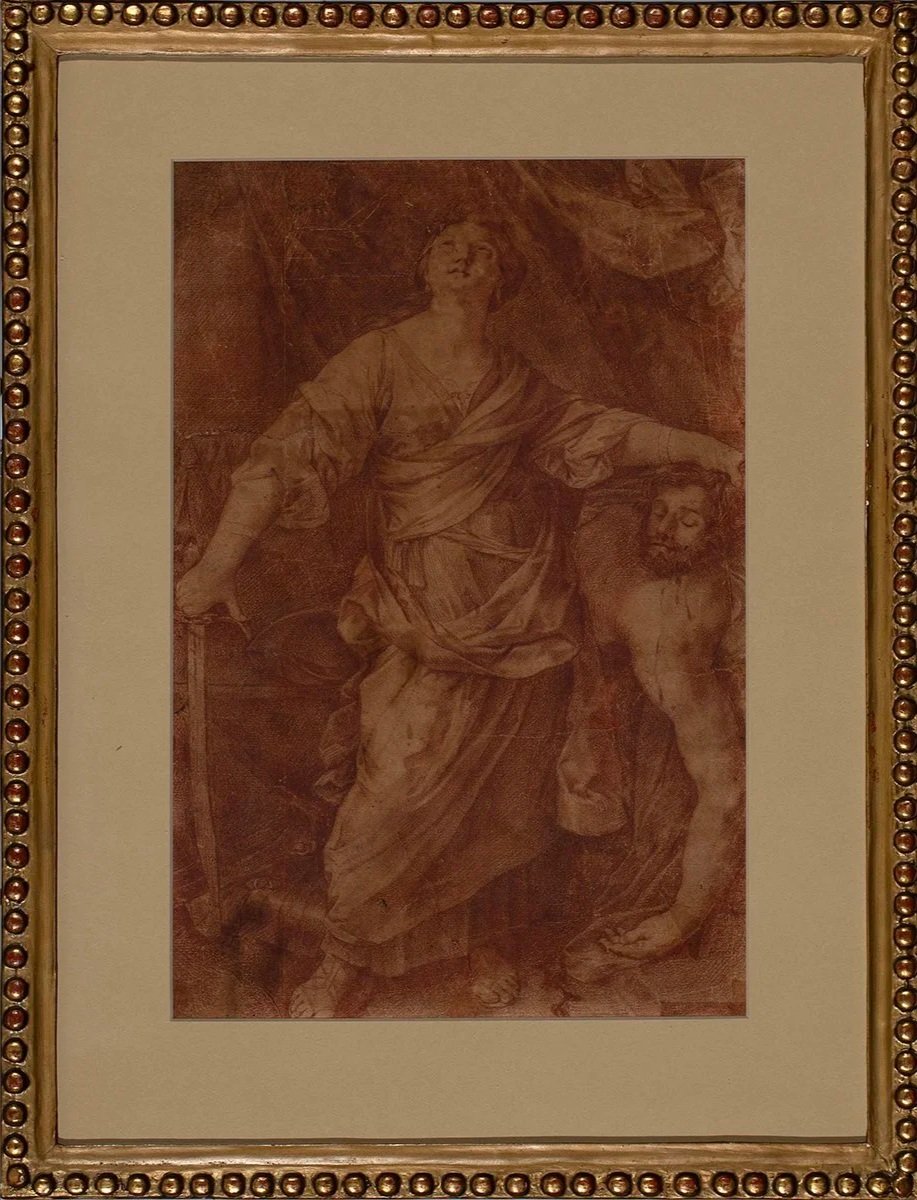
Judith stands over the body of Holofernes, her head thrown back and her gaze lifted away from the act, one arm extended down to the table edge while the other holds the severed head low against her hip. The drapery falls in long diagonals across the body and gathers behind her, and the whole composition is worked in a warm red brown that models the figure through tone rather than outline. Behind her a heavy curtain is drawn across the upper left, closing the space and pushing the two figures forward.
The subject comes from the Book of Judith, in which a widow of Bethulia enters the Assyrian camp, wins the confidence of the general besieging her city, and kills him in his tent. Bolognese and Roman painters of the seventeenth century returned to it repeatedly, and Reni himself treated Judith more than once across his career. The upward turn of the head here belongs to the devotional rather than the violent reading of the subject, presenting the act as one performed under divine direction.
Guido Reni was born in Bologna in 1575 and trained first under Denys Calvaert, then in the orbit of the Carracci workshop. He worked in Rome between 1602 and 1613, where he is reputed to have met and quarrelled with Caravaggio, and where he painted the Aurora ceiling fresco at the Casino Rospigliosi for Cardinal Scipione Borghese before 1614. He returned to Bologna by 1613 and worked there until his death in 1642, running a large studio that took commissions from across Italy.
We ship free anywhere in the world, fully insured, packed by hand.
Guido Reni, 1575 - 1642
Italy, Bologna and Rome
Drawing
16 1/2 x 21 1/2 inches (41.9 x 54.6 cm) including frame
Provenance: Josephine Moran, New York
Judith stands over the body of Holofernes, her head thrown back and her gaze lifted away from the act, one arm extended down to the table edge while the other holds the severed head low against her hip. The drapery falls in long diagonals across the body and gathers behind her, and the whole composition is worked in a warm red brown that models the figure through tone rather than outline. Behind her a heavy curtain is drawn across the upper left, closing the space and pushing the two figures forward.
The subject comes from the Book of Judith, in which a widow of Bethulia enters the Assyrian camp, wins the confidence of the general besieging her city, and kills him in his tent. Bolognese and Roman painters of the seventeenth century returned to it repeatedly, and Reni himself treated Judith more than once across his career. The upward turn of the head here belongs to the devotional rather than the violent reading of the subject, presenting the act as one performed under divine direction.
Guido Reni was born in Bologna in 1575 and trained first under Denys Calvaert, then in the orbit of the Carracci workshop. He worked in Rome between 1602 and 1613, where he is reputed to have met and quarrelled with Caravaggio, and where he painted the Aurora ceiling fresco at the Casino Rospigliosi for Cardinal Scipione Borghese before 1614. He returned to Bologna by 1613 and worked there until his death in 1642, running a large studio that took commissions from across Italy.
We ship free anywhere in the world, fully insured, packed by hand.