

 Image 1 of 3
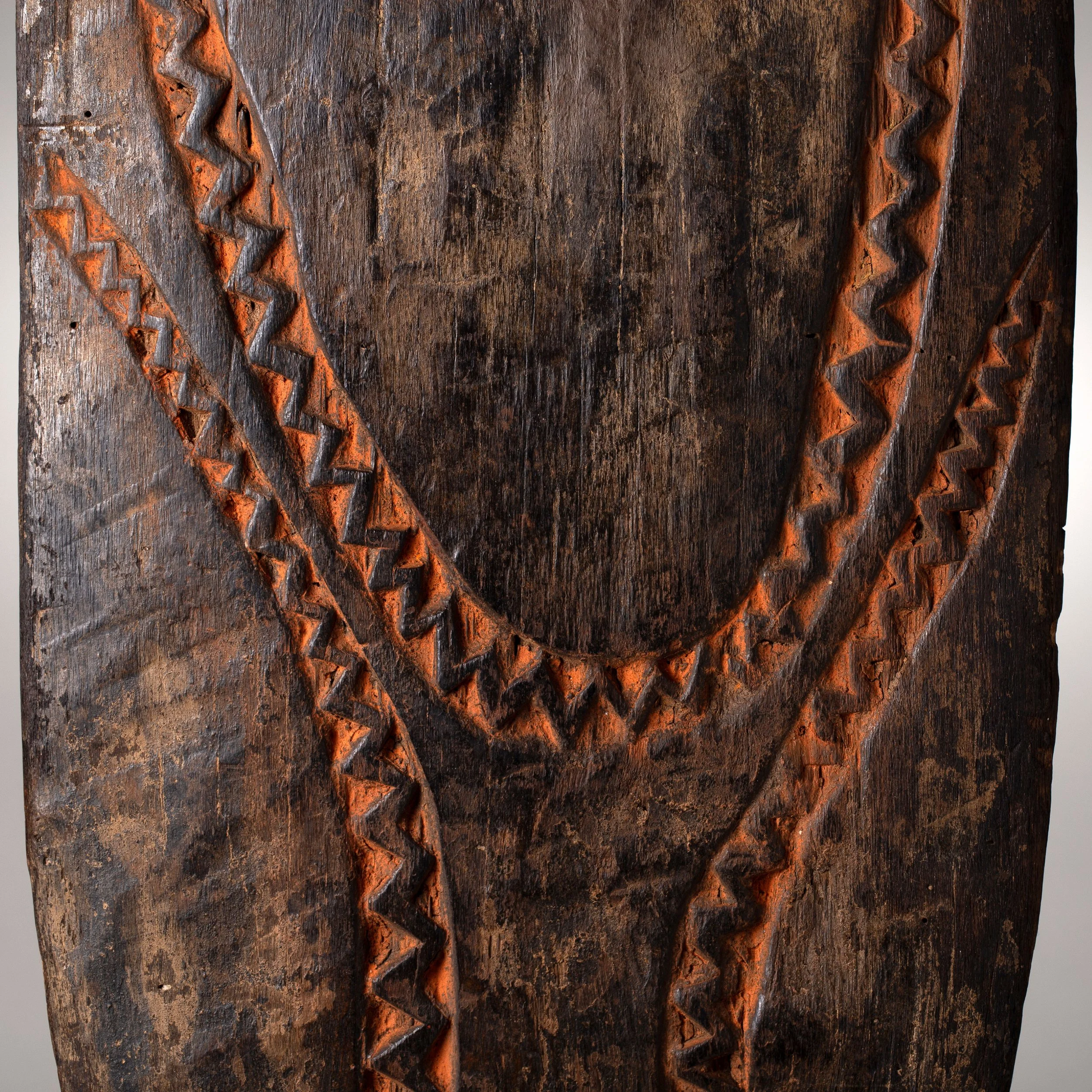 Image 2 of 3
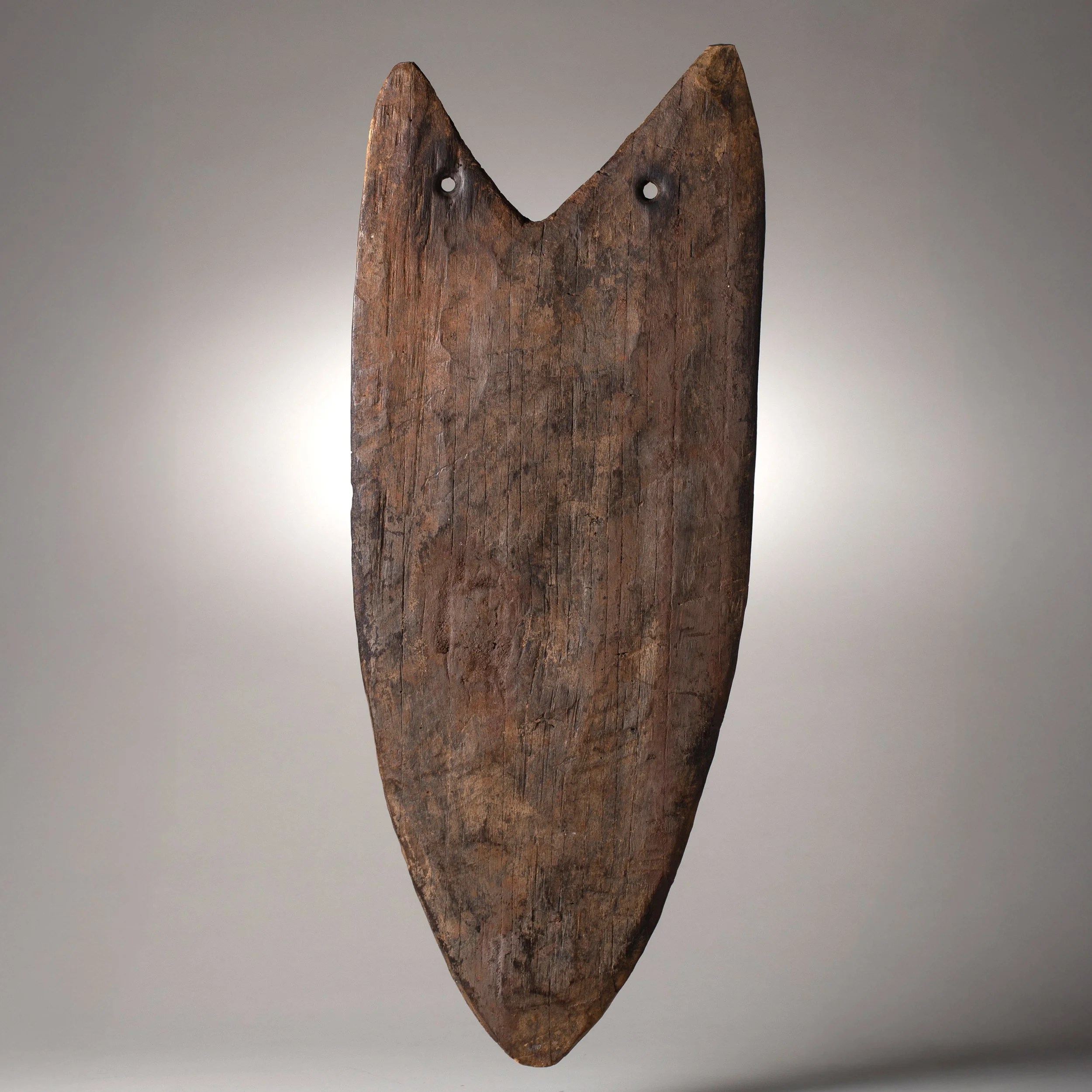 Image 3 of 3
Mendi Valley, Southern Highlands, Papua New Guinea
Early 20th century; stone-carved
Wood, red mineral pigment
Width: 11 in (27.9 cm); Height: 28½ in (72.4 cm)
Provenance: Bruce Seamans, Bora Bora, French Polynesia
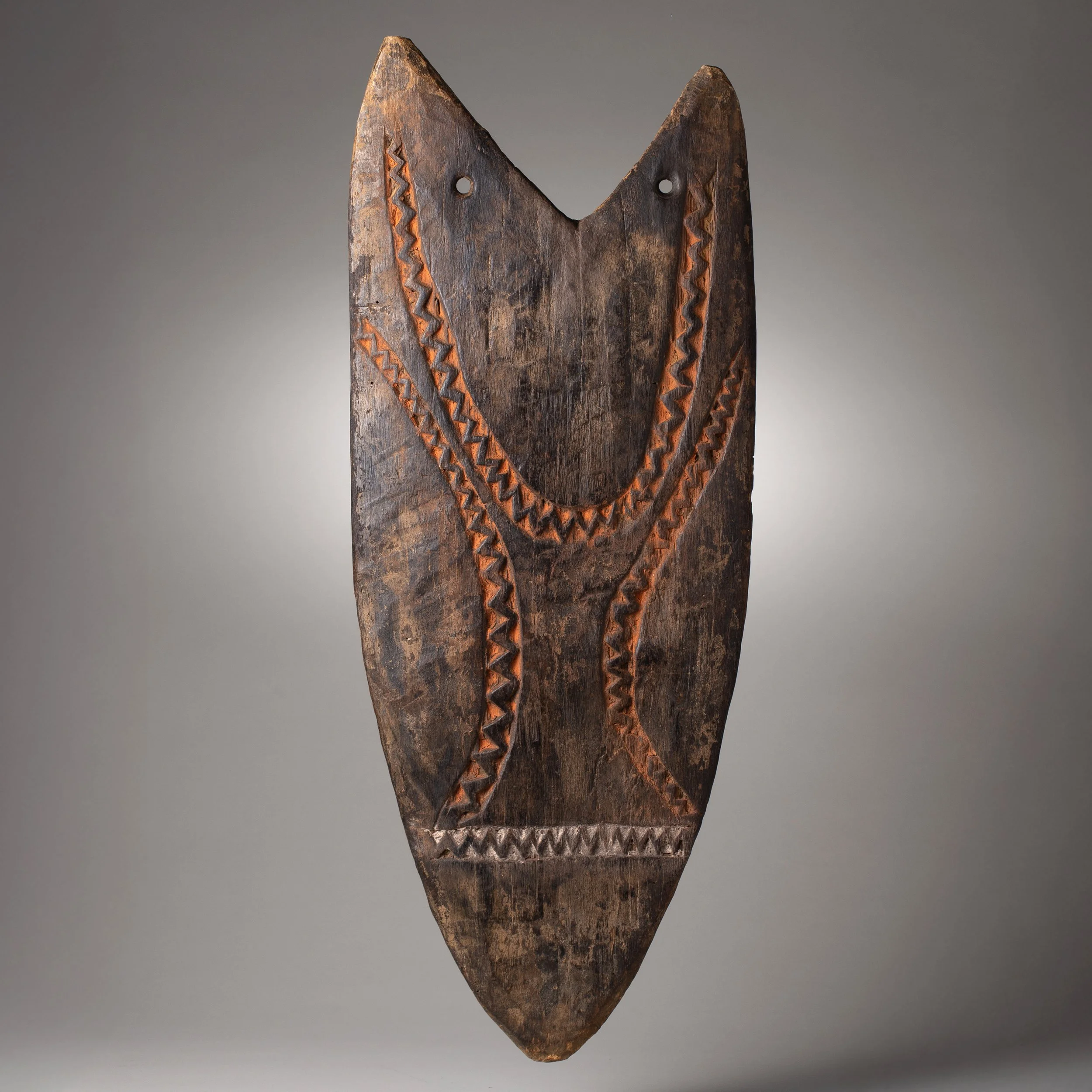
The eláyaborr is a small shoulder shield used by Mendi warriors of the Southern Highlands, designed to be slung under the arm in battle to protect the torso while leaving both hands free for bow and arrow. Its compact size and light weight made it suited to the close-range skirmishes and village raids that characterized inter-clan warfare in the Mendi Valley prior to European contact, and the U-shaped notch at the upper edge allowed an archer to sight through the gap when shooting. Australian anthropologist D'Arcy Ryan, who began fieldwork in the Mendi region in 1954, documented this shield type in detail, noting in Mankind (vol. 5, no. 6, October 1958) that the incised scoring may represent skin and body hair.
The surface is incised with a geometric composition, the triangular forms at the upper and lower registers filled with red mineral pigment that retains its color against the darkened wood ground. The shield was carved using stone tools, a technique consistent with the early 20th century dating and visible in the character of the incised lines. The overall form of the item, which is pointed at the base, notched at the crown, widest at the center, is resolved and purposeful, the design and structure working together as a single integrated object.
We ship free anywhere in the world, fully insured, packed by hand.
Mendi Valley, Southern Highlands, Papua New Guinea
Early 20th century; stone-carved
Wood, red mineral pigment
Width: 11 in (27.9 cm); Height: 28½ in (72.4 cm)
Provenance: Bruce Seamans, Bora Bora, French Polynesia
The eláyaborr is a small shoulder shield used by Mendi warriors of the Southern Highlands, designed to be slung under the arm in battle to protect the torso while leaving both hands free for bow and arrow. Its compact size and light weight made it suited to the close-range skirmishes and village raids that characterized inter-clan warfare in the Mendi Valley prior to European contact, and the U-shaped notch at the upper edge allowed an archer to sight through the gap when shooting. Australian anthropologist D'Arcy Ryan, who began fieldwork in the Mendi region in 1954, documented this shield type in detail, noting in Mankind (vol. 5, no. 6, October 1958) that the incised scoring may represent skin and body hair.
The surface is incised with a geometric composition, the triangular forms at the upper and lower registers filled with red mineral pigment that retains its color against the darkened wood ground. The shield was carved using stone tools, a technique consistent with the early 20th century dating and visible in the character of the incised lines. The overall form of the item, which is pointed at the base, notched at the crown, widest at the center, is resolved and purposeful, the design and structure working together as a single integrated object.
We ship free anywhere in the world, fully insured, packed by hand.