

 Image 1 of 3
 Image 2 of 3
 Image 3 of 3
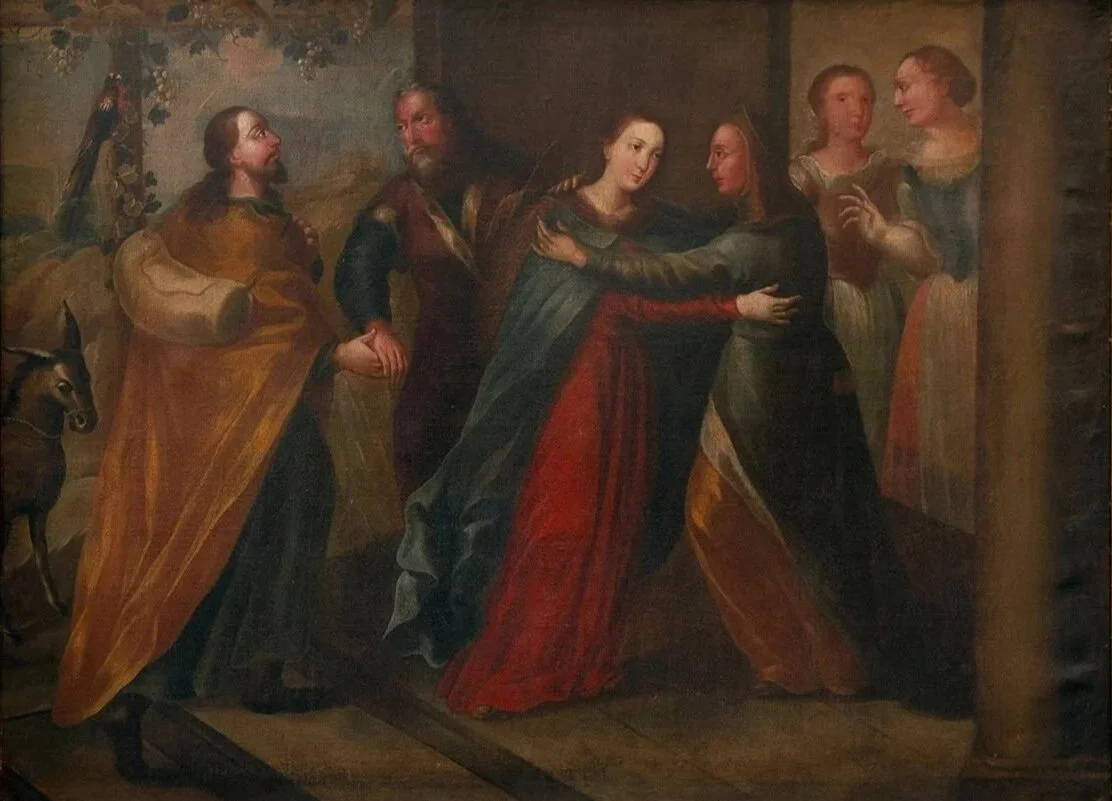
Mexican School
Circa 1820
Oil on canvas
Height 70" (177.8 cm); width 55" (139.7 cm) framed
Provenance: Private collection, Santa Fe, New Mexico
The Visitation depicts the Virgin Mary traveling to visit her cousin Elizabeth following the Annunciation, a scene drawn from the Gospel of Luke in which Elizabeth greets Mary with the words that would become part of the Hail Mary prayer. The subject was widely represented in Mexican Colonial painting as an expression of familial devotion, the recognition of the unborn Christ by the unborn John the Baptist, and the intimate bond between the two women chosen to carry figures central to Christian salvation. Large format devotional paintings of this type were produced for church altars, sacristies, and private chapels throughout New Spain.
The Mexican Colonial painting tradition of the early 19th century drew on established European Baroque compositional conventions while incorporating the expressive qualities and warm palette associated with indigenous workshop production. By circa 1820, the late colonial period was giving way to the early independence era, and large scale religious commissions continued to be produced for the substantial church and private patron networks that sustained the tradition across the transition. The scale of this canvas, at nearly six feet in height, is consistent with works produced for significant interior settings rather than portable devotion.
The Visitation as a subject carried particular resonance in New Spain, where Marian devotion was deeply woven into the spiritual life of both indigenous and mestizo communities, and the announcement of the Incarnation was understood as good news with universal rather than purely European significance. The Santa Fe provenance places this painting within a region with a long history of collecting Spanish Colonial devotional art. The large period frame and oil on canvas medium are consistent with the formal requirements of late colonial church and chapel commissions.
We ship free anywhere in the world, fully insured, packed by hand.
Mexican School
Circa 1820
Oil on canvas
Height 70" (177.8 cm); width 55" (139.7 cm) framed
Provenance: Private collection, Santa Fe, New Mexico
The Visitation depicts the Virgin Mary traveling to visit her cousin Elizabeth following the Annunciation, a scene drawn from the Gospel of Luke in which Elizabeth greets Mary with the words that would become part of the Hail Mary prayer. The subject was widely represented in Mexican Colonial painting as an expression of familial devotion, the recognition of the unborn Christ by the unborn John the Baptist, and the intimate bond between the two women chosen to carry figures central to Christian salvation. Large format devotional paintings of this type were produced for church altars, sacristies, and private chapels throughout New Spain.
The Mexican Colonial painting tradition of the early 19th century drew on established European Baroque compositional conventions while incorporating the expressive qualities and warm palette associated with indigenous workshop production. By circa 1820, the late colonial period was giving way to the early independence era, and large scale religious commissions continued to be produced for the substantial church and private patron networks that sustained the tradition across the transition. The scale of this canvas, at nearly six feet in height, is consistent with works produced for significant interior settings rather than portable devotion.
The Visitation as a subject carried particular resonance in New Spain, where Marian devotion was deeply woven into the spiritual life of both indigenous and mestizo communities, and the announcement of the Incarnation was understood as good news with universal rather than purely European significance. The Santa Fe provenance places this painting within a region with a long history of collecting Spanish Colonial devotional art. The large period frame and oil on canvas medium are consistent with the formal requirements of late colonial church and chapel commissions.
We ship free anywhere in the world, fully insured, packed by hand.