Navajo, Arizona or New Mexico
1920
Silver, leather
Six conchos, each 2 1/2 inches by 3 1/2 inches (6.4 by 8.9 cm)
Buckle 3 1/2 inches by 3 inches (8.9 by 7.6 cm)
Belt length 39 inches (99.1 cm)
472.06 grams
Provenance: Jim Owens, Corrales, New Mexico; Carl Lewis Druckman, New York
Publication: Robert Bauver, Navajo and Pueblo Jewelry and Metal 1880 to 1950, Four Winds Publishing, Pittsburgh, p. 15
Six rectangular conchos and a matching buckle are mounted on a black leather strap, each plaque stamped with four raised almond shaped bosses arranged around a central rosette, with whirling log devices punched into each corner and short barred motifs filling the intervals. The edges are worked with a scalloped border and an inner band of fine repeated punch work that frames the whole field. The silver is unset, the design carried entirely by stamping and repousse, and the surface has darkened in the recesses from long handling.
The whirling log is an ancient design element in Navajo weaving, sandpainting, and silverwork, where it carried associations with healing and with the movement of the four directions. It appears widely on jewelry made for the tourist and trade market in the first decades of the twentieth century and was abandoned by Navajo, Hopi, and Apache silversmiths in 1940, when a joint declaration renounced the symbol after its appropriation in Europe. Its presence here is a reliable indicator of a date before that year, and the belt is published in Bauver as an example of the period.
We ship free anywhere in the world, fully insured, packed by hand.
Navajo, Arizona or New Mexico
1920
Silver, leather
Six conchos, each 2 1/2 inches by 3 1/2 inches (6.4 by 8.9 cm)
Buckle 3 1/2 inches by 3 inches (8.9 by 7.6 cm)
Belt length 39 inches (99.1 cm)
472.06 grams
Provenance: Jim Owens, Corrales, New Mexico; Carl Lewis Druckman, New York
Publication: Robert Bauver, Navajo and Pueblo Jewelry and Metal 1880 to 1950, Four Winds Publishing, Pittsburgh, p. 15
Six rectangular conchos and a matching buckle are mounted on a black leather strap, each plaque stamped with four raised almond shaped bosses arranged around a central rosette, with whirling log devices punched into each corner and short barred motifs filling the intervals. The edges are worked with a scalloped border and an inner band of fine repeated punch work that frames the whole field. The silver is unset, the design carried entirely by stamping and repousse, and the surface has darkened in the recesses from long handling.
The whirling log is an ancient design element in Navajo weaving, sandpainting, and silverwork, where it carried associations with healing and with the movement of the four directions. It appears widely on jewelry made for the tourist and trade market in the first decades of the twentieth century and was abandoned by Navajo, Hopi, and Apache silversmiths in 1940, when a joint declaration renounced the symbol after its appropriation in Europe. Its presence here is a reliable indicator of a date before that year, and the belt is published in Bauver as an example of the period.
We ship free anywhere in the world, fully insured, packed by hand.


 Image 1 of 7
 Image 2 of 7
 Image 3 of 7
 Image 4 of 7
 Image 5 of 7
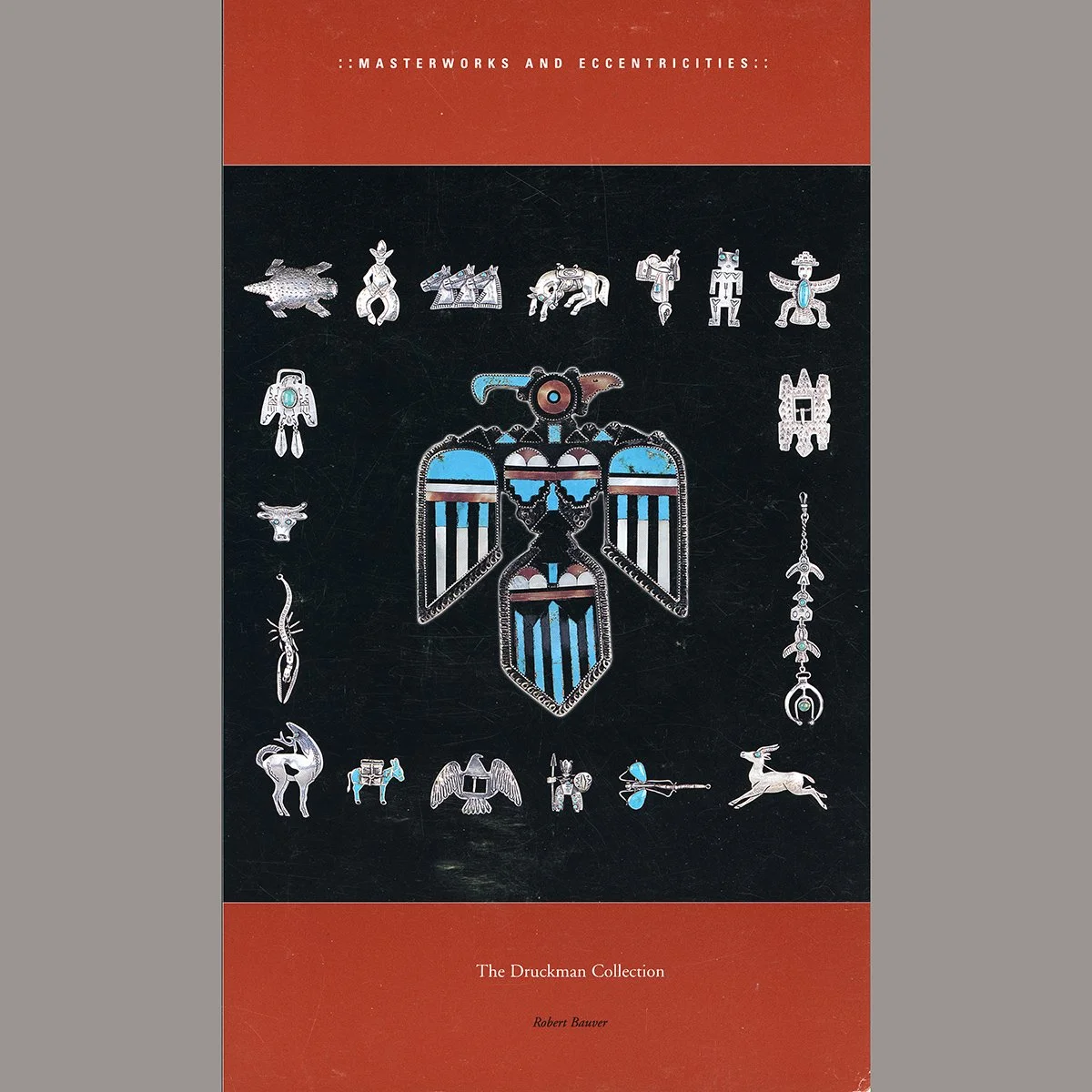 Image 6 of 7
 Image 7 of 7