

 Image 1 of 3
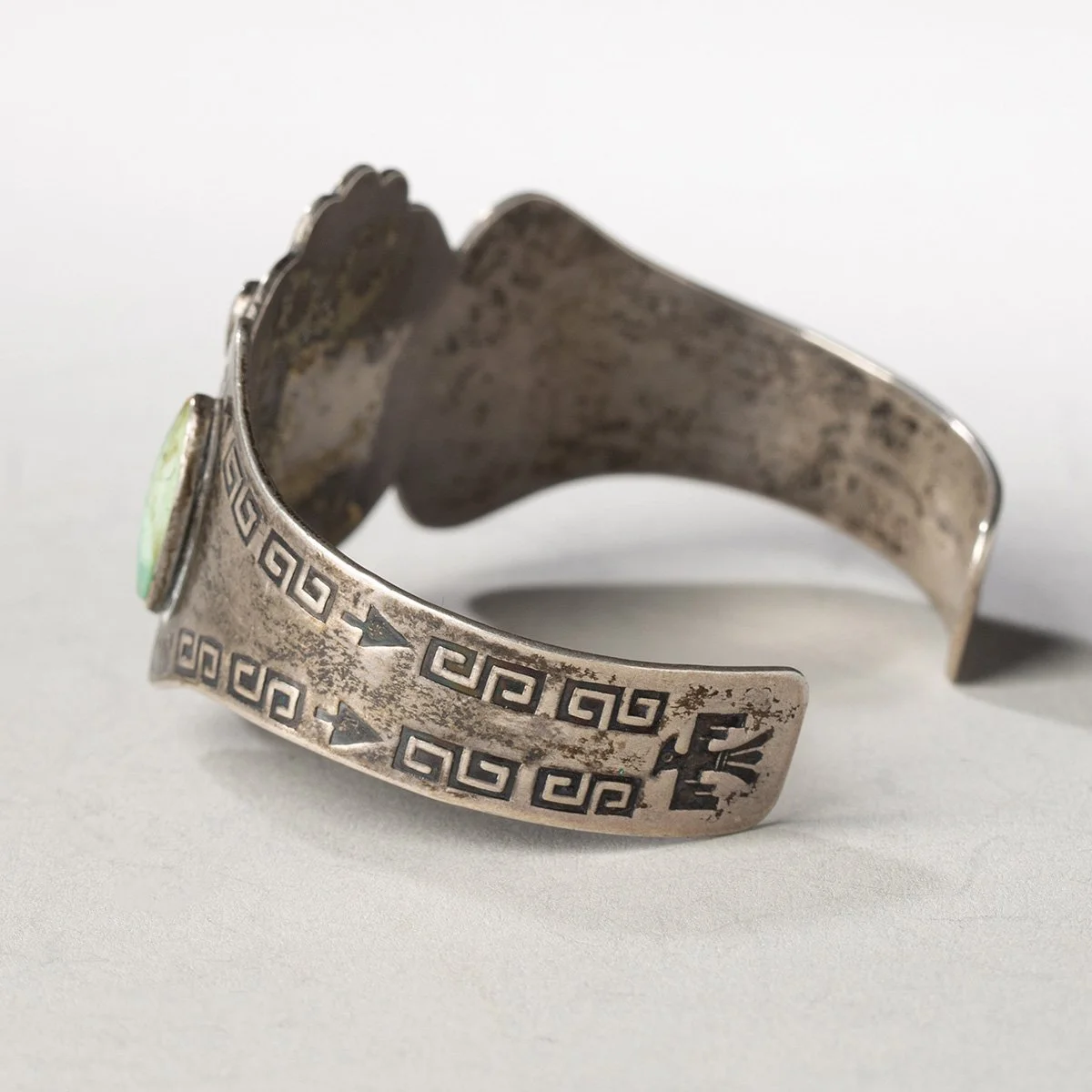 Image 2 of 3
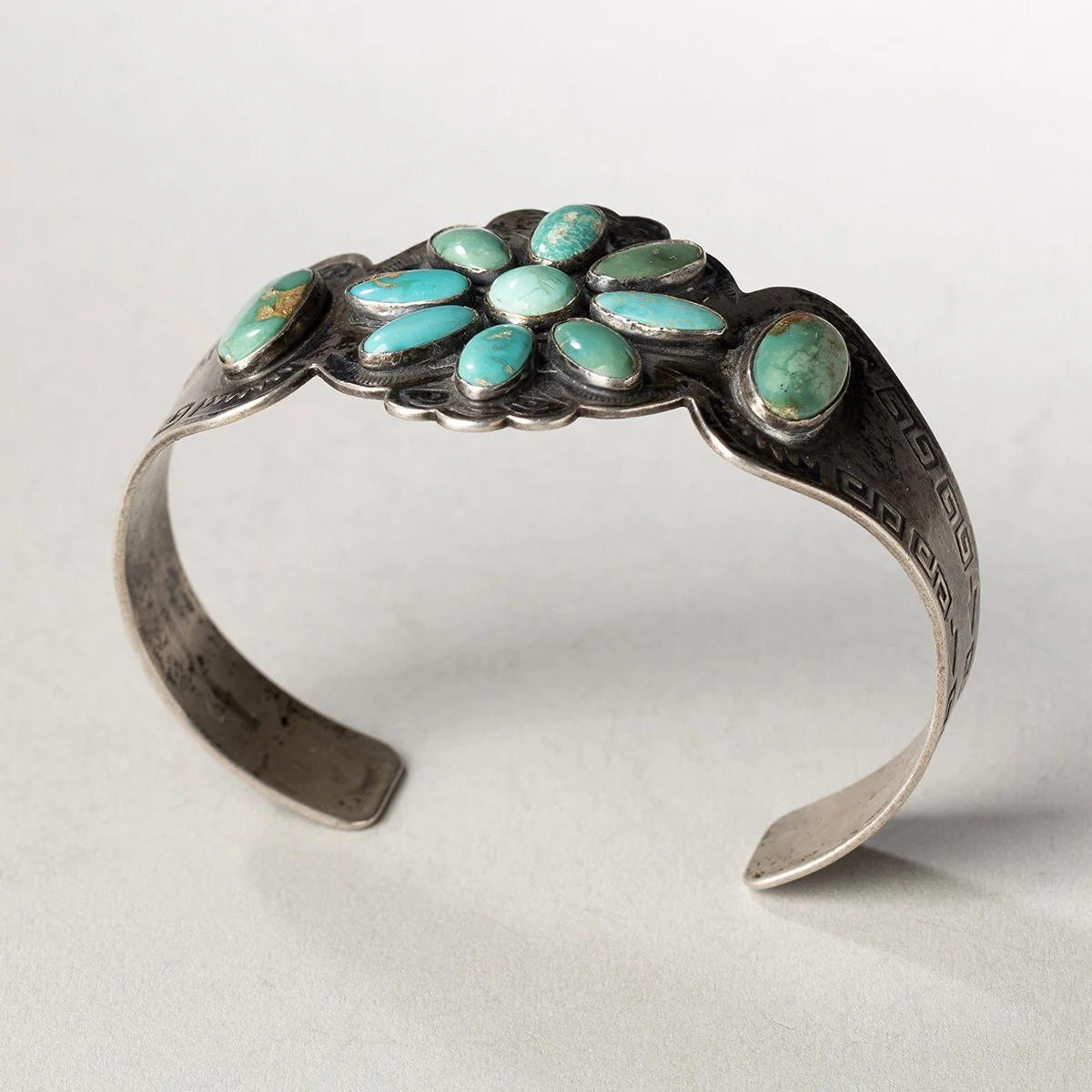 Image 3 of 3
Navajo
Southwest
1930s
Sterling silver with turquoise
Total circumference 7 1/4 in (18.4 cm), gap 1 1/4 in (3.2 cm), width 1 1/4 in (3.2 cm); 31.50 grams
Provenance: Tucson trade
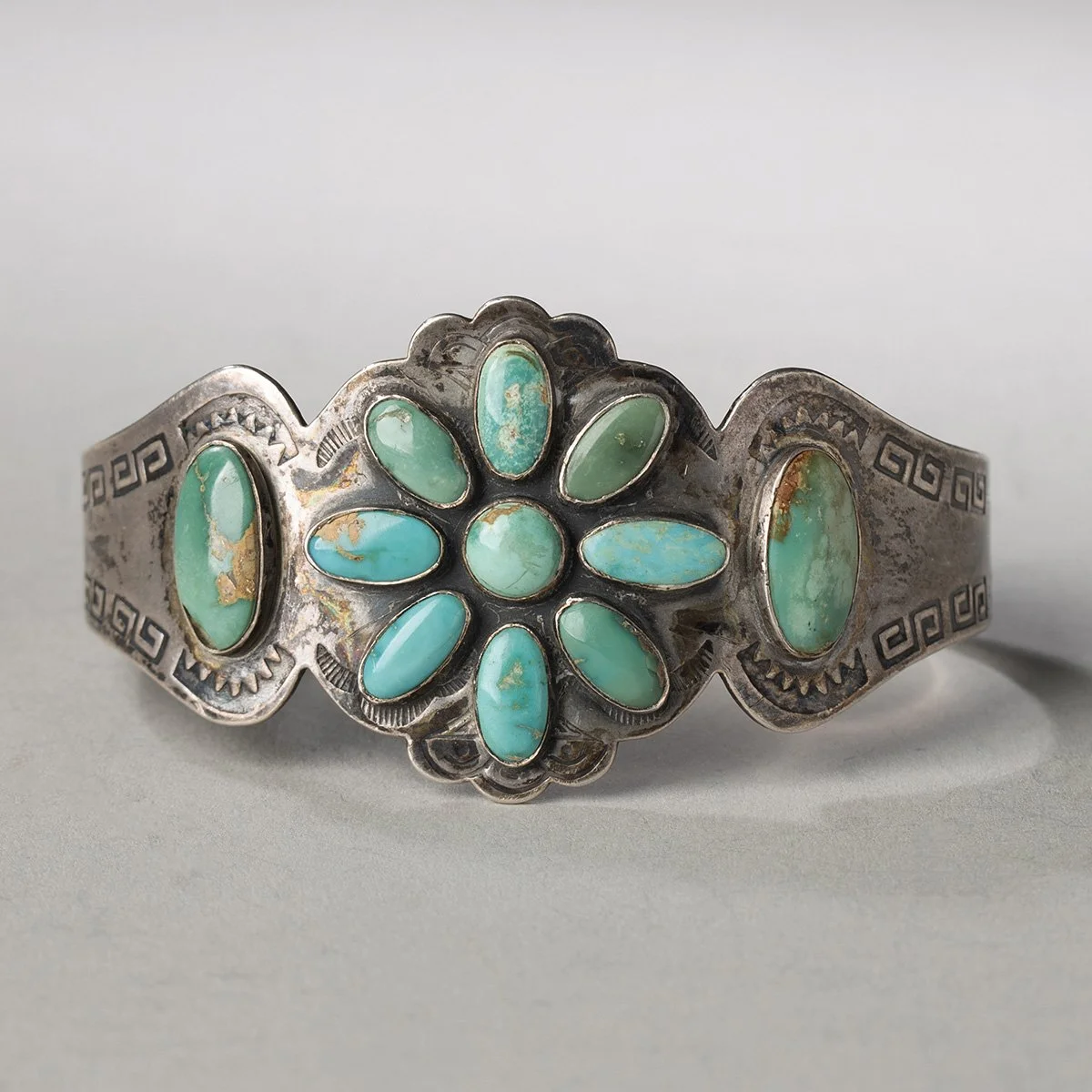
This Navajo cuff by Fred Peshlakai centers a turquoise cluster arranged as a flower, with oval and marquise cabochons radiating around a single round center stone. The turquoise runs from green to blue with light matrix, each stone in a plain bezel, set against a silver band deeply stamped with Greek key and geometric borders. The stamped ground and balanced rosette show the symmetry and careful setting for which Peshlakai is known.
The band widens at the center to carry the cluster, then narrows through the stamped shoulders to the shanks. At just over 31 grams the cuff has real presence while remaining comfortable to wear. It dates to the 1930s and reflects the high quality turquoise Peshlakai favored throughout his work.
Fred Peshlakai, 1896 to 1974, was a Navajo silversmith widely regarded as one of the most influential of the twentieth century, the bridge between the early Navajo smiths of the 1800s and the Native modernists who followed. Born at Crystal, New Mexico, he was the son of Slender Maker of Silver and apprenticed with his father before working briefly at Maisel's Trading Post in Albuquerque. He later opened a shop on Olvera Street in Los Angeles, where he worked for nearly twenty years and became the first Native American to run his own jewelry shop in the city. He taught Kenneth Begay, known as the Father of Modern Navajo Jewelry, and was among the first to emphasize symmetry and high quality turquoise in Navajo silverwork.
We ship free anywhere in the world, fully insured, packed by hand.
Navajo
Southwest
1930s
Sterling silver with turquoise
Total circumference 7 1/4 in (18.4 cm), gap 1 1/4 in (3.2 cm), width 1 1/4 in (3.2 cm); 31.50 grams
Provenance: Tucson trade
This Navajo cuff by Fred Peshlakai centers a turquoise cluster arranged as a flower, with oval and marquise cabochons radiating around a single round center stone. The turquoise runs from green to blue with light matrix, each stone in a plain bezel, set against a silver band deeply stamped with Greek key and geometric borders. The stamped ground and balanced rosette show the symmetry and careful setting for which Peshlakai is known.
The band widens at the center to carry the cluster, then narrows through the stamped shoulders to the shanks. At just over 31 grams the cuff has real presence while remaining comfortable to wear. It dates to the 1930s and reflects the high quality turquoise Peshlakai favored throughout his work.
Fred Peshlakai, 1896 to 1974, was a Navajo silversmith widely regarded as one of the most influential of the twentieth century, the bridge between the early Navajo smiths of the 1800s and the Native modernists who followed. Born at Crystal, New Mexico, he was the son of Slender Maker of Silver and apprenticed with his father before working briefly at Maisel's Trading Post in Albuquerque. He later opened a shop on Olvera Street in Los Angeles, where he worked for nearly twenty years and became the first Native American to run his own jewelry shop in the city. He taught Kenneth Begay, known as the Father of Modern Navajo Jewelry, and was among the first to emphasize symmetry and high quality turquoise in Navajo silverwork.
We ship free anywhere in the world, fully insured, packed by hand.