Pende, Democratic Republic of the Congo, 19th century
Wood
Height 6 inches (15.2 cm)
Provenance: Purchased 1966 from Royal Athena Galleries, Chicago; Lawrence Lohr, University of Michigan
The cup is carved as a head on a tall neck, the vessel opening at the crown and the whole standing inverted so that the face reads upright when the cup is set down. The forehead is high and domed, sweeping back into a coiffure worked in close parallel ridges that run from the brow over the crown to the nape, and the ears are set flat against the skull with the lobes pierced. Below a continuous arched browline the eyes are cut as heavy downcast lids, the nose runs narrow to a flattened tip, and the mouth is drawn small and turned down at the corners, the whole surface finished to a deep glossy black that has taken the light unevenly across the brow and the cheekbones where handling has worked it hardest.
Cups of this kind were used for palm wine among the Pende of the Kwilu and Kasai regions, held by titled men and used at gatherings where the vessel's carved head marked the standing of the drinker. The downcast lids beneath a single arched brow are the defining Pende facial convention, appearing in the same form on the mbuya masks and on ivory pendants, so the cup carries the full sculptural language rather than a simplified version of it. The surface is even and hard rather than dry, built up from long use with liquid and from the hand rather than from any applied finish.
We ship free anywhere in the world, fully insured, packed by hand.
Pende, Democratic Republic of the Congo, 19th century
Wood
Height 6 inches (15.2 cm)
Provenance: Purchased 1966 from Royal Athena Galleries, Chicago; Lawrence Lohr, University of Michigan
The cup is carved as a head on a tall neck, the vessel opening at the crown and the whole standing inverted so that the face reads upright when the cup is set down. The forehead is high and domed, sweeping back into a coiffure worked in close parallel ridges that run from the brow over the crown to the nape, and the ears are set flat against the skull with the lobes pierced. Below a continuous arched browline the eyes are cut as heavy downcast lids, the nose runs narrow to a flattened tip, and the mouth is drawn small and turned down at the corners, the whole surface finished to a deep glossy black that has taken the light unevenly across the brow and the cheekbones where handling has worked it hardest.
Cups of this kind were used for palm wine among the Pende of the Kwilu and Kasai regions, held by titled men and used at gatherings where the vessel's carved head marked the standing of the drinker. The downcast lids beneath a single arched brow are the defining Pende facial convention, appearing in the same form on the mbuya masks and on ivory pendants, so the cup carries the full sculptural language rather than a simplified version of it. The surface is even and hard rather than dry, built up from long use with liquid and from the hand rather than from any applied finish.
We ship free anywhere in the world, fully insured, packed by hand.


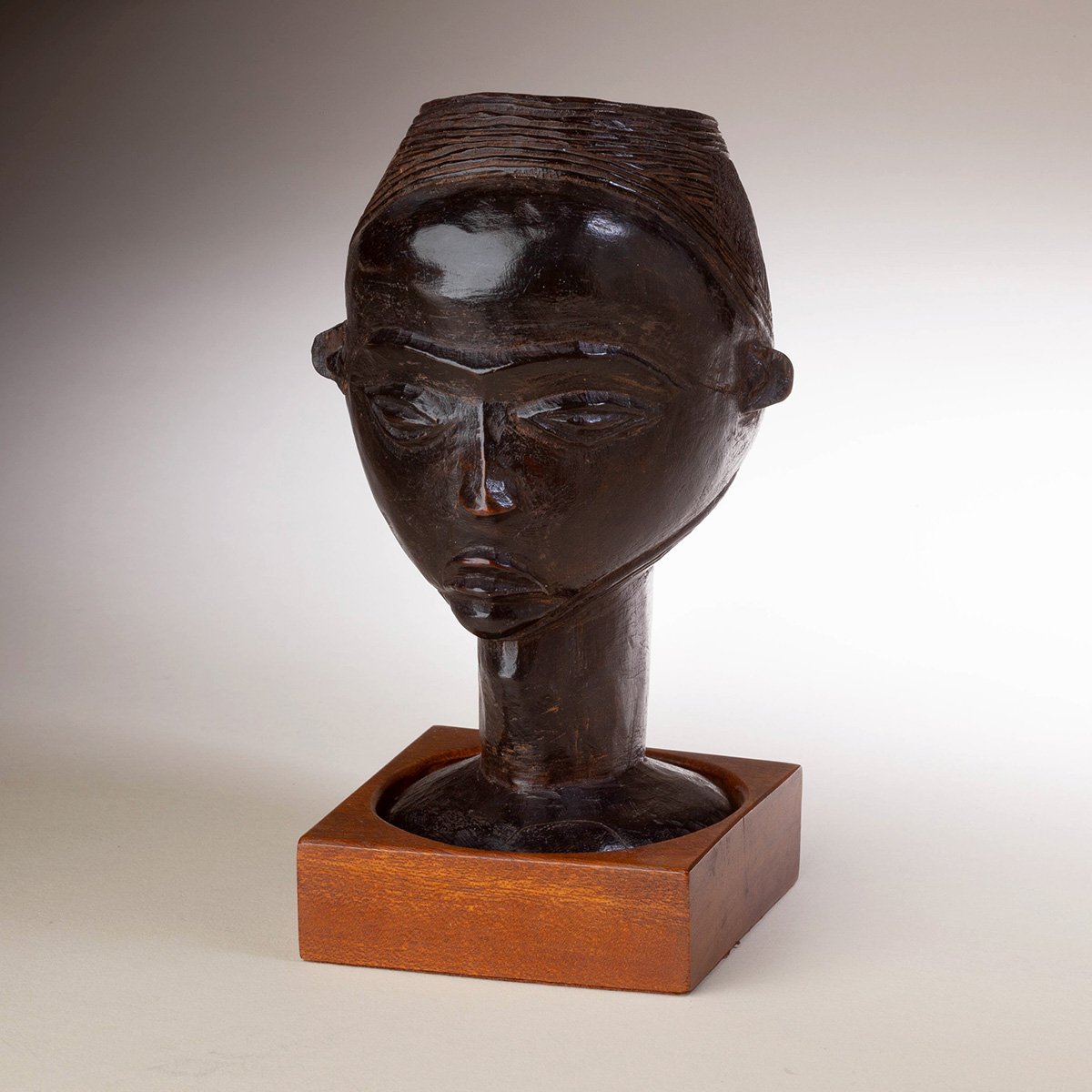 Image 1 of 11
 Image 2 of 11
 Image 3 of 11
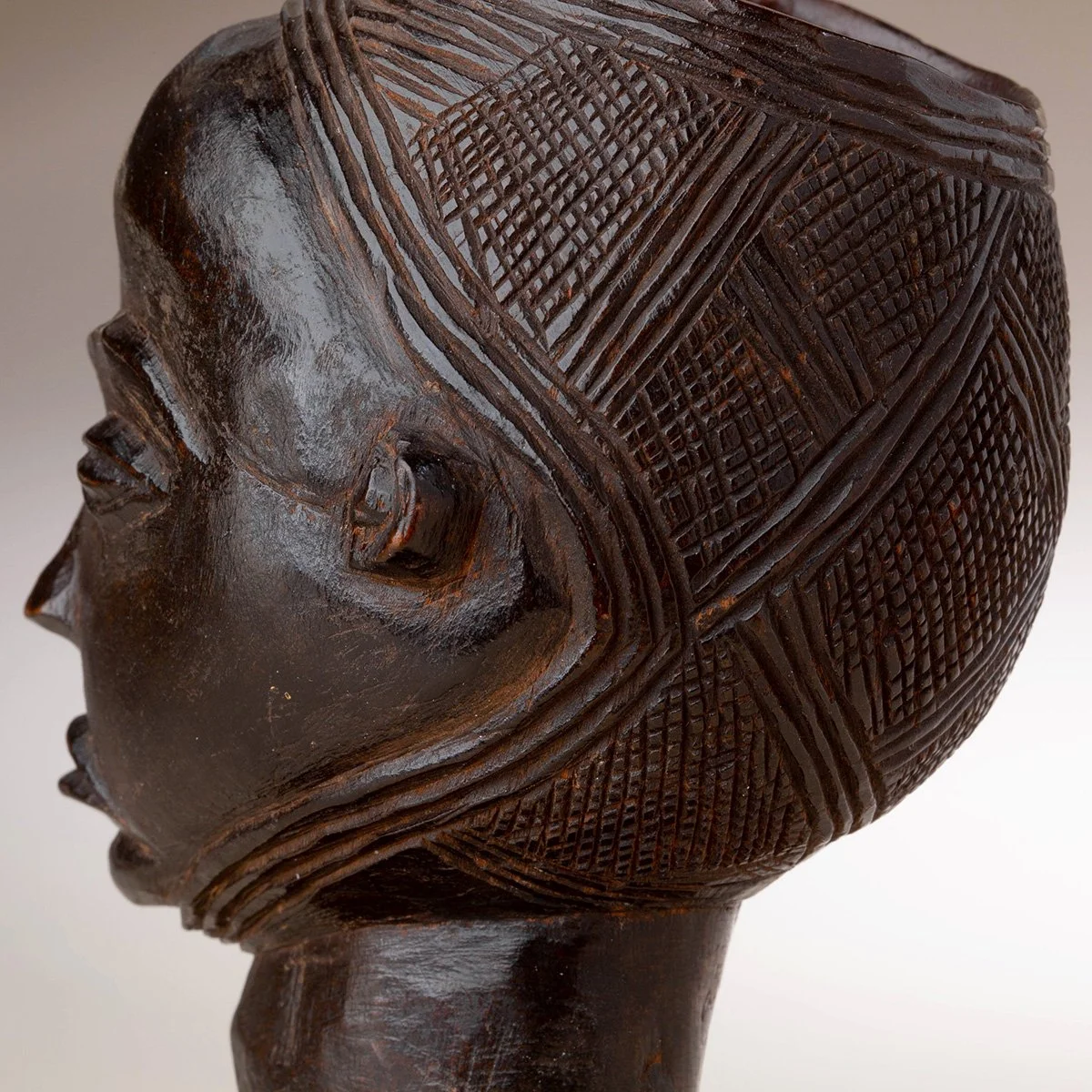 Image 4 of 11
 Image 5 of 11
 Image 6 of 11
 Image 7 of 11
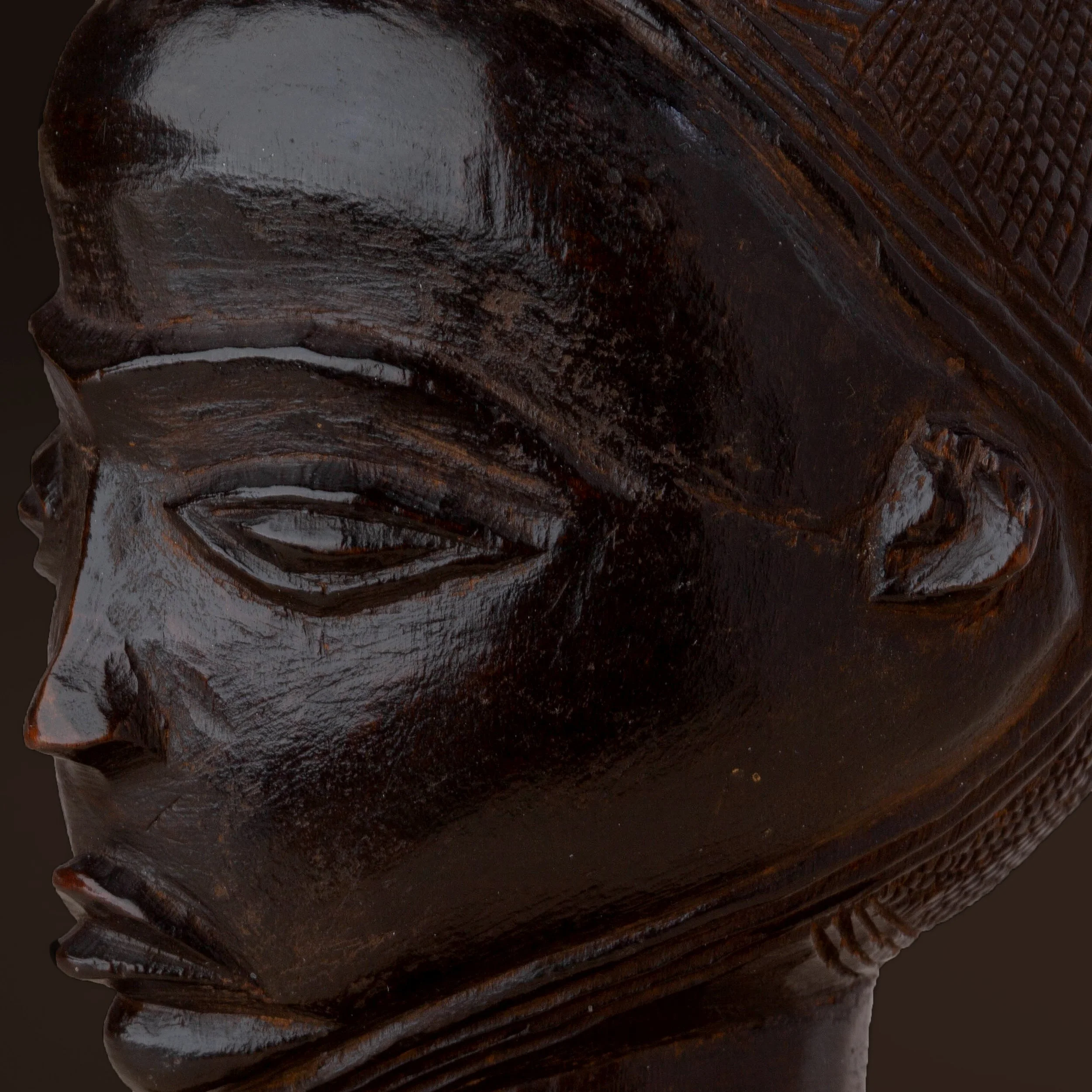 Image 8 of 11
 Image 9 of 11
 Image 10 of 11
 Image 11 of 11