

 Image 1 of 4
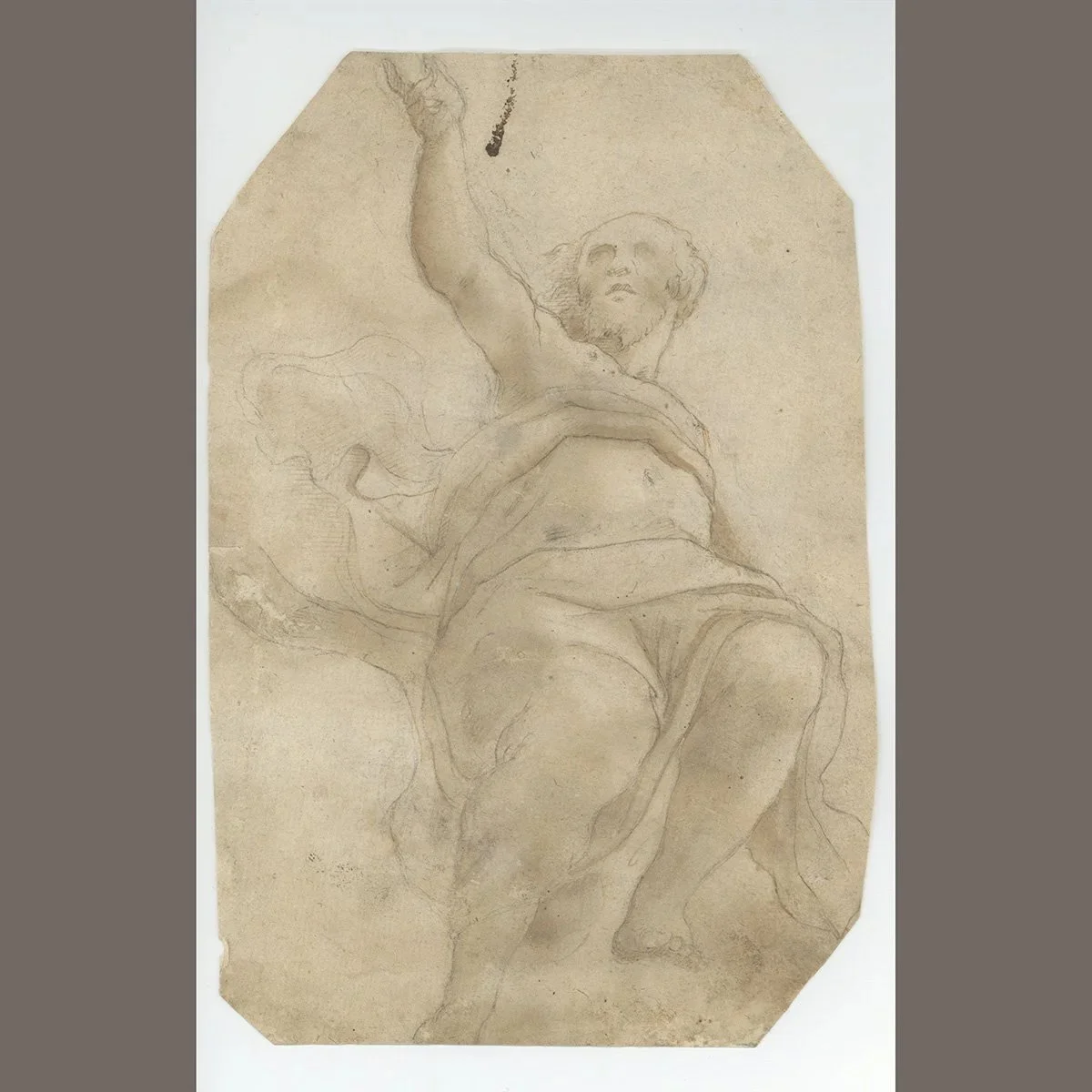 Image 2 of 4
 Image 3 of 4
 Image 4 of 4
Bolognese or Roman, 17th century
Red chalk on laid paper
5 1/4 x 8 inches (13.3 x 20.3 cm)
Provenance: Private collection, Massachusetts
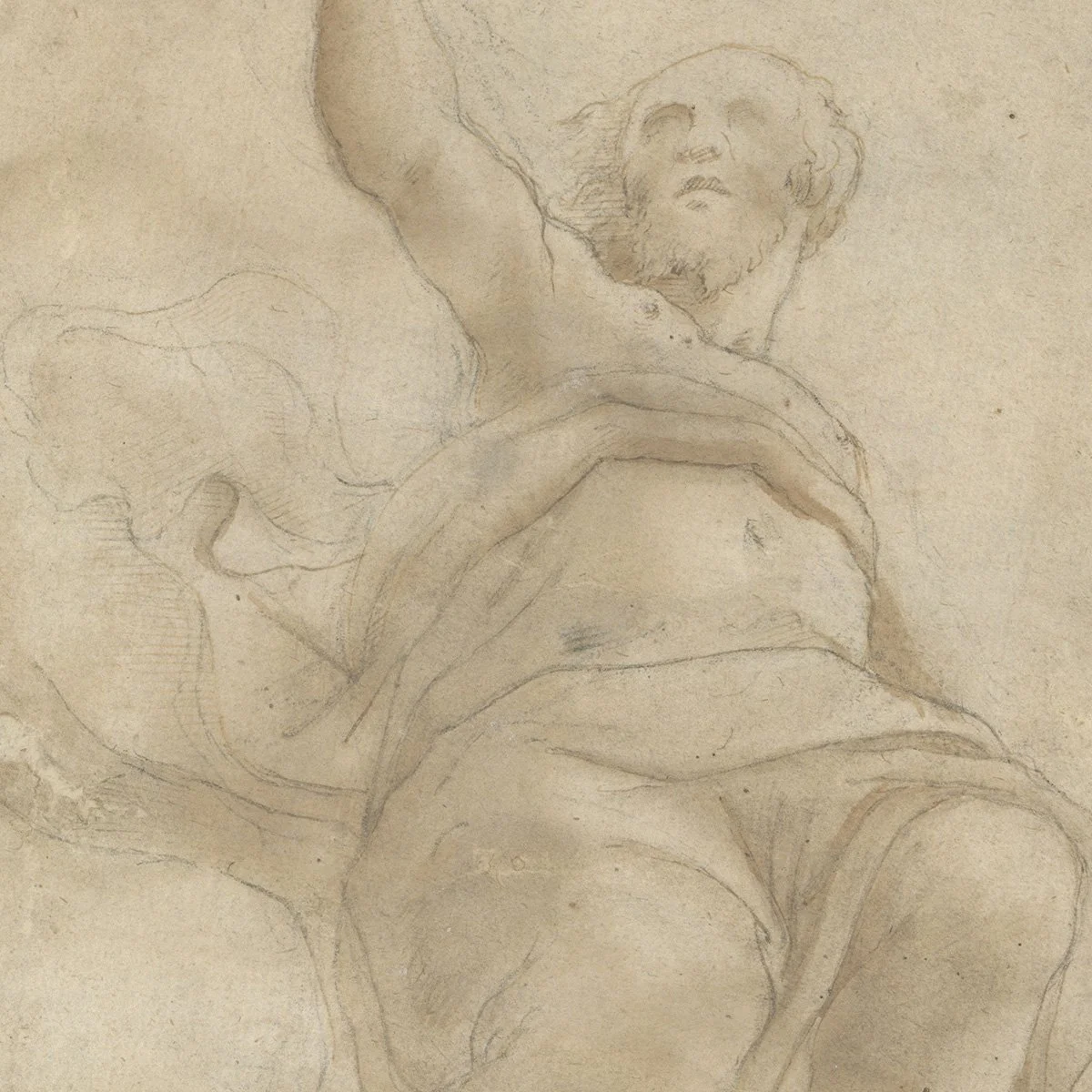
The figure reclines with the torso twisted back and the head thrown up so the face is seen from below, one arm extended above and beyond the top edge of the sheet while the other falls away to the left. Drapery gathers across the hips and thighs in long looping folds, drawn with a light open contour and then worked up with parallel hatching along the underside of the limbs and in the hollows of the cloth. The chalk is handled at two pressures throughout, a faint searching line laid down first and a firmer one committed over it, and the sheet has been cut with the corners canted off, leaving a small area of loss at the lower left and a spot of darker staining near the upper edge.
Figures of this kind were studied from a posed model for placement in a larger composition, most often a ceiling or an altarpiece where the viewer would see the figure from below, which accounts for the foreshortening of the head and the raised arm running out of the sheet. The Bolognese and Roman academies of the seventeenth century both trained draughtsmen in this manner, and red chalk was the standard medium for the figure study, valued for the range of tone it gives under varied pressure. Sheets like this one survive detached from their compositions, so the drawing stands as a record of working method rather than of a finished design.
We ship free anywhere in the world, fully insured, packed by hand.
Bolognese or Roman, 17th century
Red chalk on laid paper
5 1/4 x 8 inches (13.3 x 20.3 cm)
Provenance: Private collection, Massachusetts
The figure reclines with the torso twisted back and the head thrown up so the face is seen from below, one arm extended above and beyond the top edge of the sheet while the other falls away to the left. Drapery gathers across the hips and thighs in long looping folds, drawn with a light open contour and then worked up with parallel hatching along the underside of the limbs and in the hollows of the cloth. The chalk is handled at two pressures throughout, a faint searching line laid down first and a firmer one committed over it, and the sheet has been cut with the corners canted off, leaving a small area of loss at the lower left and a spot of darker staining near the upper edge.
Figures of this kind were studied from a posed model for placement in a larger composition, most often a ceiling or an altarpiece where the viewer would see the figure from below, which accounts for the foreshortening of the head and the raised arm running out of the sheet. The Bolognese and Roman academies of the seventeenth century both trained draughtsmen in this manner, and red chalk was the standard medium for the figure study, valued for the range of tone it gives under varied pressure. Sheets like this one survive detached from their compositions, so the drawing stands as a record of working method rather than of a finished design.
We ship free anywhere in the world, fully insured, packed by hand.