

 Image 1 of 2
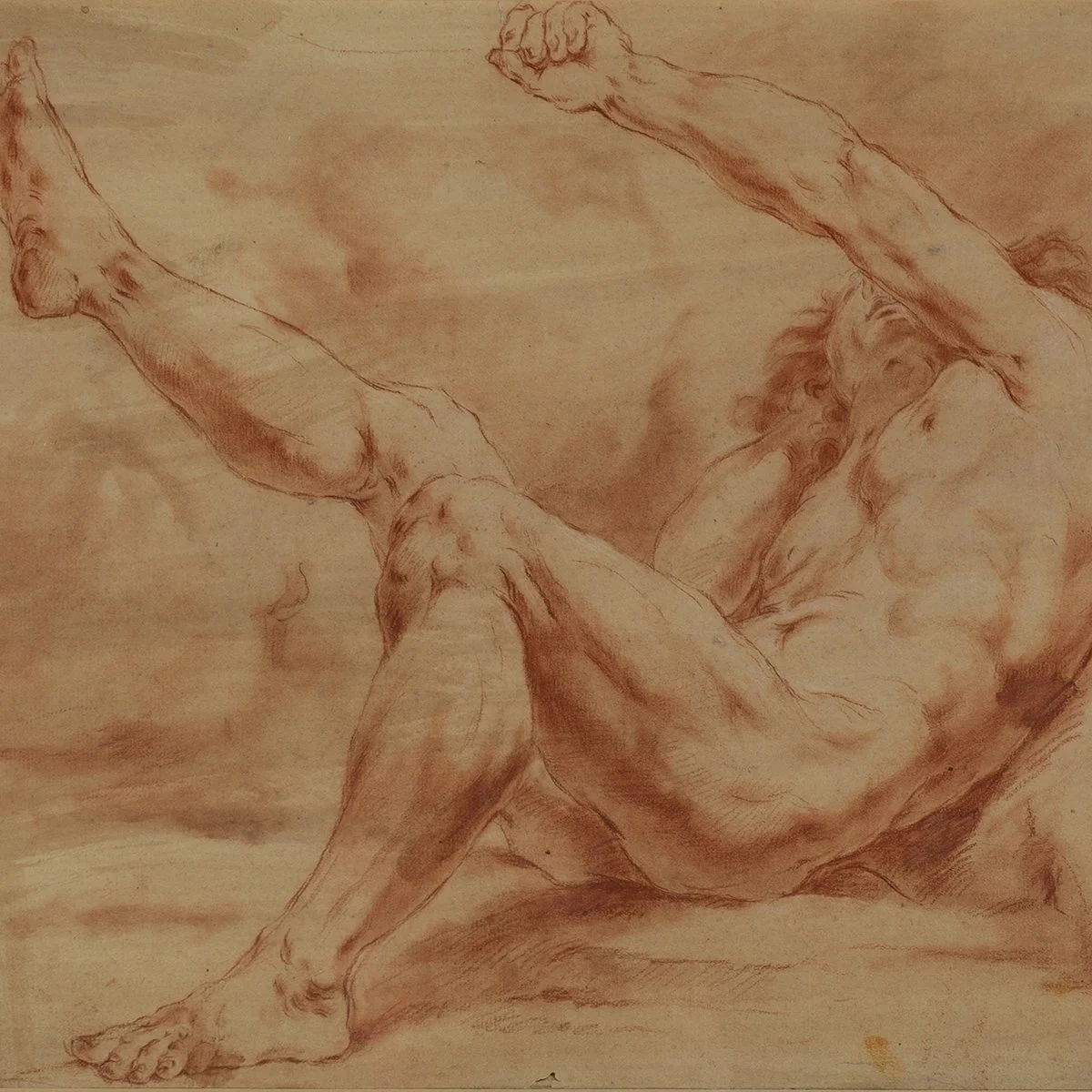 Image 2 of 2
Italian School, Bolognese or Roman
17th century
Red chalk on paper
Height 19 inches (48.3 cm), width 21 1/2 inches (54.6 cm)
Provenance: Private collection, Massachusetts
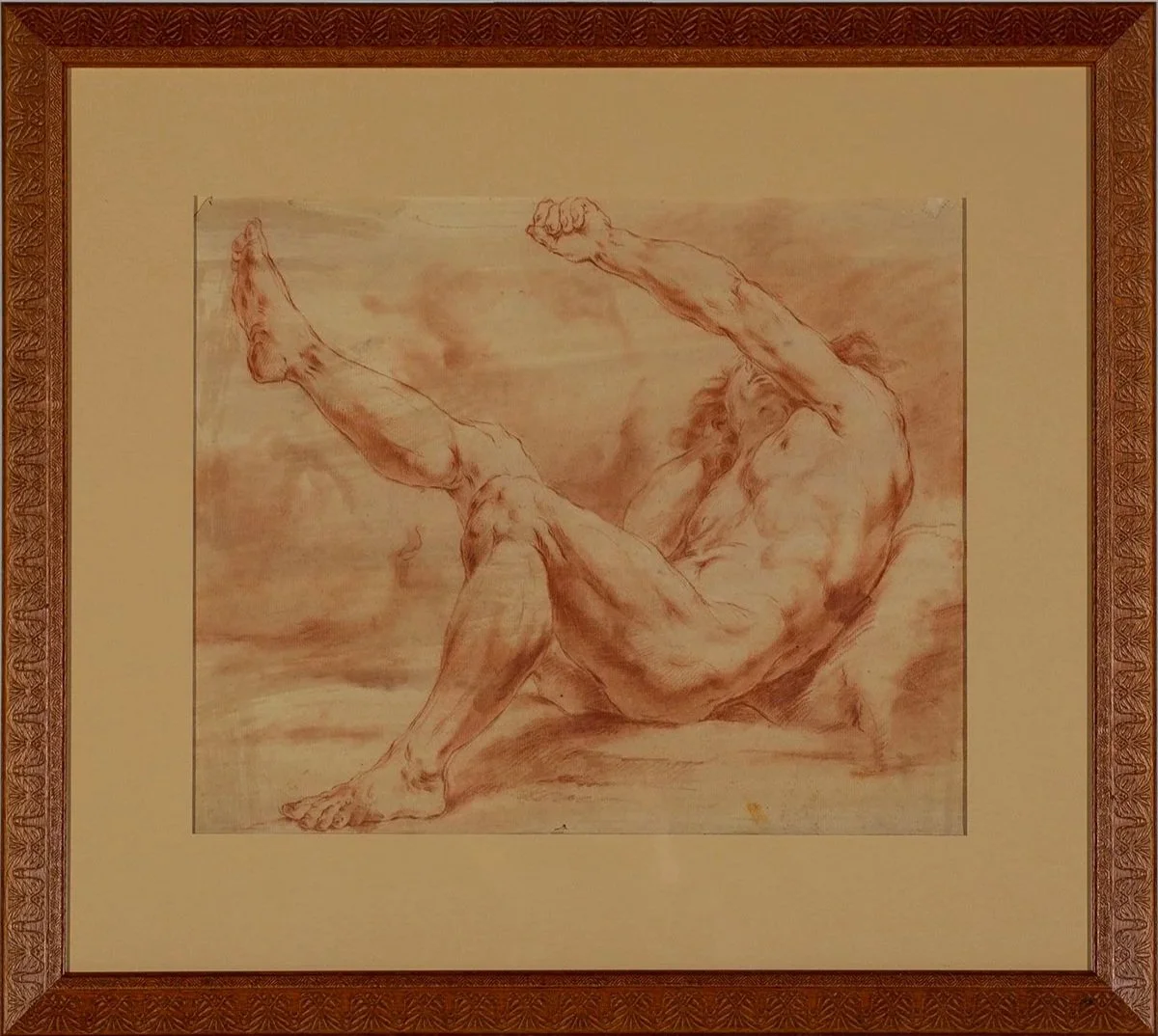
A nude male figure lies back across the sheet, the torso twisted so the chest turns upward while the hips roll away, one arm flung out and above the head with the hand closed into a fist. The legs are carried toward the viewer in steep foreshortening, the near foot rising almost to the top edge, and the whole weight of the body is thrown onto the shoulder and the far hip. The chalk is worked in long parallel strokes over the large forms and pressed harder into the hollows of the ribs, the knee, and the underside of the arm, with the lighter passages left as the tone of the paper itself.
Studies of this kind were made from the posed model in the academies of Bologna and Rome, where drawing from life was the foundation of a painter's training and sheets like this one were kept and reused as figures were worked into larger compositions. The pose, with the body falling and the arm thrown up, belongs to the vocabulary of martyrdoms, battle scenes, and ceiling schemes in which figures tumble through space. The handling of the chalk places the sheet within the Carracci tradition that dominated Bolognese practice through the seventeenth century.
We ship free anywhere in the world, fully insured, packed by hand.
Italian School, Bolognese or Roman
17th century
Red chalk on paper
Height 19 inches (48.3 cm), width 21 1/2 inches (54.6 cm)
Provenance: Private collection, Massachusetts
A nude male figure lies back across the sheet, the torso twisted so the chest turns upward while the hips roll away, one arm flung out and above the head with the hand closed into a fist. The legs are carried toward the viewer in steep foreshortening, the near foot rising almost to the top edge, and the whole weight of the body is thrown onto the shoulder and the far hip. The chalk is worked in long parallel strokes over the large forms and pressed harder into the hollows of the ribs, the knee, and the underside of the arm, with the lighter passages left as the tone of the paper itself.
Studies of this kind were made from the posed model in the academies of Bologna and Rome, where drawing from life was the foundation of a painter's training and sheets like this one were kept and reused as figures were worked into larger compositions. The pose, with the body falling and the arm thrown up, belongs to the vocabulary of martyrdoms, battle scenes, and ceiling schemes in which figures tumble through space. The handling of the chalk places the sheet within the Carracci tradition that dominated Bolognese practice through the seventeenth century.
We ship free anywhere in the world, fully insured, packed by hand.