

 Image 1 of 3
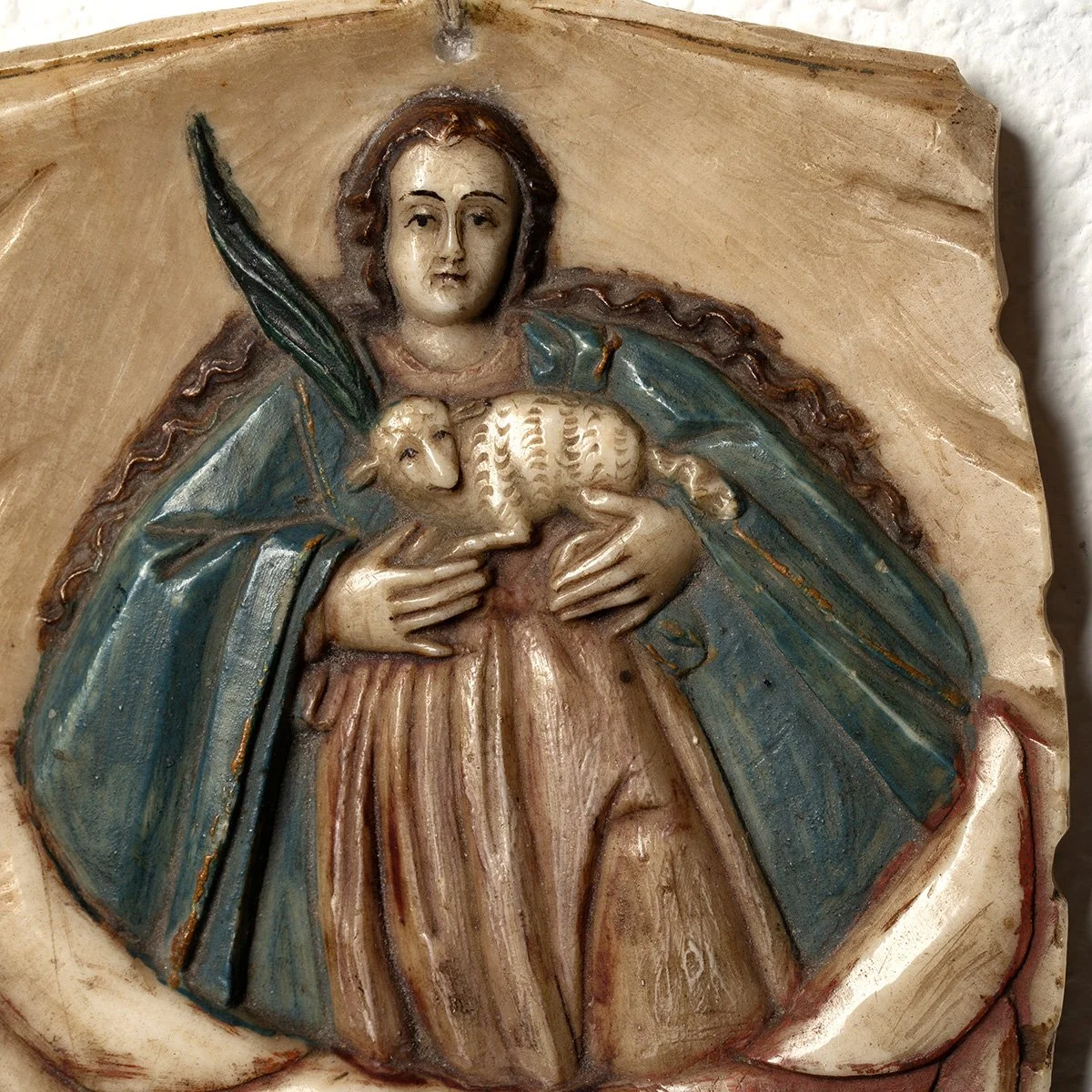 Image 2 of 3
 Image 3 of 3
Peru
18th century
Carved and polychromed Huamanga stone
4 3/4 x 6 3/4 inches (12.1 x 17.1 cm)
Provenance: London trade
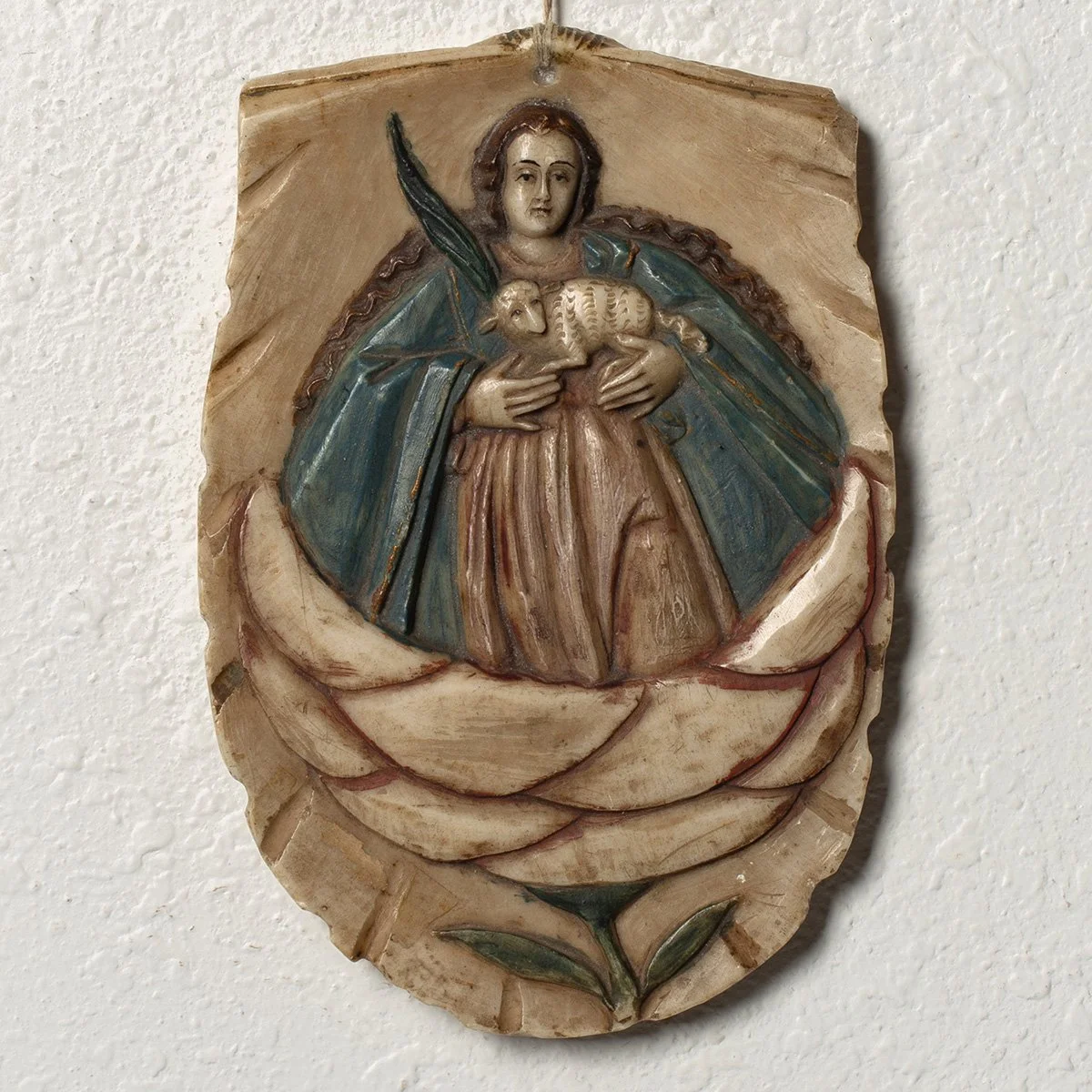
A relief plaque carved from pale Huamanga stone and painted, showing Saint Agnes standing with a lamb held in both arms across her body and a palm frond rising behind her right shoulder. She wears a rose robe under a deep blue mantle that falls open in long folds to either side, her hair loose to the shoulders, and the whole figure is set within a carved rose whose petals wrap up around her at the base and open behind her like a shell. The stone takes the color softly, the blue and rose worked over the pale ground with the carved detail of the drapery and the lamb's fleece left to catch the light.
Saint Agnes is identified by the lamb, from the Latin agnus, and by the palm frond carried as the sign of a martyr. The rose enclosing her refers to the roses said to have appeared at her grave, and the softness of the modeling is characteristic of Huamanga carving, a Peruvian tradition worked in the translucent alabaster quarried near Ayacucho and used for devotional figures from the colonial period onward.
We ship free anywhere in the world, fully insured, packed by hand.
Peru
18th century
Carved and polychromed Huamanga stone
4 3/4 x 6 3/4 inches (12.1 x 17.1 cm)
Provenance: London trade
A relief plaque carved from pale Huamanga stone and painted, showing Saint Agnes standing with a lamb held in both arms across her body and a palm frond rising behind her right shoulder. She wears a rose robe under a deep blue mantle that falls open in long folds to either side, her hair loose to the shoulders, and the whole figure is set within a carved rose whose petals wrap up around her at the base and open behind her like a shell. The stone takes the color softly, the blue and rose worked over the pale ground with the carved detail of the drapery and the lamb's fleece left to catch the light.
Saint Agnes is identified by the lamb, from the Latin agnus, and by the palm frond carried as the sign of a martyr. The rose enclosing her refers to the roses said to have appeared at her grave, and the softness of the modeling is characteristic of Huamanga carving, a Peruvian tradition worked in the translucent alabaster quarried near Ayacucho and used for devotional figures from the colonial period onward.
We ship free anywhere in the world, fully insured, packed by hand.