

 Image 1 of 2
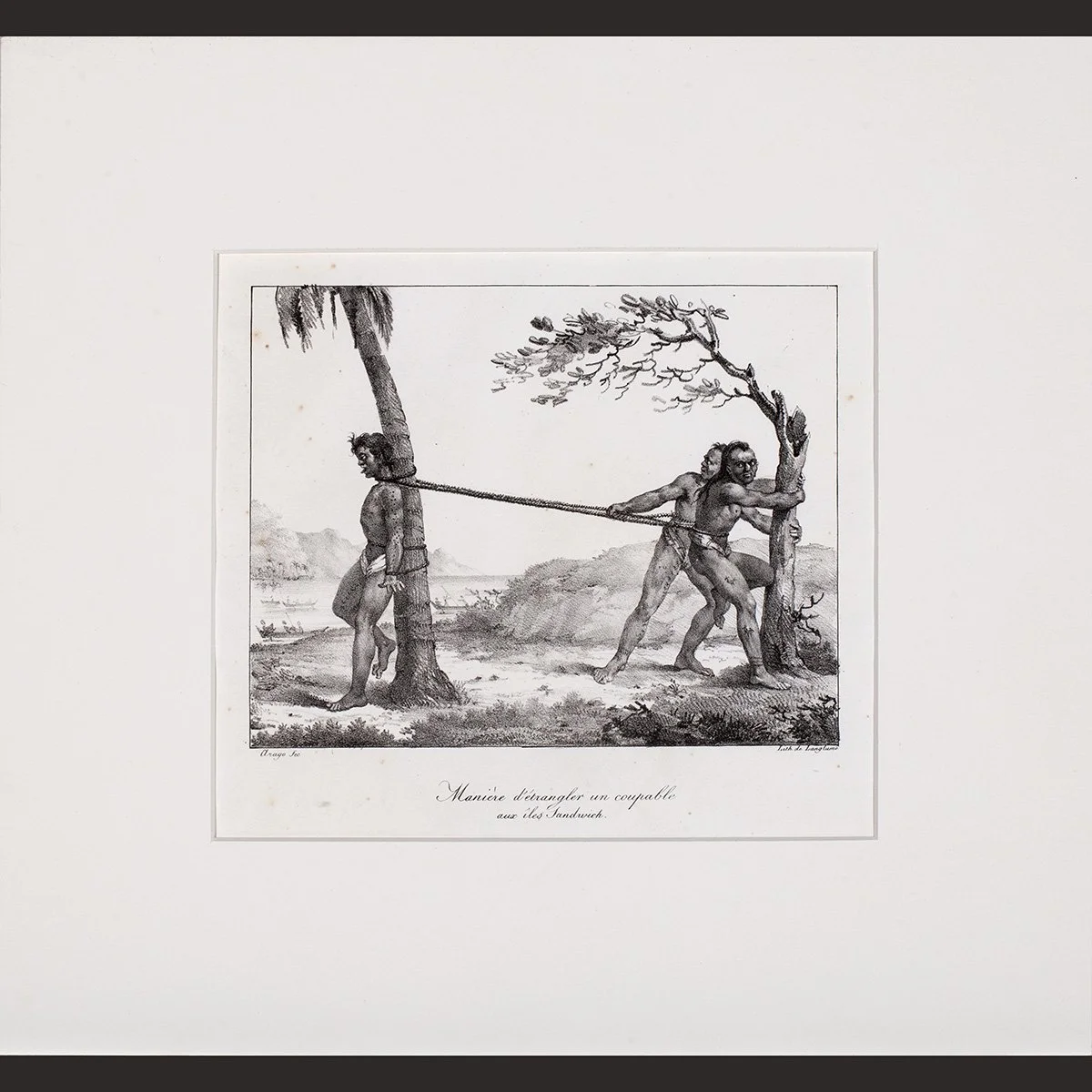 Image 2 of 2
Hawaiian Islands / Sandwich Islands
Paris, 1822
Lithograph by Jacques Arago, Lith. de Langlamé
Mat: 14 × 15 in. (35.6 × 38.1 cm); image: 8 × 9 in. (20.3 × 22.9 cm)
Provenance: John Dominis Holt, Honolulu, HI
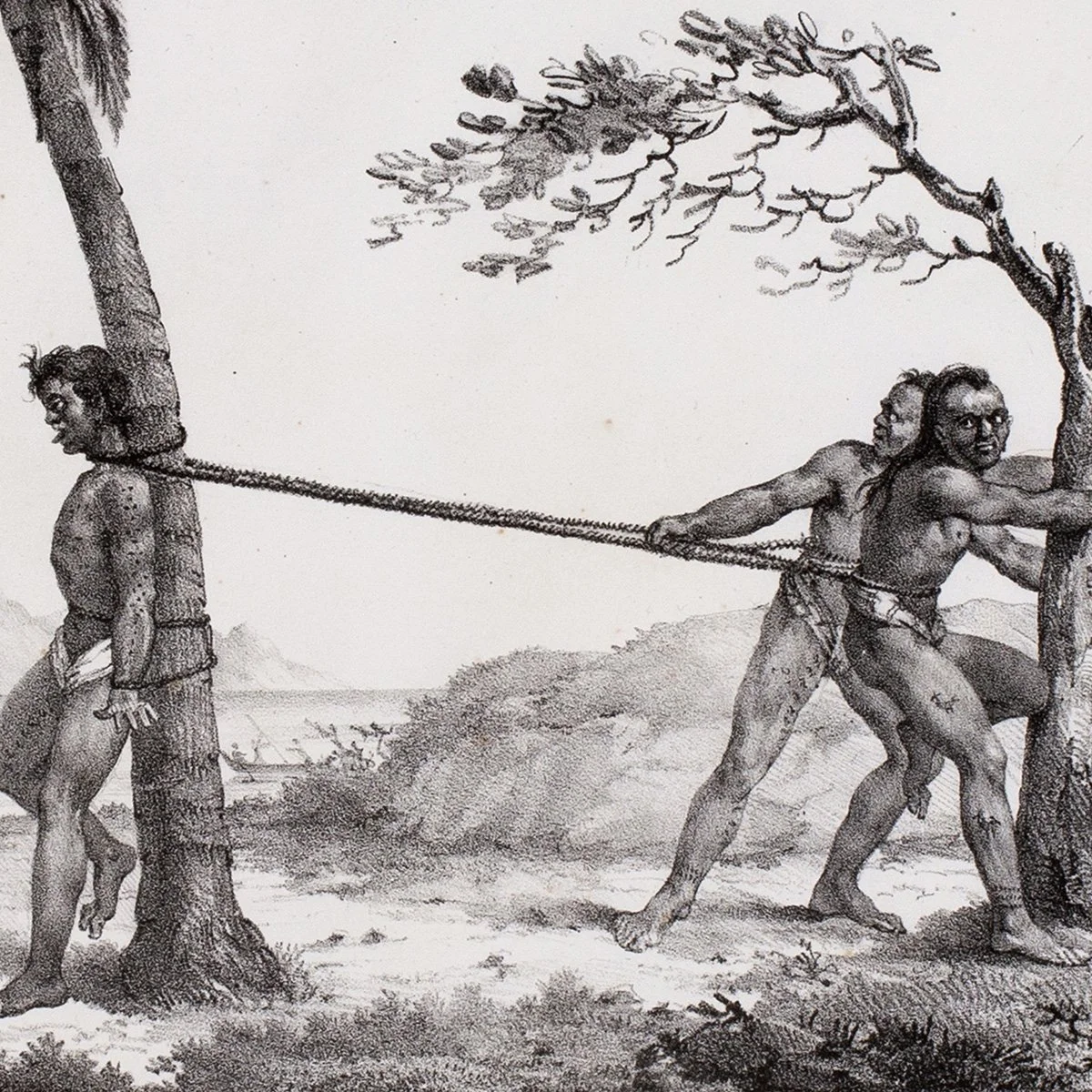
This lithograph records an early nineteenth-century European view of a Hawaiian execution by strangulation, identified in French as Manière d’étrangler un coupable aux Îles Sandwich. It was published in Jacques Arago’s account of Louis de Freycinet’s circumnavigation aboard the corvettes Uranie and Physicienne. The expedition entered the Pacific to undertake scientific observations in geography, magnetism, and meteorology, visiting the Hawaiian Islands, Australia, Tonga, and Tierra del Fuego.
Arago served as artist on the voyage, producing images that translated observed and reported scenes into printed form for a European audience. The composition is direct and stark, with the figures placed in a landscape setting and the act of punishment shown without decorative framing. As a voyage lithograph, it belongs to the wider printed record through which nineteenth-century European readers encountered Hawaiian society and the Pacific world.
We ship free anywhere in the world, fully insured, packed by hand.
Hawaiian Islands / Sandwich Islands
Paris, 1822
Lithograph by Jacques Arago, Lith. de Langlamé
Mat: 14 × 15 in. (35.6 × 38.1 cm); image: 8 × 9 in. (20.3 × 22.9 cm)
Provenance: John Dominis Holt, Honolulu, HI
This lithograph records an early nineteenth-century European view of a Hawaiian execution by strangulation, identified in French as Manière d’étrangler un coupable aux Îles Sandwich. It was published in Jacques Arago’s account of Louis de Freycinet’s circumnavigation aboard the corvettes Uranie and Physicienne. The expedition entered the Pacific to undertake scientific observations in geography, magnetism, and meteorology, visiting the Hawaiian Islands, Australia, Tonga, and Tierra del Fuego.
Arago served as artist on the voyage, producing images that translated observed and reported scenes into printed form for a European audience. The composition is direct and stark, with the figures placed in a landscape setting and the act of punishment shown without decorative framing. As a voyage lithograph, it belongs to the wider printed record through which nineteenth-century European readers encountered Hawaiian society and the Pacific world.
We ship free anywhere in the world, fully insured, packed by hand.