

 Image 1 of 2
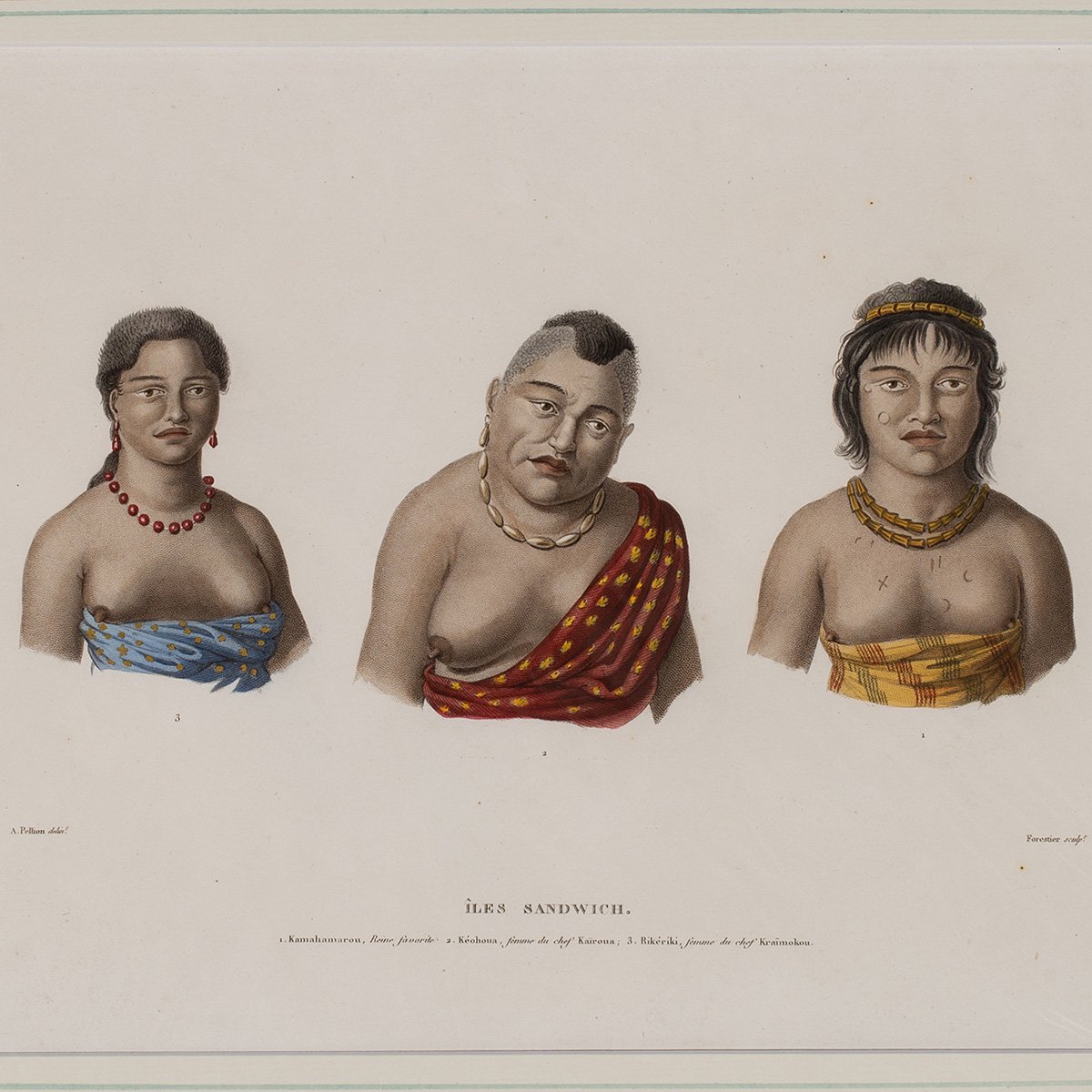 Image 2 of 2
After Alphonse Pellion
Paris
1825
Stipple engraving, printed in color and finished by hand
Image 9 1/2 x 13 inches (24.1 x 33 cm), mat 17 1/2 x 22 inches (44.5 x 55.9 cm)
Provenance: Sydney trade
Three women are shown in bust length across the sheet, each numbered beneath and each set against blank paper. At the left a young woman wears a necklace and pendant earrings of red beads with a blue and yellow patterned kapa drawn across one shoulder, and at the center a heavier woman with the hair shaved at the temples to leave a standing crest wears a white shell necklace and a deep red kapa printed with yellow. At the right a younger woman wears a woven band in her hair, several strands of small yellow beads at the throat, and a yellow and olive kapa, with small tattooed marks visible on the chest and upper arm.
The three are named in the lettering as Kamahamarou, Keohoua, and Rikeriki. The plate was drawn by Alphonse Pellion during the visit of the corvette l'Uranie to the islands in August 1819 and engraved for the atlas to Louis de Freycinet's Voyage autour du monde, Paris, 1825. It is the companion sheet to the plate of male portraits from the same expedition.
Alphonse Pellion was a French naval officer who sailed as a draughtsman on the Freycinet expedition of 1817 to 1820 aboard l'Uranie and la Physicienne. The corvette reached the Hawaiian Islands in August 1819, three months after the death of Kamehameha I, and remained for several weeks while the succession and the overturning of the kapu system were underway. Pellion and Jacques Arago made the drawings during that stay, and the plates engraved from them form the principal French visual record of the islands at that moment. His portrait subjects were drawn from life rather than composed from description.
We ship free anywhere in the world, fully insured, packed by hand.
After Alphonse Pellion
Paris
1825
Stipple engraving, printed in color and finished by hand
Image 9 1/2 x 13 inches (24.1 x 33 cm), mat 17 1/2 x 22 inches (44.5 x 55.9 cm)
Provenance: Sydney trade
Three women are shown in bust length across the sheet, each numbered beneath and each set against blank paper. At the left a young woman wears a necklace and pendant earrings of red beads with a blue and yellow patterned kapa drawn across one shoulder, and at the center a heavier woman with the hair shaved at the temples to leave a standing crest wears a white shell necklace and a deep red kapa printed with yellow. At the right a younger woman wears a woven band in her hair, several strands of small yellow beads at the throat, and a yellow and olive kapa, with small tattooed marks visible on the chest and upper arm.
The three are named in the lettering as Kamahamarou, Keohoua, and Rikeriki. The plate was drawn by Alphonse Pellion during the visit of the corvette l'Uranie to the islands in August 1819 and engraved for the atlas to Louis de Freycinet's Voyage autour du monde, Paris, 1825. It is the companion sheet to the plate of male portraits from the same expedition.
Alphonse Pellion was a French naval officer who sailed as a draughtsman on the Freycinet expedition of 1817 to 1820 aboard l'Uranie and la Physicienne. The corvette reached the Hawaiian Islands in August 1819, three months after the death of Kamehameha I, and remained for several weeks while the succession and the overturning of the kapu system were underway. Pellion and Jacques Arago made the drawings during that stay, and the plates engraved from them form the principal French visual record of the islands at that moment. His portrait subjects were drawn from life rather than composed from description.
We ship free anywhere in the world, fully insured, packed by hand.