

 Image 1 of 3
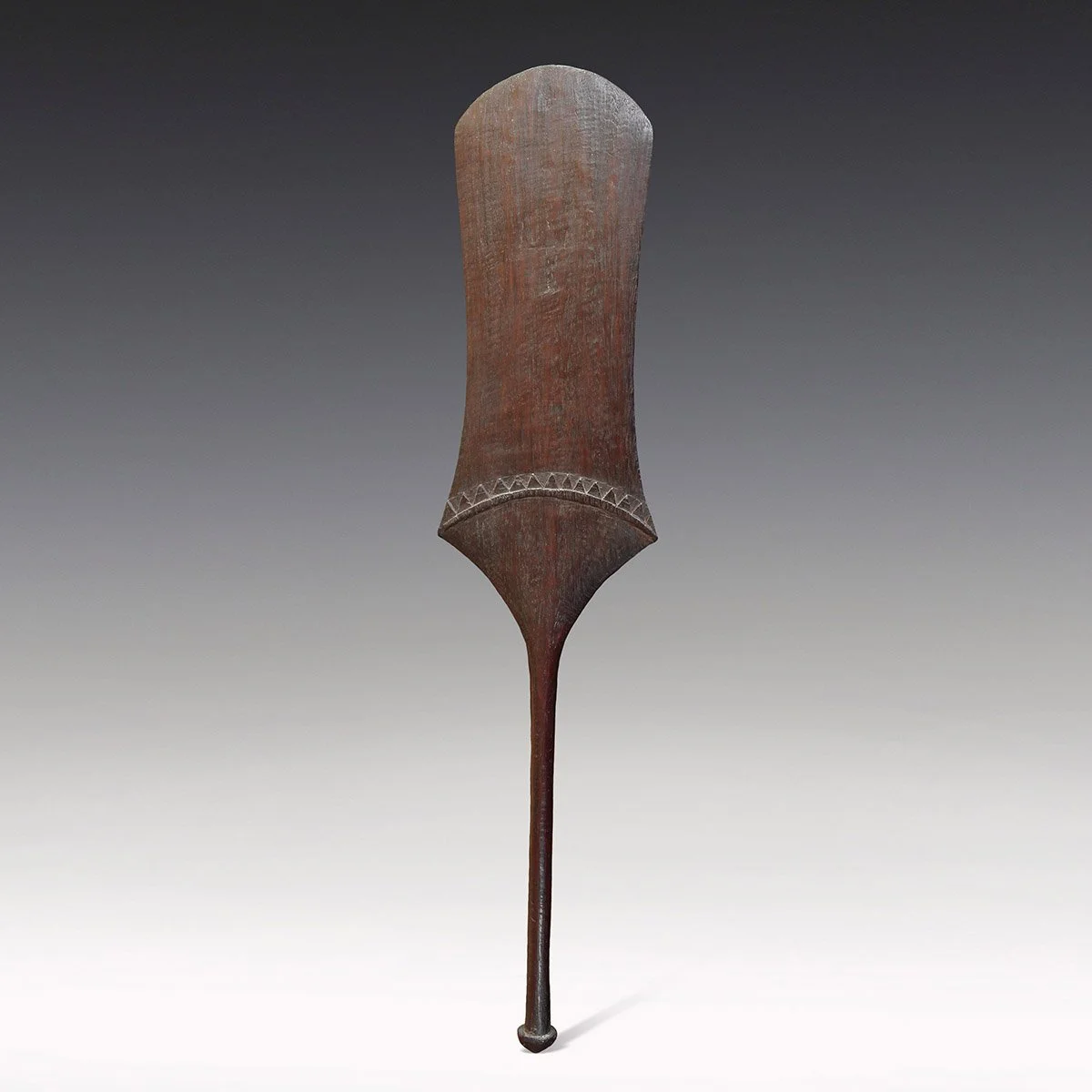 Image 2 of 3
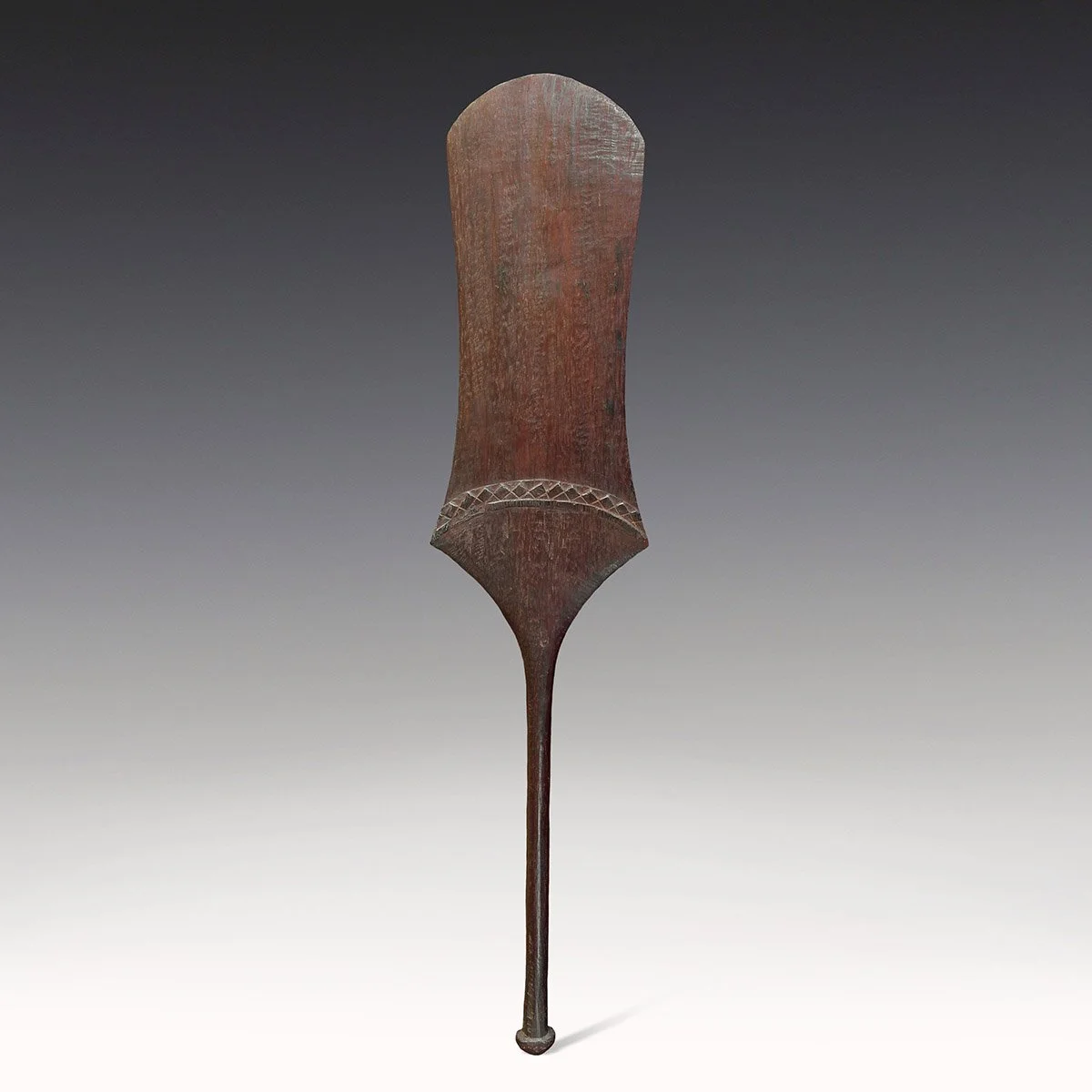 Image 3 of 3
Tongan
18th to early 19th century
Hardwood
Length: 31 1/2 in. (80 cm)
Provenance: Charles Ashby, Staines, England; Curtis Museum, Alton, Hampshire, England; Robert Hales, London
The paki is a wooden dance paddle used in the Meʻetuʻupaki, a formal Tongan group dance in which male performers twirl and slap the paddles in coordinated sequences performed to singing and drumming. Objects produced for this ceremony were carved exclusively with stone and shell tools, placing this example among the earliest documented paki in terms of both date and manufacture. The three-owner provenance, passing from a private English collection through the Curtis Museum in Hampshire and subsequently to specialist dealer Robert Hales in London, establishes a clear and well-documented collecting history.
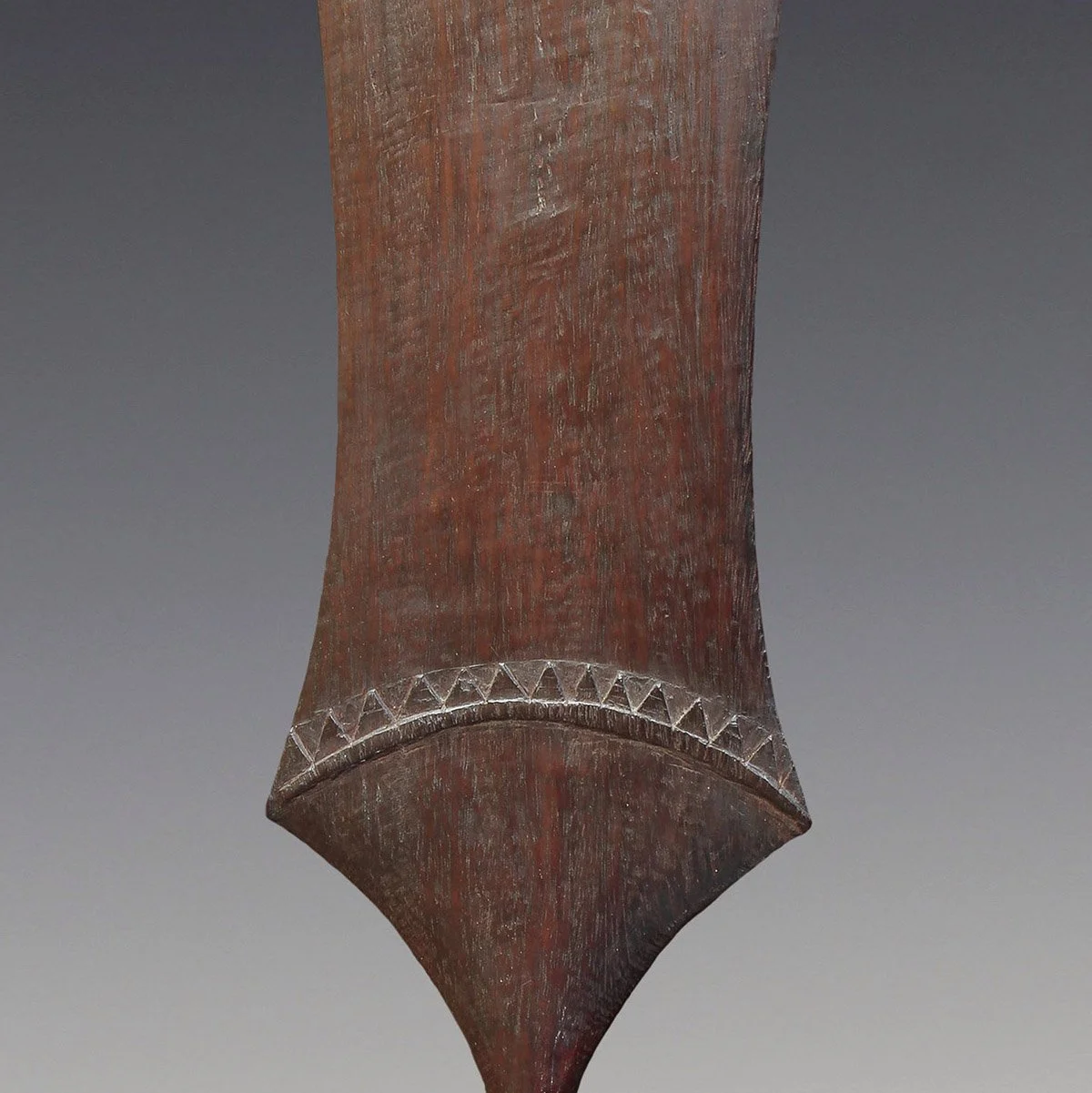
The paddle is shaped from a single piece of hardwood with a broad, rounded blade above a waisted medial section and a slender cylindrical handle terminating in a small knop. A band of incised triangular motifs sits above the arched medial ridge, a decorative element noted as uncommon in paki of this period. The wood has developed a deep, even reddish-brown patina consistent with age and sustained handling.
Collector George Ortiz, one of the foremost figures in twentieth-century Oceanic collecting, regarded Tongan paki as equal in formal quality to the celebrated dance paddles of Easter Island, a comparison that positions objects of this type within the highest tier of Polynesian prestige carving. The combination of early manufacture, stone and shell tool marks, and the triangular register ornament distinguishes this example within the known corpus of Tongan paki. Its institutional and specialist provenance further supports its standing as a significant example of the form.
We ship free anywhere in the world, fully insured, packed by hand.
Tongan
18th to early 19th century
Hardwood
Length: 31 1/2 in. (80 cm)
Provenance: Charles Ashby, Staines, England; Curtis Museum, Alton, Hampshire, England; Robert Hales, London
The paki is a wooden dance paddle used in the Meʻetuʻupaki, a formal Tongan group dance in which male performers twirl and slap the paddles in coordinated sequences performed to singing and drumming. Objects produced for this ceremony were carved exclusively with stone and shell tools, placing this example among the earliest documented paki in terms of both date and manufacture. The three-owner provenance, passing from a private English collection through the Curtis Museum in Hampshire and subsequently to specialist dealer Robert Hales in London, establishes a clear and well-documented collecting history.
The paddle is shaped from a single piece of hardwood with a broad, rounded blade above a waisted medial section and a slender cylindrical handle terminating in a small knop. A band of incised triangular motifs sits above the arched medial ridge, a decorative element noted as uncommon in paki of this period. The wood has developed a deep, even reddish-brown patina consistent with age and sustained handling.
Collector George Ortiz, one of the foremost figures in twentieth-century Oceanic collecting, regarded Tongan paki as equal in formal quality to the celebrated dance paddles of Easter Island, a comparison that positions objects of this type within the highest tier of Polynesian prestige carving. The combination of early manufacture, stone and shell tool marks, and the triangular register ornament distinguishes this example within the known corpus of Tongan paki. Its institutional and specialist provenance further supports its standing as a significant example of the form.
We ship free anywhere in the world, fully insured, packed by hand.