

 Image 1 of 2
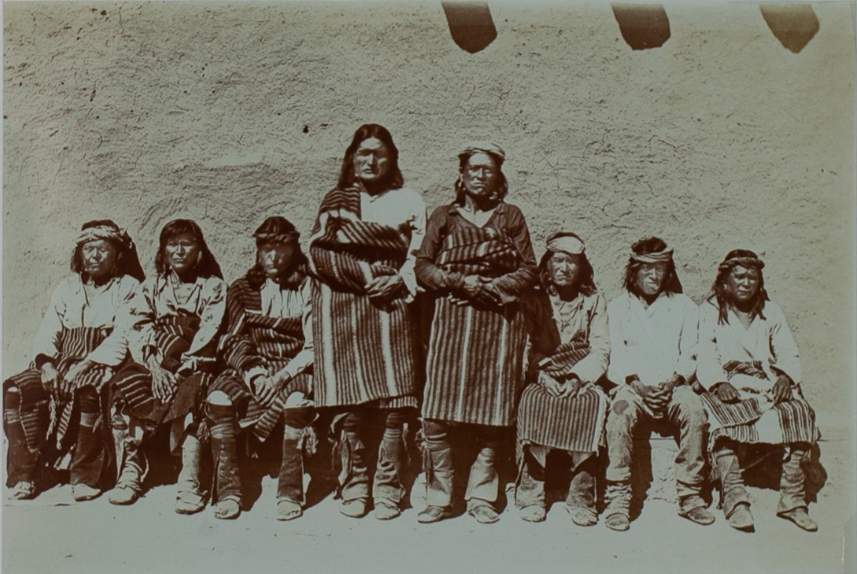 Image 2 of 2
John K Hillers (1843 to 1925)
Zuni Pueblo, New Mexico
Circa 1879
Albumen print
10 3/4 x 12 1/2 inches (27.3 x 31.8 cm), in an archival frame
Provenance: Utah trade
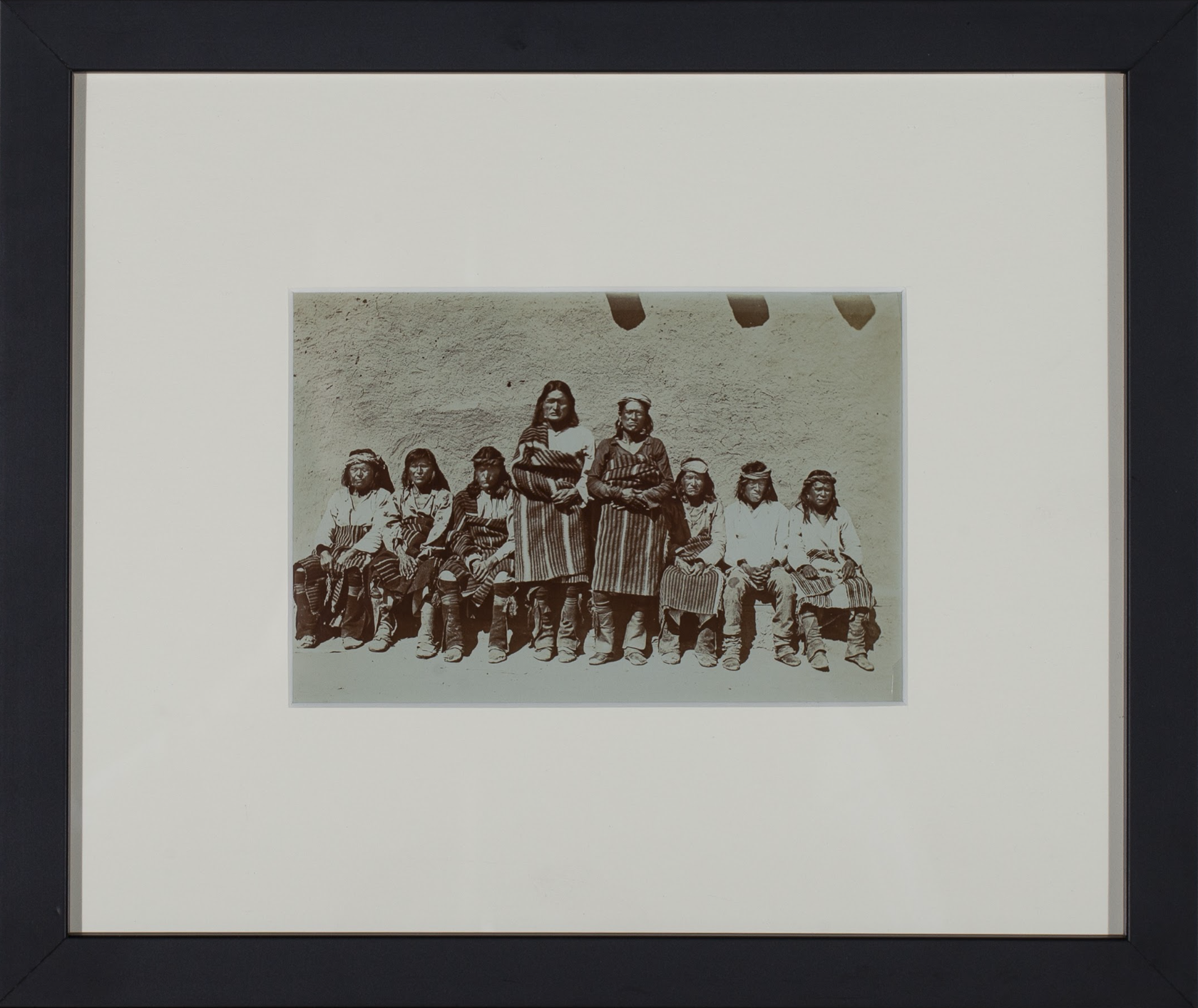
Nine Zuni men and women are photographed against an adobe wall, two standing at the center and seven seated to either side. Most wear striped woven blankets drawn around the shoulders or across the lap, with headbands, white cotton shirts, and leggings above moccasins. The wall behind carries projecting roof beams that throw short shadows across the plaster, placing the exposure near the middle of the day. The print is float mounted within a wide cream mat in a black archival frame, and is sound throughout.
John Karl Hillers (1843 to 1925) was born near Hanover, Germany, and emigrated with his family to the United States in 1852. He served in the Union Army during the Civil War, and in 1871 signed on as a boatman for John Wesley Powell's second expedition down the Colorado River, assisting the expedition photographers before taking over as chief photographer the following year. When the Bureau of Ethnology was established at the Smithsonian in 1879 under Powell's direction, Hillers was appointed its first staff photographer, and from 1881 to 1900 he served as chief photographer of the United States Geological Survey. Beginning in 1879 he travelled through New Mexico and Arizona alongside the collector James Stevenson and the anthropologist Frank Hamilton Cushing, making an extensive record of the pueblos and the people living in them. His Zuni and Hopi photographs are among the earliest sustained visual records of those communities, and are held today by the Smithsonian, the Newberry Library, and the Metropolitan Museum of Art.
We ship free anywhere in the world, fully insured, packed by hand.
John K Hillers (1843 to 1925)
Zuni Pueblo, New Mexico
Circa 1879
Albumen print
10 3/4 x 12 1/2 inches (27.3 x 31.8 cm), in an archival frame
Provenance: Utah trade
Nine Zuni men and women are photographed against an adobe wall, two standing at the center and seven seated to either side. Most wear striped woven blankets drawn around the shoulders or across the lap, with headbands, white cotton shirts, and leggings above moccasins. The wall behind carries projecting roof beams that throw short shadows across the plaster, placing the exposure near the middle of the day. The print is float mounted within a wide cream mat in a black archival frame, and is sound throughout.
John Karl Hillers (1843 to 1925) was born near Hanover, Germany, and emigrated with his family to the United States in 1852. He served in the Union Army during the Civil War, and in 1871 signed on as a boatman for John Wesley Powell's second expedition down the Colorado River, assisting the expedition photographers before taking over as chief photographer the following year. When the Bureau of Ethnology was established at the Smithsonian in 1879 under Powell's direction, Hillers was appointed its first staff photographer, and from 1881 to 1900 he served as chief photographer of the United States Geological Survey. Beginning in 1879 he travelled through New Mexico and Arizona alongside the collector James Stevenson and the anthropologist Frank Hamilton Cushing, making an extensive record of the pueblos and the people living in them. His Zuni and Hopi photographs are among the earliest sustained visual records of those communities, and are held today by the Smithsonian, the Newberry Library, and the Metropolitan Museum of Art.
We ship free anywhere in the world, fully insured, packed by hand.