

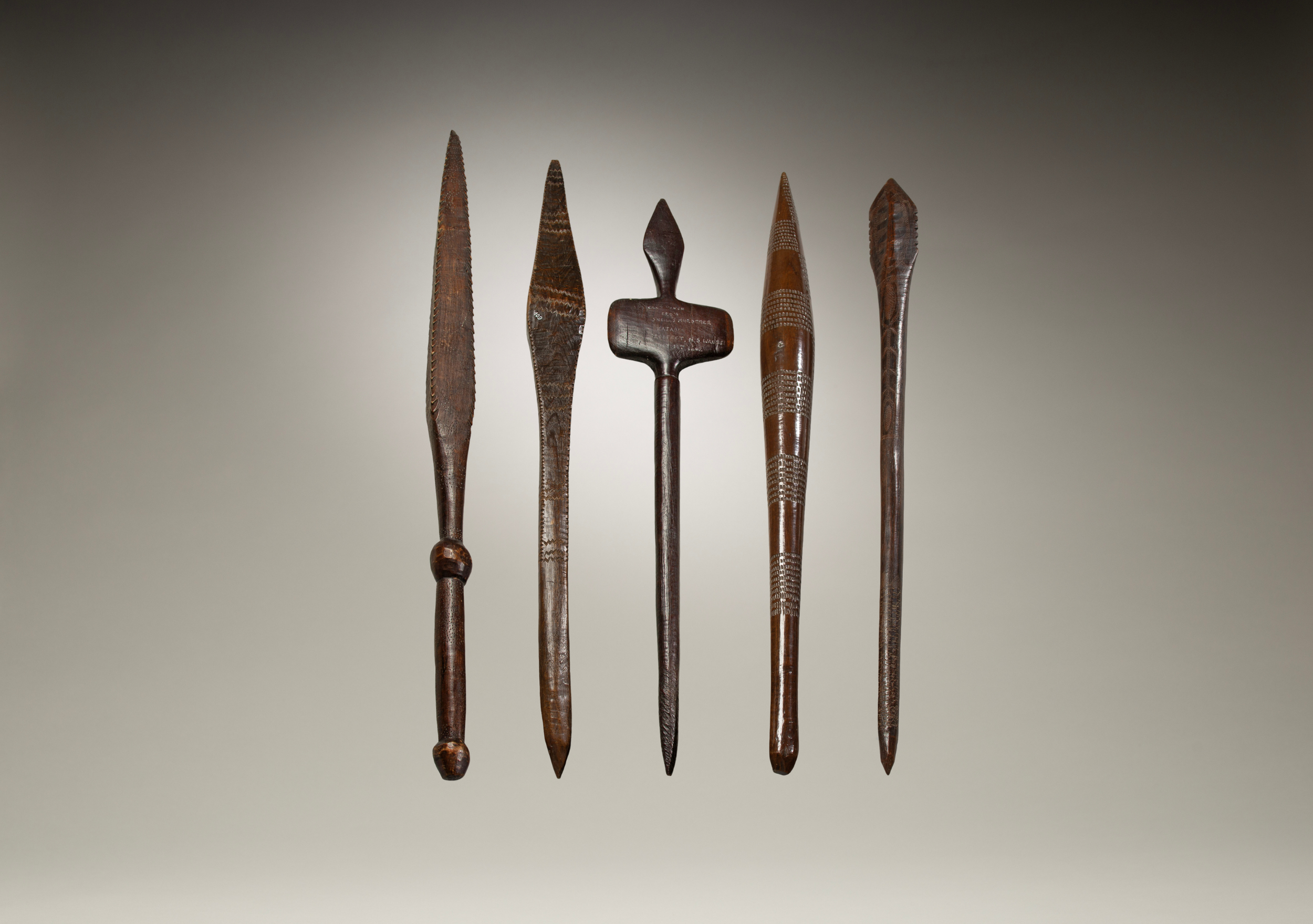
Clubs as pictured from left to right:
A) Used by the aboriginal tribes of the Kulin nation of Victoria, this heavy fighting club was carved with a long tapering point fashioned with distinct serrated edges that frame a serpentine motif rendered by a series of tiny, connected dots. For the aboriginal tribes of Victoria, the snake held deep spiritual significance, embodying the great Rainbow Serpent Mindye, whose primary role was to punish those who disobeyed traditional laws and customs. This supernatural serpent was also credited with shaping the physical world; carving out deep gorges and riverbeds as it slithered across what was once flat land. Mid-19th century. Height 30.25 inches (77 cm)
B) Carved by a member of the Wurundjeru tribe from the Victoria region, this elongated diamond shaped hardwood club was carved and finished with native stone tooling. The edges of the club are lined with a finely serrated “tooth” motif, and a series of three-banded chevron designs adorn the surface of the club. An old collection inventory number 109 is still visible. Early 19th century. Height: 28.75 inches (73 cm)
C) Originating from the Sydney region in New South Wales, this remarkable hardwood fighting club features a broad rectangular body bearing a painted inscription which reads “Club taken from O’Neill’s murderer - Kajabee - Prospect N.S. Wales - July 14th 1862”. This inscription highlights the frequent deadly encounters between white settlers and aboriginal groups during the mid-19th century in the area. The town of Prospect sits today within the borders of the western suburbs of Sydney. Carved and finished with stone tools, the club dates to the early 19th century and features a dark oxidized surface and well-worn patina. Height: 27.5 inches (70 cm)
D) Called a Kud-jer-oong by the natives of the Yarra River region, this variety of hardwood club from East-central Victoria was used primarily in single combat, when both combatants were also provided with a strong and heavy shield. Blows were aimed exclusively at the head with this weapon. One of the finest examples of its type, the surface is decorated with multiple rows of intricately incised rectangular motifs, and the club possesses a beautiful and rich red coloration and glossy patina. Mid-19th century. Height: 29.5 inches (75 cm)
E) Originating from the Hunter Valley region of New South Wales, this remarkable club features a series of finely incised pictographic glyphs. Depicted on the flattened head of the club is a Warabah long-necked turtle, below which are a series of foliate motifs extending down the shaft of the club. For the Gomeroi aboriginal tribes of the Hunter Valley region, the Warabah served as an emblem of the warrior spirit, symbolizing protection and resilience in battle. Early to Mid-19th century. Height: 28.25 inches (72 cm).