

 Image 1 of 4
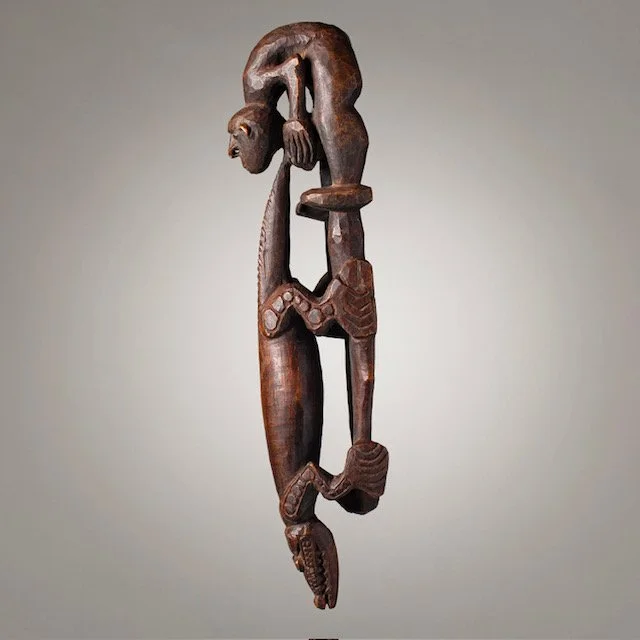 Image 2 of 4
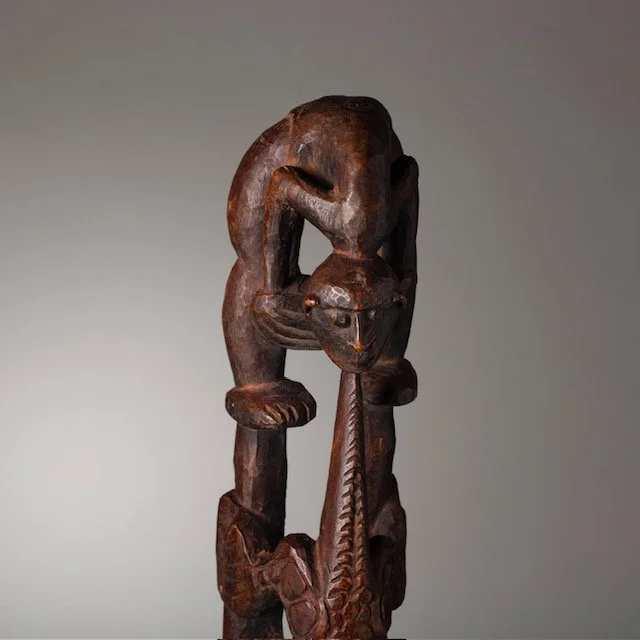 Image 3 of 4
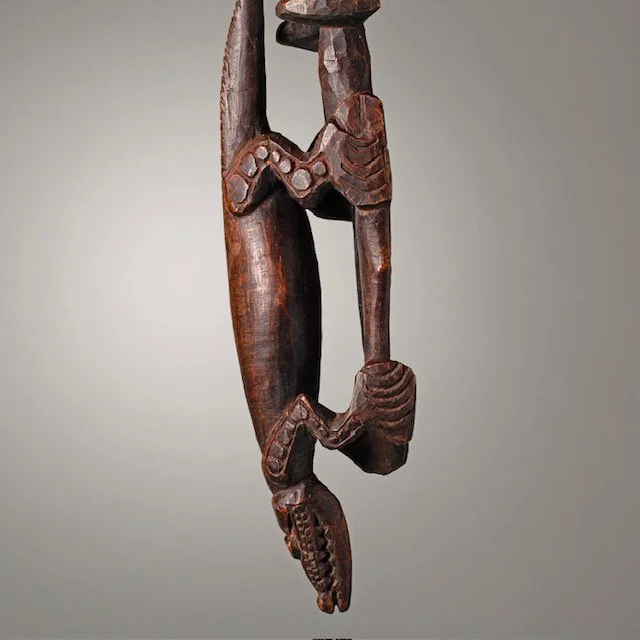 Image 4 of 4
Iatmul People, Middle Sepik Region, Papua New Guinea
Early 20th century
Length: 19.25 inches (49 cm)
Provenance: Field collected in 1930 by a crew member of Burns Philp Steamship Line / Chris and Anna Thorpe personal collection – Sydney, Australia.
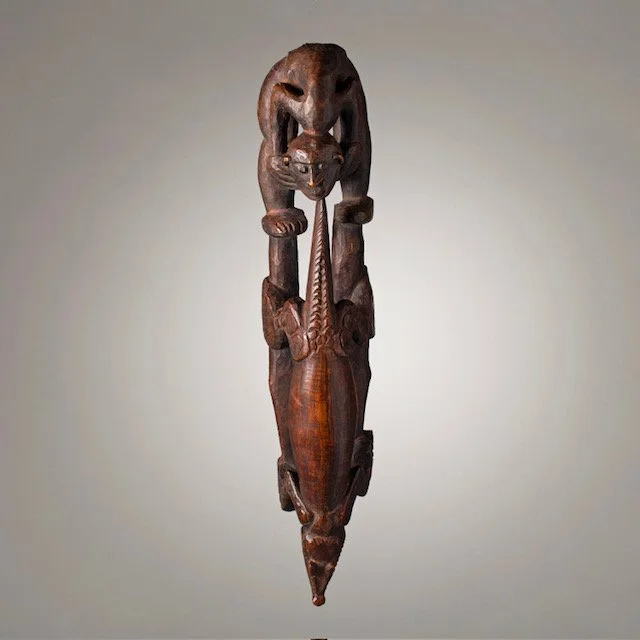
Among the Iatmul people of the middle Sepik River, crocodiles were foundational to cosmology, origin myth, male initiation, and clan identity. In the beginning, according to Iatmul tradition, the earth was submerged beneath a primordial ocean. An ancestral crocodile dove to the bottom and surfaced carrying mud on its back, which became the first island and eventually all dry land that still rests upon the crocodile, whose movements cause earthquakes. A second creation myth centers on the ancestral woman Kwalanambu, who pursued the crocodile and copulated with its tail, giving birth to twin hero sons capable of transforming into a snake and an eel. Kwalanambu is also credited with carving the course of the Sepik River from a vast mythical lake called Mebenbit — likely an ancestral memory of the large saltwater embayment that covered the Sepik Basin several thousand years ago.
Carved over a century ago from dense vitex cofassus wood by a master Iatmul carver, this ritual implement gives powerful form to that mythological world. Its dark, warm, glossy patina was developed through long exposure to the smoke-filled interior of a community men's house and repeated ritual handling. Closely related ceremonial implements from the neighboring Biwat people were reportedly clutched between men's thighs during initiation ceremonies, suggesting a similar function here. Beyond its ritual use, the work stands as a testament to the carver's sculptural genius and its dynamic composition as an intimate glimpse into a primordial artistic and spiritual vision.
Iatmul People, Middle Sepik Region, Papua New Guinea
Early 20th century
Length: 19.25 inches (49 cm)
Provenance: Field collected in 1930 by a crew member of Burns Philp Steamship Line / Chris and Anna Thorpe personal collection – Sydney, Australia.
Among the Iatmul people of the middle Sepik River, crocodiles were foundational to cosmology, origin myth, male initiation, and clan identity. In the beginning, according to Iatmul tradition, the earth was submerged beneath a primordial ocean. An ancestral crocodile dove to the bottom and surfaced carrying mud on its back, which became the first island and eventually all dry land that still rests upon the crocodile, whose movements cause earthquakes. A second creation myth centers on the ancestral woman Kwalanambu, who pursued the crocodile and copulated with its tail, giving birth to twin hero sons capable of transforming into a snake and an eel. Kwalanambu is also credited with carving the course of the Sepik River from a vast mythical lake called Mebenbit — likely an ancestral memory of the large saltwater embayment that covered the Sepik Basin several thousand years ago.
Carved over a century ago from dense vitex cofassus wood by a master Iatmul carver, this ritual implement gives powerful form to that mythological world. Its dark, warm, glossy patina was developed through long exposure to the smoke-filled interior of a community men's house and repeated ritual handling. Closely related ceremonial implements from the neighboring Biwat people were reportedly clutched between men's thighs during initiation ceremonies, suggesting a similar function here. Beyond its ritual use, the work stands as a testament to the carver's sculptural genius and its dynamic composition as an intimate glimpse into a primordial artistic and spiritual vision.